
After Melanoma, Ovarian Cancer: A New Era in PRAME-TCR Immunotherapy

In this article
PRAME-Targeted TCR-T Cell Therapy
Why are PRAME-targeted treatments attracting attention?
PRAME, or PReferentially expressed Antigen in MElanoma, is a cancer-testis antigen with limited expression in normal tissues but high expression in many cancers. PRAME expression may occur in melanoma, synovial sarcoma, ovarian cancer, uterine cancer, and other solid tumors. It is therefore viewed as an immunotherapy platform target that could extend across different solid tumors rather than a single cancer type.
The particularly important feature of PRAME is that it is not a cell-surface protein readily accessible to conventional antibodies. PRAME is produced inside the cell, making it difficult to target with conventional antibody therapies. However, tumor cells can present small peptides derived from PRAME to T cells on HLA molecules. TCR-T cell therapy exploits precisely this: it reprograms a T cell to recognize the PRAME peptide presented on HLA.
CAR-T cells mostly recognize targets on the cell surface and do not require HLA matching. TCR-T cells recognize fragments of intracellular antigens presented on HLA molecules. TCR-T therapies can therefore reach intracellular targets such as PRAME, but generally can be used only in patients with a particular compatible HLA type.
The first signal came in melanoma: IMA203 had demonstrated the PRAME platform
To understand these ovarian cancer data, we should first recall the PRAME-TCR experience in melanoma. IMA203 phase 1b data, presented at ASCO 2025 and previously discussed on our website, had shown that PRAME targeting could produce a strong clinical signal, particularly in melanoma progressing after immunotherapy.
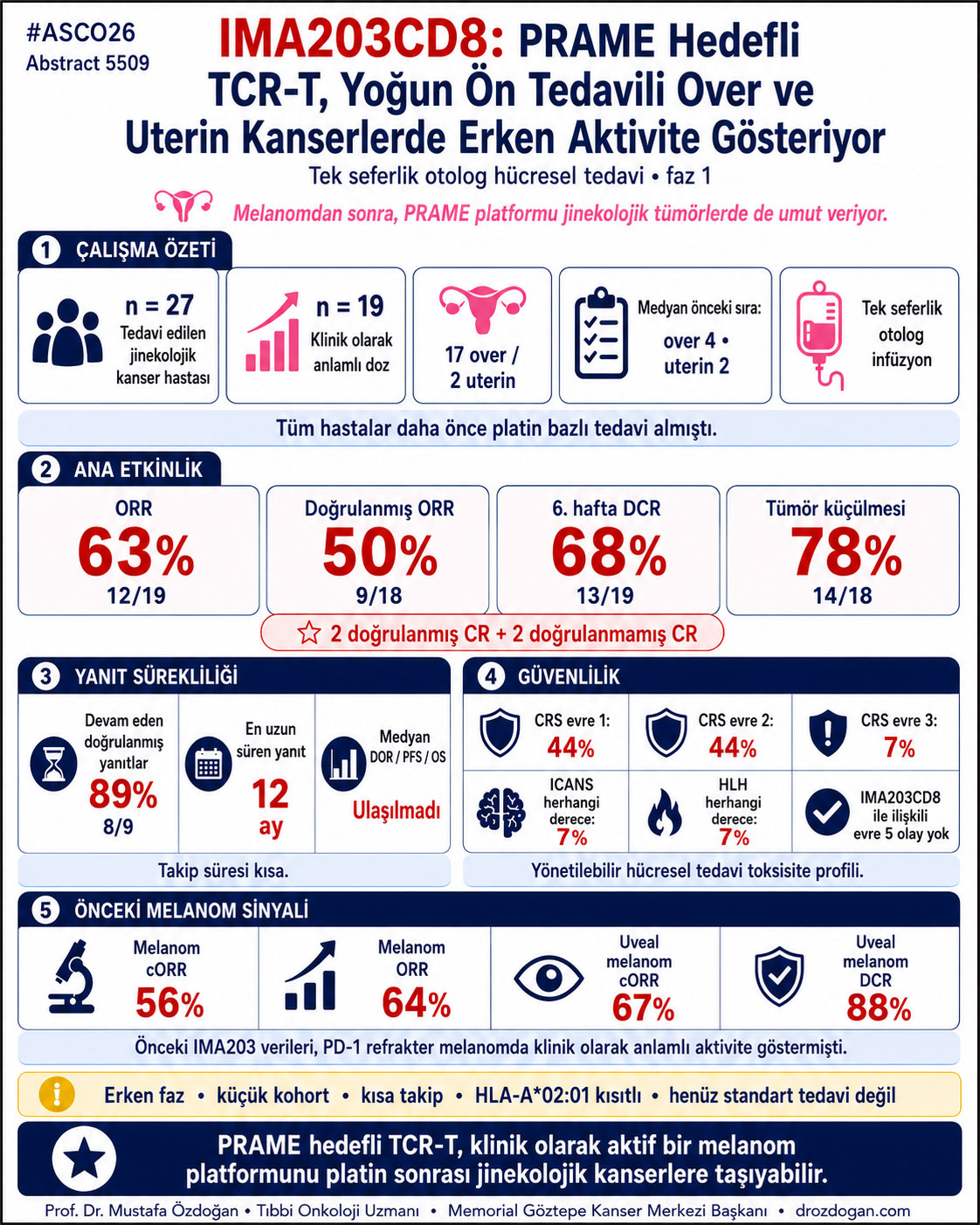
In the melanoma cohort, a total of 33 patients with advanced melanoma received IMA203. All patients had previously received anti-PD-1 therapy. In the overall melanoma group, the confirmed objective response rate was reported as %56, the objective response rate as %64, and the disease control rate as %91 . In a treatment-resistant subgroup such as uveal melanoma, the confirmed response rate was %67, ORR %69, DCR %88, median PFS 8,5 months , and median OS 16,2 months .
| Melanoma subgroup | Confirmed ORR | ORR | DCR | mDOR | mPFS | Clinical interpretation |
|---|---|---|---|---|---|---|
| All melanoma | %56 | %64 | %91 | 12,1 months | 6,1 months | A strong cellular-therapy signal in melanoma progressing after anti-PD-1. |
| Cutaneous melanoma | %50 | %57 | %93 | Not reached | 6,0 months | Striking activity in patients previously treated with checkpoint inhibitors. |
| Uveal melanoma | %67 | %69 | %88 | 11,0 months | 8,5 months | A particularly important signal in treatment-resistant uveal melanoma. |
This melanoma experience makes the ovarian and uterine cancer data from 2026 more meaningful. We are no longer asking only “Can PRAME be targeted?” but moving to a further question: Can the PRAME-TCR platform show clinical activity across different solid tumors? The early responses with IMA203CD8 in gynecological tumors provide a promising answer to this second question.
New data: What did IMA203CD8 show in ovarian and uterine cancers?
The data presented at ASCO 2026 come from the gynecological cancer cohort of an ongoing phase 1 dose-escalation and dose-expansion study evaluating IMA203 / IMA203CD8 in PRAME-expressing solid tumors. In the current analysis, 27 heavily pretreated patients with gynecological cancers received a one-time IMA203CD8 infusion.
All patients had received at least one previous platinum-based treatment. The median number of previous systemic treatment lines in ovarian cancer was 4 lines, compared with a median of 2 lines in uterine cancer. Of the 19 patients evaluated at clinically meaningful dose levels, 17 had ovarian and 2 had uterine cancer.
| Item | Data | Clinical significance |
|---|---|---|
| Study phase | Phase 1 dose escalation / dose expansion | The primary aim is to establish safety, an appropriate dose, and an early efficacy signal. |
| Treatment | A one-time infusion of autologous IMA203CD8 PRAME TCR-T cells | The patient’s own T cells are modified in the laboratory to target PRAME and then returned to the patient. |
| Total patients with gynecological cancer | 27 | An early-phase patient group for safety and dose assessment. |
| Clinically meaningful dose level | 19 patients; 17 ovarian, 2 uterine cancer | Efficacy interpretation focuses particularly on this subgroup. |
| Previous treatment burden | Ovarian cancer, median 4 lines; uterine cancer, median 2 lines | Responses in a heavily pretreated population with dwindling treatment options are important. |
| Next step | Determination of RP2D is awaited | The optimal dose for phase 2 will be selected by balancing efficacy, durability, and tolerability. |
They can be considered related products of the same PRAME-TCR platform; however, IMA203CD8 is a next-generation approach enhanced with a CD8 coreceptor component. The design aims to support the antitumor functions not only of CD8 T cells, but also of CD4 T cells.
Main efficacy results
In the 19 patients treated at clinically meaningful dose levels, the objective response rate was %63 . The confirmed objective response rate was reported as %50 . Responses included two confirmed and two unconfirmed complete responses . The disease control rate at week six was %68 .
Response durability is not yet fully mature because follow-up is still early. However, at the data cutoff, 89% of confirmed responses were ongoing, and the longest ongoing response had reached 12 months. Median duration of response, median PFS, and median OS had not yet been reached.
| Outcome | IMA203CD8 | Clinical interpretation |
|---|---|---|
| ORR | %63; 12/19 | A strong early response signal in heavily pretreated gynecological cancers. |
| Confirmed ORR | %50; 9/18 | A substantial proportion of responses were confirmed during follow-up. |
| Complete responses | 2 confirmed + 2 unconfirmed complete responses | A particularly striking deep-response signal for cellular therapy. |
| Tumor shrinkage | %78; 14/18 | Biological antitumor activity was observed in most patients. |
| DCR, week 6 | %68; 13/19 | Early disease control through response or stable disease. |
| Ongoing response | 89%; 8/9 confirmed responses | Promising for durability, but follow-up is still short. |
What do we see when melanoma and ovarian data are read together?
Melanoma and ovarian cancer are biologically very different tumors. While melanoma is considered more sensitive to conventional immunotherapies, ovarian cancer generally has a tumor microenvironment more resistant to immunotherapy. A clinical activity signal from the PRAME-TCR approach in both settings is therefore important.
The melanoma data had shown that PRAME-targeted TCR-T cell therapy could produce deep and durable responses in solid tumors. The IMA203CD8 data in ovarian and uterine cancers suggest that this platform may not be limited to melanoma. Responses even in gynecological tumors, where PRAME expression may be more variable or lower, are an important signal supporting the biological strength of the target.
| Item | Melanoma IMA203 data | Gynecological cancer IMA203CD8 data | Interpretation |
|---|---|---|---|
| Cancer type | Metastatic melanoma; cutaneous, uveal, mucosal, and unknown primary | Ovarian and uterine cancers | The PRAME-TCR platform is being tested across different solid-tumor biologies. |
| Patient group | Heavily pretreated melanoma progressing after anti-PD-1 | Heavily pretreated gynecological cancers progressing after platinum | Both populations have limited treatment options. |
| ORR / cORR | Overall melanoma ORR 64%, cORR 56%; uveal melanoma cORR 67% | ORR 63%, confirmed ORR 50% | Strong response signals in both settings at the early-phase level. |
| Durability | Overall melanoma mDOR 12,1 months; uveal melanoma mDOR 11 months | 89% of confirmed responses were ongoing at the data cutoff | Follow-up in gynecological cancer is shorter; durability is the key question. |
| Development stage | The phase 3 SUPRAME study in melanoma has been initiated | Determination of RP2D and larger cohorts are awaited | Melanoma is further along in clinical development; ovarian/uterine disease is at the early-signal stage. |
Safety: Expected cellular-therapy toxicities
The tolerability profile of IMA203CD8 was reported as manageable. The most common treatment-emergent adverse effects were expected cytopenias associated with lymphodepletion. Cytokine release syndrome was mostly low grade: grade 1 %44, grade 2 %44, grade 3 %7. ICANS and HLH occurred less frequently; each was reported at an any-grade rate of %7 . No IMA203CD8-related grade 5 event was observed.
CRS is cytokine release syndrome; it may present with fever, low blood pressure, or a need for oxygen. ICANS is immune effector cell-associated neurotoxicity syndrome; it may cause changes in consciousness, speech, or neurological function. HLH is a serious inflammatory condition with excessive immune activation. These toxicities require cellular treatments to be delivered at experienced centers.
Why is this so noteworthy?
Ovarian cancer is often considered resistant to conventional immunotherapy. Response rates generally remain limited when PD-1 / PD-L1 inhibitors are used alone. What makes the IMA203CD8 data interesting is therefore the high response rate in heavily pretreated patients with a cellular-therapy approach that directs the immune system more directly toward the tumor.
Another important point is PRAME’s potential as a platform target. If the clinical signal that began with IMA203 in melanoma continues with IMA203CD8 in ovarian and uterine cancers, this field may extend beyond a single treatment or cancer type. PRAME-targeted cellular treatments could become a new class of immunotherapy spanning different solid tumors in selected patients with compatible HLA and target expression.
Critical reading: How should these data be interpreted in a balanced way?
- Early phase and small patient numbers: Although ORR 63% is very striking, the main efficacy interpretation is based on the clinically meaningful dose group of 19 patients.
- Follow-up is short: Median duration of response, PFS, and OS have not yet been reached; this may be a good sign, but longer follow-up is needed to assess durability.
- HLA-restricted treatment: IMA203CD8 recognizes the PRAME peptide on HLA-A*02:01; therefore, not every patient may be biologically eligible.
- PRAME expression alone may not be enough: Target density, tumor heterogeneity, HLA presentation, and the tumor microenvironment may influence response.
- Cellular-therapy logistics are difficult: It requires autologous cell manufacturing, waiting time, lymphodepletion, hospital infrastructure, and experienced toxicity management.
- There is a risk of CRS / ICANS / HLH: Although toxicity appears manageable, this treatment cannot be delivered like conventional chemotherapy or tablet therapy.
- Melanoma data are strong, but the product and tumor biology differ: IMA203 melanoma data support the PRAME platform; however, the real value of IMA203CD8 in ovarian/uterine cancers must be demonstrated in its own larger studies.
Message for clinical practice
IMA203CD8 is not standard treatment today, but provides a strong early signal that cellular treatments may have a genuine role in advanced ovarian cancer with limited options after platinum. These data suggest that TCR-T cell therapies may become an important future option through clinical research, particularly for PRAME-positive patients with a compatible HLA type.
Earlier IMA203 data in melanoma had shown that PRAME-TCR is not merely a theoretical idea, but can produce tumor shrinkage and durable responses in real patient groups. IMA203CD8 data in ovarian and uterine cancers now bring its potential expansion into more resistant solid tumors into focus.
How should this be explained to the patient?
“This treatment is based on modifying your own immune cells in the laboratory to recognize cancer cells and then returning them to your body. Early studies have shown marked tumor shrinkage in some patients with advanced ovarian cancer. However, this method is still investigational; it is not suitable for everyone, requires a particular HLA type and the PRAME target, takes time to manufacture, and requires close monitoring at experienced centers.”
Drozdogan Academic Commentary
The IMA203CD8 data are a very striking early-phase result suggesting that cellular treatments may open a new immune pathway in ovarian cancer after the failures of conventional immunotherapy.
What makes these data special is that the PRAME-targeted TCR-T platform has already shown strong response signals in melanoma. A confirmed response rate of 67% in a treatment-resistant setting such as uveal melanoma had shown that PRAME targeting might have genuine biological relevance in solid tumors. Now, ORR 63% and confirmed ORR 50% in ovarian and uterine cancers suggest that the platform may not be limited to a single tumor type.
Nevertheless, these data still come from a small, early-phase study with short follow-up. The true clinical value will become clearer with determination of RP2D, larger phase 2/3 cohorts, response duration, manufacturing logistics, toxicity management, HLA eligibility, and appropriate patient selection.
Future questions
The future of PRAME-targeted TCR-T cell therapies will depend on several critical questions. The first is how durable the responses are. In early data, most confirmed responses remain ongoing, but median duration of response and PFS are not yet mature. The second is which patients respond best. PRAME expression level, HLA presentation, tumor burden, intensity of lymphodepletion, and the tumor microenvironment may be decisive for response.
The third question is logistics. Autologous cellular treatments are complex in terms of manufacturing time, center experience, toxicity management, and cost. The true clinical value of the PRAME-TCR platform should therefore be evaluated not only through ORR, but also manufacturability, accessibility, safety, and long-term quality of life.
Conclusion
IMA203CD8 phase 1 data presented at ASCO 2026 showed that PRAME-targeted TCR-T cell therapy could provide striking antitumor activity in heavily pretreated advanced ovarian and uterine cancers. At clinically meaningful dose levels, ORR was reported as 63%, confirmed ORR as 50%, disease control rate at week 6 as 68%, and tumor shrinkage as 78%.
These results become even more meaningful alongside the PRAME-TCR signal previously observed in melanoma. With IMA203, confirmed responses in 56% of the overall melanoma group and 67% of uveal melanoma patients had suggested that PRAME could be a strong platform for solid-tumor cellular therapies. The early activity of IMA203CD8 in ovarian and uterine cancers is an important first step suggesting that this platform could extend to gynecological tumors.
However, this approach is not standard treatment today. HLA restriction, manufacturing, toxicity management, long-term response durability, and the need for validation in larger patient groups remain relevant. The most appropriate interpretation is that PRAME-targeted TCR-T cell therapies are opening a strong but still early-stage new pathway in solid-tumor immunotherapy.
- ASCO Daily News. Novel PRAME-Targeting T-Cell Receptor Therapy Demonstrates Durable Activity in Advanced Ovarian Cancer. 31 May 2026.
- Immatics. IMA203CD8 PRAME Cell Therapy in Hard-to-Treat Gynecologic Cancers at ASCO 2026. 30 May 2026.
- ClinicalTrials.gov. ACTengine IMA203 / IMA203CD8 in PRAME-positive solid tumors. NCT03686124.
- drozdogan.com. The Highest Response Rate Reported in Uveal Melanoma With PRAME-Targeted T-Cell Therapy: 67%. 1 June 2025.
- Immatics. IMA203 PRAME Cell Therapy Data Presented at 2025 ASCO Annual Meeting in Metastatic Melanoma. 31 May 2025.
- Wermke M et al. Phase 1 clinical update of IMA203, an autologous TCR-T targeting PRAME in patients with PD-1 refractory metastatic melanoma. J Clin Oncol. 2025;43(16_suppl):2508.
- ClinicalTrials.gov. SUPRAME: IMA203 versus investigator’s choice in previously treated unresectable or metastatic cutaneous melanoma. NCT06743126.
Was this article helpful?
Your feedback helps us improve our content.


Reader comments
Share your comment
Your name and comment are published only after administrator approval. Your email address is never shown to visitors.
Be the first to comment.