
Breakthroughs and Milestones in the Treatment of Muscle-Invasive Bladder Cancer

In this article
🚀 Advances in the Treatment of Muscle-Invasive Bladder Cancer
Muscle-invasive bladder cancer (MIBC) is a complex disease with an aggressive course. It is usually diagnosed around age 72 and occurs approximately 3 times more often in men than in women:contentReference[oaicite:1]{index=1}. Until now, standard treatments have been radical cystectomy or chemoradiotherapy . However, on August 5, 2025, the Journal of Clinical Oncologypublished an article by Galsky and colleagues revealing “landmark” developments in this field. Immunotherapies, targeted agents and biomarkers such as ctDNA are now opening the door to more personalized and effective treatment options.
🔎 What Is Muscle-Invasive Bladder Cancer?
-
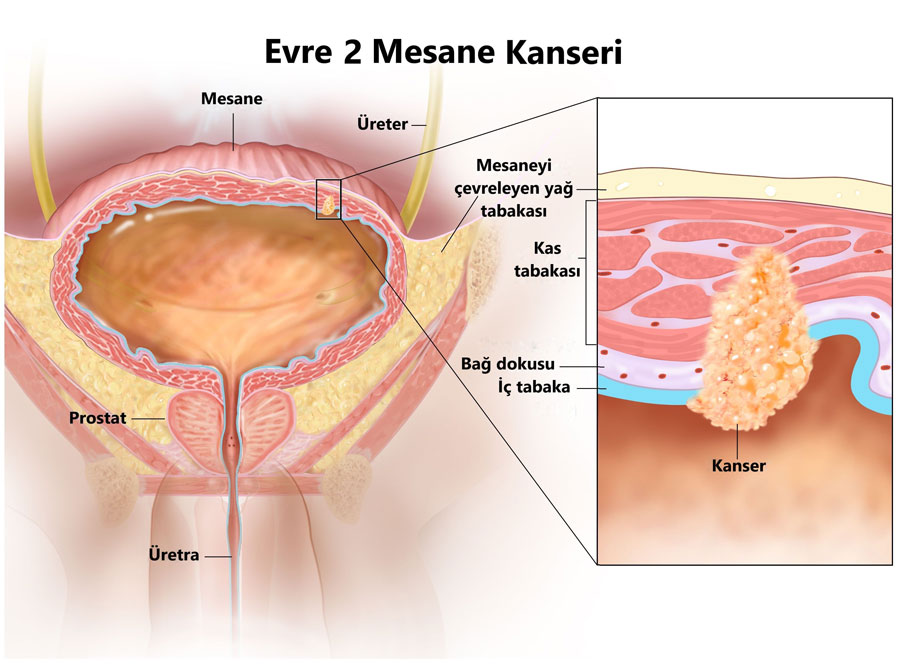
Muscle-invasive bladder cancer (MIBC)refers to bladder cancer that is at least Stage II .
-
At this stage, the tumor has extended beyond the superficial layers into the bladder’s muscle layer (muscularis propria) .
-
Stage T2 falls within this definition:
- T2a: Invasion of the superficial muscle layer
- T2b: Invasion of the deep muscle layer -
At more advanced stages (T3–T4), the tumor may extend beyond the muscle layer into surrounding tissues or adjacent organs.
In brief, “muscle-invasive” means that bladder cancer is no longer superficial and has reached a more advanced and aggressive stage. Treatment therefore differs greatly from that for superficial bladder cancer.
🔬 Diagnosis and Molecular Subtypes
The most common first sign of MIBC is hematuria (blood in the urine) , which starts the diagnostic process in most patients. For diagnosis, transurethral resection (TURBT)is critical for both histological confirmation and staging of the tumor. In particular, specimens must contain the muscularis propria layer; otherwise, staging will be incomplete and a second TURBT will be required.
Advances in molecular biology have allowed us to classify bladder cancer at the genetic as well as the microscopic level. The international consensus classification published in 2020 identified 6 different molecular subtypes :
- Luminal papillary (24%)
- Luminal nonspecified (8%)
- Luminal unstable (15%)
- Stroma-rich (15%)
- Basal/Squamous (35%)
- Neuroendocrine-like (3%)
Like breast cancer subtypes, these subtypes have different biological features and treatment responses. Basal/Squamous types are generally more aggressive but may be more sensitive to chemotherapy. Patients with an FGFR3 mutation (15%) may benefit from FGFR inhibitors such as erdafitinib. Luminal types have been associated with a better prognosis but may differ in their response to immunotherapy.
🧬 Genetic and Mutational Landscape
MIBC is a highly mutated tumor. A substantial proportion of mutations result from APOBEC-mediated mutagenesis . Among the most common gene alterations are losses of TP53 and RB1 . Significant alterations are also found in genes such as ERCC2, FGFR3, PIK3CA, ERBB3, ARID1A, KDM6A, EP300 .
In particular, HER2 expression may be seen in approximately 80% of MIBC patients. Although not yet in standard clinical use, antibody–drug conjugates such as trastuzumab deruxtecan have received FDA approval in metastatic cases, opening up a new therapeutic target.
🧪 Genetic Mutations and ctDNA
MIBC is a cancer with a high mutational burden. Most mutations are associated with APOBEC-mediated mutagenesis . The most common gene alterations are losses of TP53 and RB1 . However, many genes, including FGFR3, ERBB3, PIK3CA, ERCC2, ARID1A, KDM6A, EP300 , also play a role in tumor biology.
- ERCC2 (8%): Increases sensitivity to cisplatin-based chemotherapy.
- FGFR3 (15%): Confers sensitivity to FGFR inhibitors such as Erdafitinib.
- HER2 (~80% expression): Not yet standard in routine clinical practice, but for metastatic cases, trastuzumab deruxtecan has received FDA approval and represents a promising target for the future.
Circulating Tumor DNA (ctDNA): In the IMvigor010 trial, among patients with ctDNA positivity after cystectomy, the risk of recurrence was 6.3 times higher, and the risk of death was 8.0 times higher . This finding suggests that ctDNA is not only a prognostic marker, but also a tool for guiding treatment decisions.
Current trials (IMvigor011, TOMBOLA, MODERN/A032103) are testing adjuvant immunotherapy in ctDNA-positive patients and avoidance of treatment in negative patients. By avoiding unnecessary treatments, this approach has the potential to make treatment more personalized .
💉 Breakthrough Immunotherapy Data
| Trial | Drug | Disease-Free Survival | Risk Reduction / HR |
|---|---|---|---|
| CheckMate-274 | Nivolumab | 10.9 → 22.0 months | 29% ↓ (HR 0.71) |
| AMBASSADOR | Pembrolizumab | 14.2 → 29.6 months | 27% ↓ (HR 0.73) |
| NIAGARA | Durvalumab | 32% improvement | OS HR 0.75 |
🏥 Bladder-Preserving Approaches
For muscle-invasive bladder cancer, trimodality therapy (TMT), meaning maximal TURBT followed by chemoradiotherapy, is considered an alternative to radical cystectomy. Comparisons have reported 5-year metastasis-free survival rates of 74% (cystectomy) and 75% (TMT) , with no statistically significant difference. In addition, after TMT, the salvage cystectomy rate is around 13% .
🔹 RTOG analyses: After TMT, 5-year overall survival was 57% and 10-year survival was 36%. 🔹 BC2001 trial: Adding chemotherapy to radiotherapy significantly improved local control (HR 0.61) and reduced the need for salvage cystectomy to 14%. These results show that TMT is a strong bladder-preserving option in selected patient groups.
🌟 A Vision for the Future
Future treatment strategies are expected to be more risk-adapted and biomarker-based . In the HCRN GU16-257 trial, among patients who achieved a clinical complete response, 43% chose bladder preservation, and this response was shown to predict metastasis-free survival with 97% accuracy at 2 years.
🔬 RETAIN trial: Patients with ATM, FANCC and RB1 mutations had a higher pathological complete response rate. In this group, approximately 48% of patients avoided cystectomy and remained free of metastases long term.
🔬 RETAIN2: Adding nivolumab to this strategy further increased response rates and successful bladder preservation.
🔬 ctDNA-based approaches: Current trials (e.g., MODERN/A032103) are testing treatment guided by ctDNA status. This may allow treatment to become personalized while avoiding unnecessary intensity.
Over the next 10 years, powerful systemic therapies, precise biomarkers and organ-preserving strategies will come together to usher in a new era in bladder cancer treatment. The goal will be not only to extend life, but also to preserve bladder function and quality of life .
Sources
DOI:10.1200/JCO-25-00718
Was this article helpful?
Your feedback helps us improve our content.




Reader comments
Share your comment
Your name and comment are published only after administrator approval. Your email address is never shown to visitors.
Be the first to comment.