
Historic Success in ALK-Positive Lung Cancer: 7-Year CROWN Data With Lorlatinib

In this article
More Than Half of Patients Remain Progression-Free With Lorlatinib
Study design: What did CROWN compare?
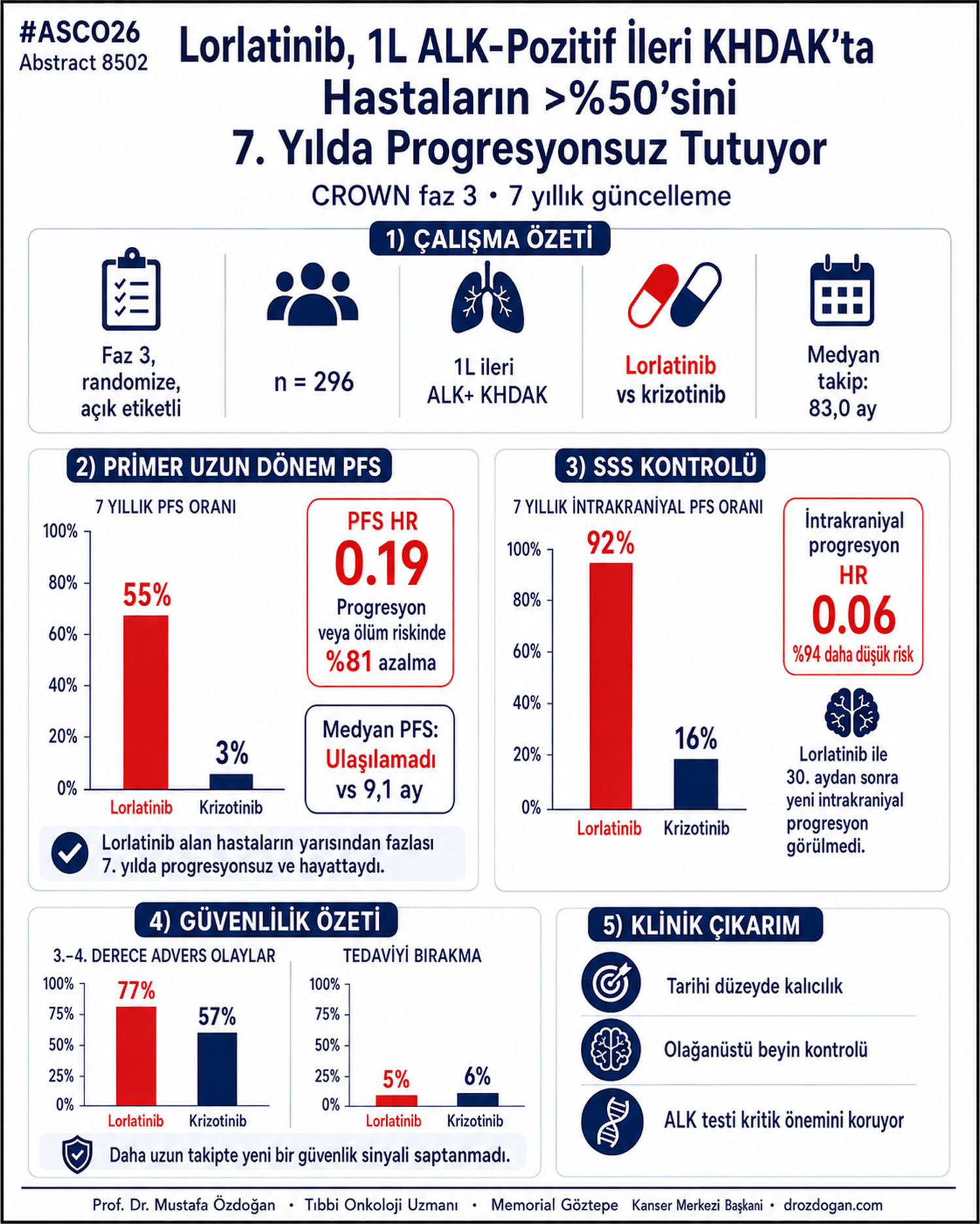
CROWN is a global, randomized, open-label study involving 296 patients with advanced ALK-positive non-small cell lung cancer who had not previously received systemic treatment for advanced disease. It was a phase 3 study, with patients randomized 1:1 to lorlatinib or crizotinib.
| Item | Lorlatinib arm | Crizotinib arm | Clinical significance |
|---|---|---|---|
| Number of patients | 149 patients | 147 patients | Comparison of first-line treatment in advanced ALK+ NSCLC. |
| Treatment | Lorlatinib 100 mg, 1 time daily | Crizotinib 250 mg, 2 times daily | A third-generation ALK inhibitor with strong brain penetration was compared with a first-generation ALK inhibitor. |
| Patient profile | ALK-positive NSCLC without previous systemic treatment for advanced disease | The patient group establishing a first-line treatment standard. | |
| Brain metastases | Patients with asymptomatic, stable brain metastases could be included | Brain control is central to treatment selection in ALK+ disease. | |
| Primary endpoint | Progression-free survival by independent central review | Time during which disease remained controlled without progression or death was assessed. | |
| Important secondary endpoints | Intracranial response, time to intracranial progression, objective response, and safety | Intracranial control was lorlatinib’s most important differentiating feature. | |
ALK fusion is a targetable genetic alteration that continuously signals tumor-cell growth in lung cancer. ALK inhibitors are targeted drugs that suppress this growth signal. Lorlatinib is a third-generation ALK inhibitor with strong brain penetration.
Efficacy: The PFS difference persists at 7 years
At the 7-year update, median PFS in the lorlatinib arm had still not been reached. Median PFS in the crizotinib arm was 9,1 months . The 7-year PFS rate was reported as %55with lorlatinib, versus only %3 with crizotinib. HR for PFS was 0,19 ; this represents an approximately 81% relative reduction in the risk of progression or death.
Intracranial control: CROWN’s most striking message
Brain metastases are common in ALK-positive lung cancer and can seriously affect quality of life. In CROWN’s 7-year update, the risk of intracranial progression in the lorlatinib arm fell by 94%. The 7-year intracranial PFS rate was %92with lorlatinib, versus %16 with crizotinib.
It is the time without disease progression in the brain or death. When selecting treatment in ALK-positive disease, brain control is as important as systemic PFS.
Detailed results table
| Outcome | Lorlatinib | Crizotinib | Clinical interpretation |
|---|---|---|---|
| Median PFS | Not reached | 9,1 months | Even after 7 years of follow-up, median PFS could not be calculated in the lorlatinib arm. |
| 7-year PFS | %55 | %3 | Long-term control very rarely seen in advanced lung cancer. |
| PFS HR | 0,19 | 81% relative reduction in the risk of progression or death. | |
| Intracranial progression risk | HR 0,06 | Median time 16,4 months | 94% reduction in intracranial progression risk. |
| 7-year intracranial PFS | %92 | %16 | Lorlatinib’s brain-protective effect persists over the long term. |
Safety: Very strong efficacy, but monitoring needs care
No new safety signal was reported in the 7-year analysis. The adverse effects most closely monitored with lorlatinib are hypercholesterolemia, hypertriglyceridemia, weight gain, edema, peripheral neuropathy, cognitive effects, and mood effects.
Points to consider
CROWN’s comparator was crizotinib; today, many countries use stronger ALK inhibitors such as alectinib, brigatinib, or lorlatinib in the first line. Lorlatinib’s current clinical role should therefore be evaluated not only through CROWN, but together with efficacy, brain protection, metabolic and neurocognitive adverse effects, patient preference, and real-world tolerability.
Drozdogan Academic Commentary
CROWN’s 7-year data are a historic result showing how profoundly targeted therapy can alter the natural course of advanced ALK-positive lung cancer.
Median PFS still not being reached at 7 years, with 7-year PFS maintained at 55%, represents a level of long-term disease control very rarely seen in advanced solid tumors.
These data position lorlatinib not merely as a potent first-line ALK inhibitor, but as one of the most ambitious options for long-term control, particularly in ALK-positive disease with a high risk of brain metastases.
Conclusion
CROWN’s 7-year update shows that first-line lorlatinib can provide exceptionally long disease control in advanced ALK-positive NSCLC. With 55% still progression-free and alive at 7 years, median PFS not reached, and a 94% reduction in intracranial progression risk, this is one of ASCO 2026’s strongest long-term targeted-therapy datasets.
- ASCO 2026 Abstract 8502. Lorlatinib vs crizotinib as first-line treatment for advanced ALK+ NSCLC: 7-year update from CROWN.
- Mok TS et al. Lorlatinib versus crizotinib as first-line treatment for advanced ALK-positive NSCLC: 7-year update from CROWN. Annals of Oncology. 2026.
- Pfizer. Seven-Year Analysis from LORBRENA CROWN Trial Shows Longest Progression-Free Survival Reported to Date in Advanced NSCLC. 2026.
- OncLive. Seven Years Strong: Updated CROWN Data Showcase Lorlatinib’s Durability in ALK+ NSCLC at ASCO 2026.
- Shaw AT et al. First-Line Lorlatinib or Crizotinib in Advanced ALK-Positive Lung Cancer. New England Journal of Medicine. 2020.
- Solomon BJ et al. Lorlatinib versus crizotinib in advanced ALK-positive NSCLC: 5-year outcomes from CROWN. Journal of Clinical Oncology. 2024.
- drozdogan.com. Lorlatinib in ALK-Positive Lung Cancer Made Its Mark at ASCO 2024.
Was this article helpful?
Your feedback helps us improve our content.


Reader comments
Share your comment
Your name and comment are published only after administrator approval. Your email address is never shown to visitors.
Be the first to comment.