
The Life-Saving Role of PSMA PET/CT After Biochemical Recurrence of Prostate Cancer

In this article
🎯 The Right Treatment for the Right Prostate Cancer Patient
Prostate cancer is among the most common cancers in men, and high rates of postoperative biochemical recurrence (a renewed rise in PSA) pose a major clinical management challenge. PSA rises again in approximately 30–40% of patients who undergo radical prostatectomy, providing an early sign of microscopic cancer recurrence.
At this stage, the most effective treatment option is salvage radiotherapy (salvage RT, sRT). However, a crucial question remains: How can we predict which patients will actually benefit? If microscopic disease has spread beyond the prostate bed, radiotherapy often causes unnecessary side effects without providing benefit.
Conventional imaging methods (CT, MRI and bone scintigraphy) struggle to detect the site of recurrence at low PSA levels . Many patients therefore start sRT without imaging, exposing some to ineffective treatment and unnecessary toxicity.
Graphical Summary
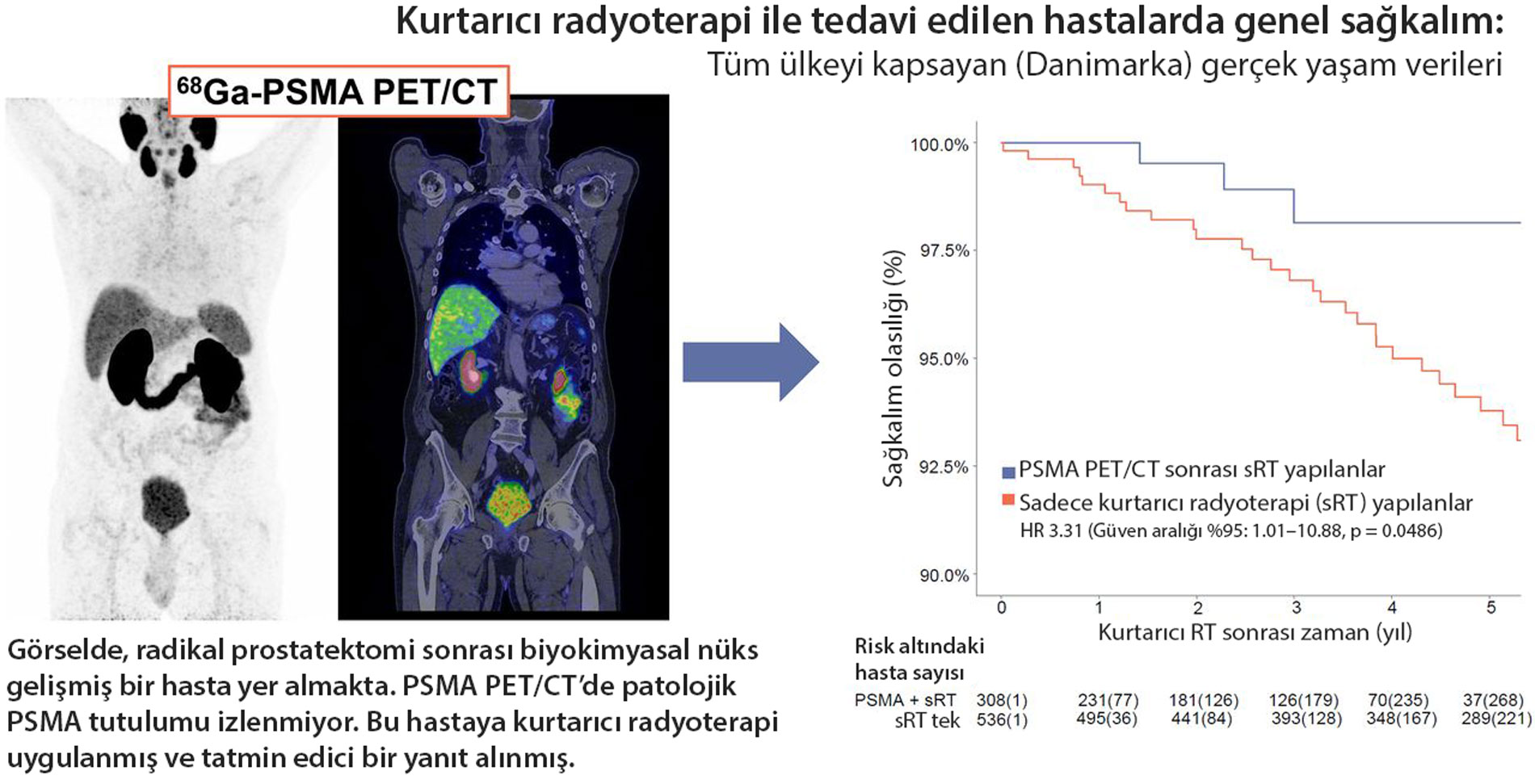
In patients with biochemical recurrence after radical prostatectomy, assessment using ⁶⁸Ga-PSMA PET/CT improves the effectiveness of salvage radiotherapy. Patients whose treatment is guided by PSMA PET/CT have significantly higher 5-year overall survival than those receiving radiotherapy alone (HR: 3.31, p=0.0486). These findings identify PSMA PET/CT as a critical planning tool that improves survival.
🔬 The Solution: PSMA PET/CT
One of the most important recent advances, PSMA PET/CT, can reveal recurrence with high sensitivity even at very low PSA levels. It helps physicians make more informed, personalized treatment plans.
A new Danish study, published in August 2025 in the Journal of Nuclear Medicine, demonstrated not only the diagnostic value of PSMA PET/CT but also its ability to make a difference in patients' life expectancy .
✅ This Imaging Helps:
- Select the right patients,
- Avoid unnecessary radiotherapy,
- Make treatment more personalized,
- And, most importantly: Patients live longer.
💡 These findings strongly suggest that PSMA PET/CT has become more than a diagnostic tool: it is also a game-changing guide to treatment planning.
📊 How Was the Study Conducted?
Design and Period: From 2015–2023, a nationwide study was conducted: based on real-world data, this retrospective cohort used Denmark's national health records.
👥 Who Was Included?
- Men with a history of radical prostatectomy ,
- Biochemical recurrence (BCR): Confirmed by at least two measurements showing PSA ≥0.2 ng/mL,
- Threshold for inclusion in the analysis: PSA before sRT: 0.2–1.0 ng/mL,
- Patients receiving radiotherapy for oligometastatic disease were excluded.
🔎 Comparison Groups
- Patients undergoing sRT with prior PSMA PET/CT,
- and patients undergoing sRT without prior PSMA PET/CT imaging.
Note: PSMA PET/CT had to be performed within 6 months of the diagnosis of biochemical recurrence and no later than 6 months before the start of sRT.
PSMA Tracers Used: ⁶⁸Ga-PSMA-11 (since 2015) and ¹⁸F-PSMA-1007 (at some centers since 2020).
Treatment Standard: All patients received salvage radiotherapy (sRT) (approximately 30–40 fractions). Under the 2015 guideline update, all patients also received 2 years of ADT (androgen deprivation therapy).
💡 Clinical Significance: Systemic treatment use was similar between groups; the main difference was more accurate patient and treatment-field selection with PSMA .
📌 Sample Size
- Total: 844 patients
- PSMA PET/CT performed: 36.5% (n=308)
- No PSMA PET/CT: 63.5% (n=536)
Baseline Characteristics: The groups were similar in age, comorbidities and preoperative parameters. However:
- The PSMA group had a slightly higher LN(+) rate (12.3% vs 9.9%),
- But a lower positive surgical margin rate (50.7% vs 57.5%).
💡 Clinical Significance: Despite more adverse prognostic factors in the PSMA group, outcomes were better → the difference came from accurate selection with PSMA.
📈 Follow-Up and Outcomes
- Primary Outcome: Overall survival (OS) — follow-up began 30 days after completion of sRT.
- Secondary Outcome: Biochemical recurrence-free survival (BRFS) — PSA ≥0.2 ng/mL after sRT.
- Follow-Up Duration: Median 30 months in the PSMA group versus 68.4 months without PSMA, because PSMA was introduced more recently.
💡 Clinical Significance: Despite shorter follow-up in the PSMA group, the survival advantage persisted. This supports the reliability of the findings.
📈 Main Findings
✅ Overall Survival (OS)
- Year 1: 100% (PSMA) vs 99% (non-PSMA)
- Year 2: 99.5% vs 97.8%
- Year 5: 98.1% vs 93.8% → Absolute difference: +4.3 points (favoring PSMA)
Crude hazard ratio (crude HR): 3.31; p=0.0486
👉 The risk of death was approximately 3.3 times higher without PSMA.
Clinical Interpretation:
• The 4.3% absolute increase in OS at year 5 is significant and clinically valuable.
• Approximately 1 additional life may be gained per 23 patients (a rough, hypothesis-generating estimate).
✅ Biochemical Recurrence-Free Survival (BRFS)
- Year 3 BRFS: 74.9% (PSMA) vs 69.4% (non-PSMA) → Absolute difference: +5.5 points
HR (for recurrence risk): 1.53; p=0.0187
👉 The risk of another PSA rise was 53% higher without PSMA.
- Relative Risk Reduction:
- Year 1: ≈ 42%
- Year 3: ≈ 18%
💡 Clinical Significance: PSMA-based patient selection provides strong protection, particularly early on . Although the advantage becomes more modest over subsequent years, it persists over time.
🧠 Why Does PSMA Offer an Advantage?
- 🎯 Accurate Targeting: PSMA PET/CT detects hidden tumor sites beyond the prostate bed with high accuracy, allowing optimal planning of the radiotherapy field and dose.
- 🚫 Avoiding Unnecessary Treatment: Patients unlikely to benefit are spared ineffective radiotherapy. This prevents serious urinary and bowel side effects as well as unnecessary costs.
- ⚡ Early, Precise Intervention: Recurrence can be detected with high sensitivity even at PSA levels as low as 0.2–1.0 ng/mL, enabling effective early treatment.
🔎 What Do the Findings Mean?
- 📈 A Direct Contribution to Life Expectancy: PSMA PET/CT does more than detect recurrence; it improves survival by directing the right patients to treatment at the right time.
- 👤 Personalized Treatment: It identifies patients who will benefit from radiotherapy and prevents unnecessary treatment.
- 🔬 Greater Success Through Early Detection: PSMA PET/CT at low PSA levels detects small recurrences, improving treatment success.
🩺 Clinical Message
This study provides strong evidence that PSMA PET/CT should become the new standard for planning salvage radiotherapy after biochemical recurrence .
📊 A 4.3% Absolute Difference in Overall Survival at Year 5 (98.1% with PSMA versus 93.8% without) is a critical gain with a direct impact on patients' lives.
Sources
Was this article helpful?
Your feedback helps us improve our content.




Reader comments
Share your comment
Your name and comment are published only after administrator approval. Your email address is never shown to visitors.
Be the first to comment.