
vPE Gene Editing with Near-Zero Error Rates Accelerates Medical Transformation

In this article
Why Does It Matter?
Gene editing technologies, widely known through the Nobel Prize-winning biotechnology CRISPR , have the potential to provide lasting solutions for hundreds of inherited diseases and some cancers. However, unwanted mutations (off-target changes or secondary repairs) are the greatest safety barrier to clinical use.
Researchers at the Massachusetts Institute of Technology (MIT), in a study published in Nature on September 17, 2025, (Chauhan, Sharp & Langerredesigned CRISPR's advanced derivative, Prime Editing , creating a new version, vPE (variable Prime Editor) , that reduced the gene editing error rate 60-fold. This advance could substantially accelerate clinical translation in the treatment of genetic diseases and oncology research .
Study Summary
The MIT team combined rational Cas9 mutations that shift the cleavage site by a few bases with a design improving RNA template stability to develop vPE.
Testing environments: human cells and mouse models.
📊 Numerical Findings
- Error reduction: ~60×
- Incorrect insertion rate: With conventional Prime Editing, DNA editing produced a small error in 1 of every 7 attempts. With vPE, the rate fell to 1 in 100.
Clinical Perspective
Lower error rates improve the risk–benefit balance of in vivo applications and accelerate readiness for clinical trials . They also increase the sensitivity of basic oncology research.
CRISPR vs Prime Editing vs vPE — A Brief Comparison
| Feature | CRISPR-Cas9 (Conventional) | Prime Editing (PE) | vPE (New) |
|---|---|---|---|
| Cleavage Type | Double-strand break (DSB) | Single-strand nick (nickase) | Single-strand nick + micro-shifted cleavage site |
| Template | External DNA (requires HDR) | RT template within pegRNA | Enhanced pegRNA stability + RT |
| Error Profile | Irregular indels through NHEJ | Low, but “incorrect insertions” may occur | ~60× fewer incorrect insertions |
| Clinical Potential | Gene silencing/knockout | Precise correction/writing | Precise correction + improved safety |
🧬 How Does vPE Work? A Step-by-Step Mechanism
vPE strengthens two key Prime Editing components (Cas9 nickase + reverse transcriptase/RT and pegRNA) through rational Cas9 mutations and pegRNA stabilization . The goal: Minimize incorrect insertion of the original DNA strand and facilitate correct integration of the new sequence.
1) Targeting & Single-Strand Nick
vPE uses Cas9 nickase and pegRNA to locate the target sequence. Cas9's selected mutationsshift the cleavage point at a microscopic scale, thereby , compared with conventional PE, reducing original-strand stability.
- Result: The original strand is less likely to reattach.
- Clinical meaning: Incorrect insertion is reduced at its source.
2) Writing the New Sequence with RT
Fused to Cas9, reverse transcriptase (RT)uses the pegRNA template to write the correct sequenceonto the nicked strand. vPE's design enhances stabilization of pegRNA ends .
- Result: Improved template readability and writing efficiency.
- Technical gain: Mis-insertion and partial insertions decrease.
3) Facilitating Original-Strand Dissociation
The micro-shifted nick reduces the original strand's thermodynamic stability. Rather than incorrect reinsertion, this promotes correct placement of the new sequence .
- Result: Incorrectly positioned insertions decrease ~60× .
- Evidence: Consistent reduction in human cell and mouse models (≈ 14% → ≈ 1%).
4) Why a ~60× Reduction?
Two synergistic effects: (i) Micro-shifting the cleavage site reduces the original strand's re-annealing probability; (ii) pegRNA stabilization helps RT maintain correct writing. Together, they narrow the window for incorrect insertion .
- Initial error rate: ≈ 1/7 (≈ 14%)
- After vPE: ≈ 1/101 (≈ 0.99%)
Technical Note
The Cas9 variants used in vPE alter cleavage-position specificity to optimize the nick's geometry at the target site. This shifts the balance away from re-annealing toward DNA completion (RT-mediated new sequence integration).
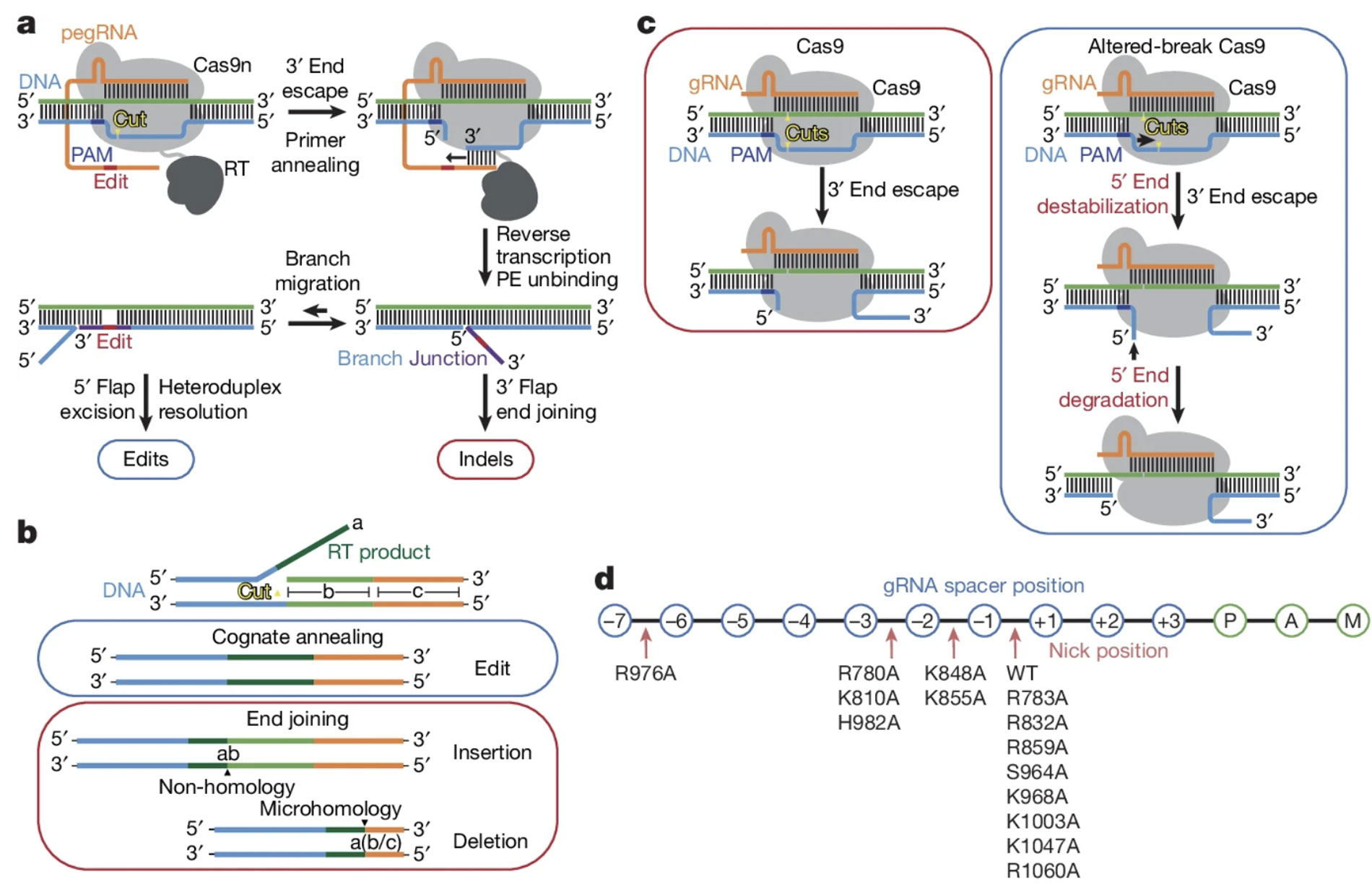
The image above shows Prime Editing and vPE systems step by step, explaining why some editing events produce indel (small insertion/deletion) errors.
a) Prime Editing Can Produce Two Outcomes
After a single DNA strand is nicked, it may be repaired correctly (edit) or misjoin, creating small insertions/deletions (indel).
b) The Molecular Source of Errors
Broken DNA ends may confuse similar sequences and join at the wrong point . This “incorrect gluing” produces indel errors.
c) Cas9 Cleavage Determines the Error
Conventional Cas9 may overprotect the 5′ end, promoting rejoining. The “altered-break” Cas9 in vPE leaves the 5′ end less stabilized, reducing incorrect joining.
d) vPE's Contribution
Rational mutations in Cas9 cause the cleavage site to be shifted by a few bases and increase pegRNA stability. Correct repair is promoted, making gene editing much safer .
Conclusion: In Prime Editing, errors usually arise from DNA ends incorrectly joining. Optimizing Cas9 cleavage position and strand stability (the vPE approach) can substantially reduce these errors.
The Clinical Meaning of a 60× Reduction
The vPE error rate's approximately 60-fold reductionis more than a statistical improvement; it means crossing the most critical safety threshold for clinical translation. This fundamentally changes gene therapies' risk–benefit balance .
Implications for Clinicians
- Lower genetic adverse effect risk: Fewer off-target mutations minimize the likelihood of long-term complications such as tumor development.
- Dose and protocol flexibility: Lower error rates allow more challenging targets to be edited safely.
- Clinical trial design: Crossing the safety threshold may accelerate progression from Phase I to Phase II trials.
- Translational advantage: In oncology models, genomic response mapping can now use cleaner data.
What Does It Mean for Patients?
Gene therapies have often remained between “laboratory success and clinical uncertainty.” With vPE, this boundary has begun moving for the first time into a zone of clinical safety .
- More predictable outcomes: Greater genetic stability after treatment.
- Long-term confidence: Higher durability and safety of correction.
- Broader scope: Currently, rare genetic diseases are targeted; in the medium term, cancer and metabolic diseases are next.
Example Applications
| Field | Application | vPE's Contribution |
|---|---|---|
| Inherited muscle diseases | Correcting specific mutations in DMD or SMA genes | Highly accurate single-base correction |
| Oncology – Research | Modeling drug resistance genes | Fewer errors → more reliable tumor models |
| Hematology | Correcting β-thalassemia and sickle cell mutations | Off-target 0.99% allows safer correction at this reduced level |
| Pharmacogenomics | Individual editing of drug metabolism genes | Treatment-specific, personalized gene correction |
Summary
vPE technology is redefining gene therapy's safety–efficacy balance . The goal is no longer just correcting a gene, but doing so at the correct base, at the right time, safely . This represents, for clinical research and patients alike, the beginning of a new era .
Impact on Oncology and Future Perspectives
This “error-threshold revolution” opens a new era not only for genetic disease but also for cancer biology and drug resistance research . vPE makes tools for understanding cancer's molecular evolution more accurate, reliable and predictable.
1. A New Era of Precision in Basic Research
Cancer cells constantly acquire mutations through genomic instability , making it difficult to test a particular gene's effects in isolation. With vPE, targeted base corrections can now be performed free from off-target effects .
- Advantage: More accurate single-mutation models in cell lines.
- Example application: TP53, KRAS or PIK3CA variant functional testing becomes “cleaner.”
- Result: Fewer “false-negative/positive” findings caused by incorrect gene editing.
2. Overcoming the Safety Barrier in Clinical Research
The greatest clinical obstacle is the potential tumorigenic effect of genetic changes caused by “mistargeting.” vPE's lower error rate means a statistically significant reduction in this risk . This paves the way for gene therapies in oncology to receive broader ethical approval .
- Goal: Correction of somatic mutations through in vivo oncological gene therapies.
- Example scenario: Correcting inherited mutations in DNA repair genes (e.g., BRCA1/2).
- Ethical contribution: The principle that “benefits outweigh risks” now has a technical foundation.
3. The Future: Synergy Between AI and Gene Editing
Combining high-precision systems such as vPE with AI-supported design algorithms makes de novo gene therapy design possible. This suggests benefits not only from single-gene corrections but also from editing multigene interactions .
- AI-supported optimization: Simulations determine target selection, template length and RT configuration.
- Omics integration: Combining vPE data with multi-omics profiling may generate “digital twin” models.
- Vision: Patient-specific genome editing strategies (custom genome repair) could be developed for cancer treatment.
Conclusion and Vision
vPE redefines the concept of “correction” in medicine. The aim is no longer simply editing genes, but repairing biological errors with near-zero error rates. This advance may herald an era of personalized, error-free molecular surgery in oncology. The coming years will bring both clinical adoption and reconstruction of ethical and legal frameworks .
📚 References
- Chauhan VP, Sharp PA, Langer R. Engineered prime editors with minimal genomic errors. Nature. 2025; doi:10.1038/s41586-025-09537-3.
- Anzalone AV et al. Search-and-replace genome editing without double-strand breaks or donor DNA. Nature. 2019; 576(7785):149–157.
- Komor AC, Badran AH, Liu DR. Chemically and biochemically modified CRISPR systems for improved precision and safety. Nat Chem Biol. 2017; 13(6):576–583.
Was this article helpful?
Your feedback helps us improve our content.




Reader comments
Share your comment
Your name and comment are published only after administrator approval. Your email address is never shown to visitors.
Be the first to comment.