
Digital Exhaust or Digital Gold? The Real Value of AI-Generated Clinical Visit Transcripts

In this article
This article is based on a perspective published in the New England Journal of Medicine (NEJM) on 3 December 2025, titled “Digital Exhaust or Digital Gold? The Value of AI-Generated Clinical Visit Transcripts” .
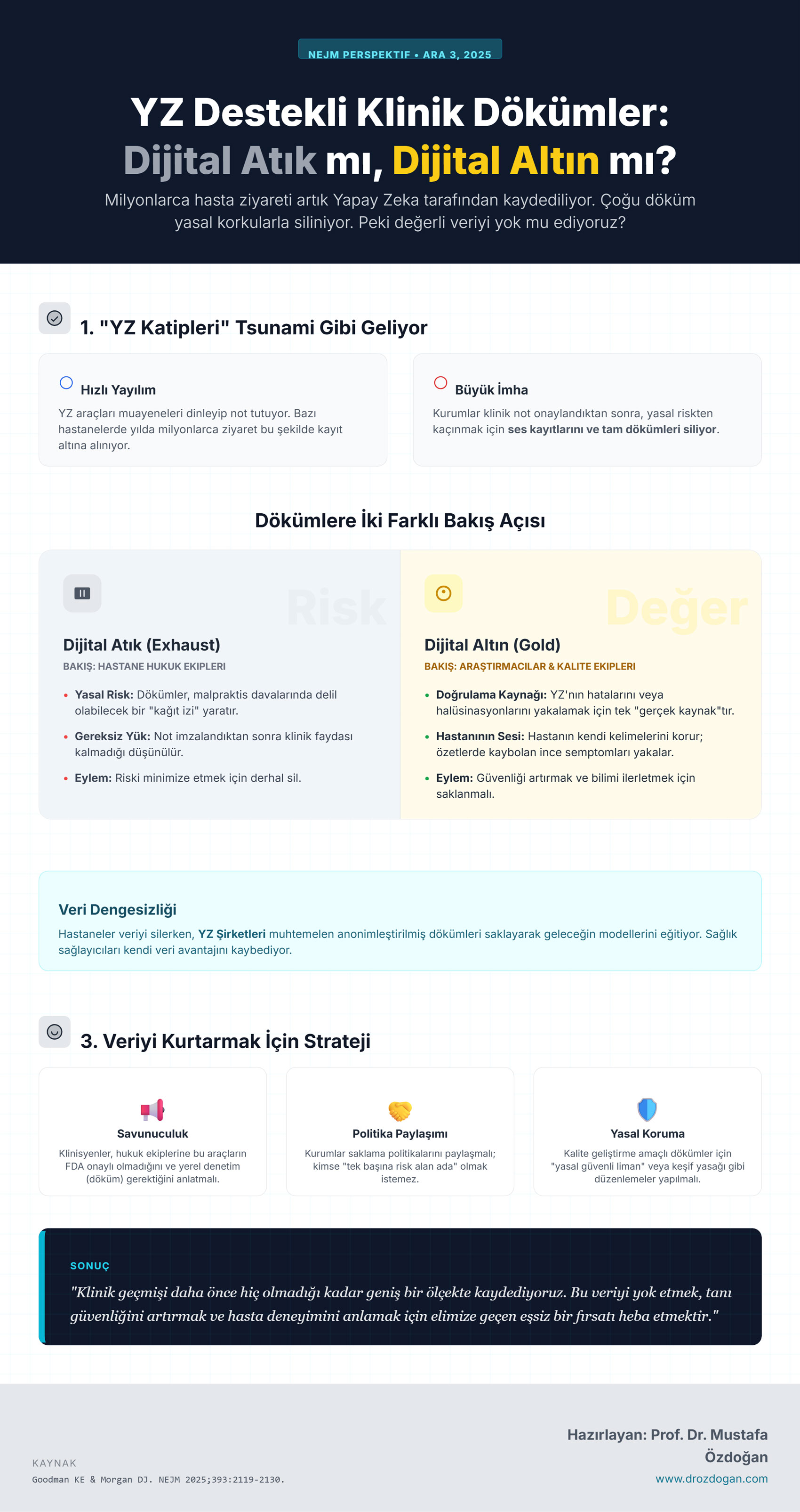
AI-powered “digital scribes” now listen to millions of consultations and automatically create notes . In doing so, they produce both an audio recording and a complete written transcript of each visit. Yet many US healthcare organizations, concerned about malpractice, delete these transcripts as soon as the note is finalized. Dialogue data being generated at an unprecedented scale in clinical medicine is therefore often destroyed almost before it exists.
The NEJM perspective argues that while healthcare organizations view visit transcripts as “digital exhaust”—unnecessary, risky baggage—for researchers and quality improvement teams they are actually “digital gold” . Below, I summarize this tension and explain why transcripts are indispensable for patient safety, AI accuracy, and medical research .
What does this article discuss?
Why AI clinical scribe transcripts are deleted, how they are actually an enormous data treasure , and ways to retain them securely and with legal protection.
Why does it matter?
Because destroying transcripts means losing both the opportunity to measure AI tools' real performance and clinical insights from patients' own words. Meanwhile, a substantial share of these conversations continues to be used to train private companies' models .
How Are AI Scribes Changing Clinical Visits?
AI scribes are software systems that listen to consultation-room conversations, transcribe them, and summarize them into draft clinical reports . Organizations are adopting them rapidly to reduce physicians' documentation burden and burnout risk. In some health systems, they are now used in millions of visits each year .
An important detail: because most of these systems technically do not qualify as “medical devices” , they do not undergo conventional FDA review. Despite widespread clinical use, independent, systematic assessment of safety and accuracy is therefore often lacking.
Each visit first produces an audio recording and a complete transcript , from which a summary note is generated. The physician checks, edits, and signs it, and the note enters the patient's record. The critical question is: What happens to the transcript and audio recording afterward?
Why Do Healthcare Organizations Fear Transcripts?
For many organizations, transcripts mean legal risk more than clinical benefit . The rationale is simple:
- The transcript records exactly who said what and which risks were discussed during the visit.
- There is concern that these records could be requested as evidence in malpractice litigation.
- Shortly after physician approval, many organizations delete transcripts routinely.
From a risk-management perspective, transcripts are thus a form of “digital exhaust”: byproducts with legal burdens and no planned use…
What Do Companies Do With These Data?
The irony is that while healthcare organizations delete transcripts, AI scribe vendors often retain deidentified conversations . This allows them to:
- Collect valuable training data for next-generation clinical AI models.
- Analyze millions of lines of real-world patient–physician dialogue .
The result: clinical and academic communities miss out on transcript opportunities, while the strategic value of dialogue data largely flows to the private sector.
Digital Gold, Not Digital Exhaust: What Do Transcripts Actually Offer?
To understand an AI scribe's real performance, we need two things:
- The original dialogue (transcript),
- The summary note generated from it.
But after transcripts are deleted, only flattened summary notes remain. We then cannot objectively measure:
- What the AI captured correctly,
- Where it made omissions, distortions, or hallucinations ,
- How often the physician noticed and corrected these errors
.
A recently published case reported that an AI scribe inserted “diabetes” and “heart disease” diagnoses never discussed during the visit as hallucinations. The information entered the medical record and affected treatment. To study such examples systematically, transcripts are essential.
The Patient's Own Words: A New Window Into Diagnosis, Communication, and Medical History
Transcripts offer a unique resource not only for AI evaluation but also for clinical research . For example:
- How often physicians interrupt patientsand whether this is linked to diagnostic errors,
- Which subtle but critical symptoms patients with rare cancers described years before diagnosis ,
- What words patients use to describe symptoms outside medical terminology
were previously questions almost impossible to study with large-scale data. Properly retained, anonymized transcripts now allow researchers to investigate them across thousands to millions of visits .
These analyses offer a unique opportunity to understand how not only AI tools but our own clinical communication styles relate to patient outcomes.
What Steps Could Support Safe Transcript Retention?
1. Advocacy by the Clinical and Academic Community
In most organizations, risk-management teams and lawyers decide whether transcripts are retained. Researchers and clinicians should clearly emphasize in internal discussions:
- AI scribes have not yet been independently and systematically evaluated,
- Without transcripts, these tools cannot generate robust evidence about patient safety,
. Moreover, as patients increasingly record consultations on their own phones , many alternative recordings will already exist.
2. Sharing Policies Across Organizations
No organization wants to be “the first to act alone.” Anonymous surveys and networks can share:
- How many organizations retain transcripts,
- Under what conditions and for how long,
- Good practices for patient consent, anonymization, and access permissions
. Each organization can then decide within a collective frame of reference, rather than in isolation .
3. Graduated, Secure Retention Models
Instead of “keep everything or delete everything,” transcripts can be managed using a tiered risk model :
- Irreversible anonymization: Transcripts masked so that neither patient nor physician can be reidentified have considerable research value.
- Use solely for quality improvement: In some legal systems, data retained with restricted access may receive greater protection in litigation.
- For broad research use: For data linkable to patients or physicians, new mechanisms may be needed: legal “safe harbors” and periods of malpractice blackout during which transcripts are protected from discovery for a defined time.
Such legal changes will not happen automatically; active advocacy by researchers and clinicians will be essential to making progress.
Conclusion: Preserving the Dialogue, Not Just the Note
AI scribes have been adopted by administrators and frontline physicians with unusual speed. But by systematically destroying the raw data they produce, we also undermine medicine's ability to evaluate and improve itself.
Clinical conversations are more than raw material for a note; they are unique records for patient safety, diagnostic accuracy, communication quality, and AI reliability . Researchers, clinicians, and legal experts can work together to design models that preserve transcripts securely and ethically . Otherwise, data viewed as a “risk” by health systems will remain digital gold only for outside companies.
Reference
Goodman, K. E., & Morgan, D. J. (2025). Digital Exhaust or Digital Gold? The Value of AI-Generated Clinical Visit Transcripts. New England Journal of Medicine. Published: 3 December 2025. DOI: 10.1056/NEJMp2514616. The full article is available on the NEJM website .
Was this article helpful?
Your feedback helps us improve our content.




Reader comments
Share your comment
Your name and comment are published only after administrator approval. Your email address is never shown to visitors.
Be the first to comment.