
GLP-1 Agonists (Weight-Loss Injections) Reduced Metastasis Risk in 4 Cancer Types

In this article
Can GLP-1 Receptor Agonists Reduce Cancer Progression? A Notable Signal for Metabolic Oncology From ASCO 2026
Metabolic Oncology Is No Longer a Peripheral Topic
For many years, cancer treatment focused largely on the tumor itself: mutations, immunotherapy targets, chemotherapy sensitivity, radiotherapy fields and surgical margins. Yet one reality has become increasingly clear in recent years: a tumor is a dynamic biological system living within the patient's metabolic environment. Obesity, insulin resistance, type 2 diabetes, chronic inflammation and adipose tissue biology may influence cancer development, recurrence risk, treatment tolerance and long-term survival.
GLP-1 receptor agonists should therefore not be viewed solely as drugs that cause weight loss or regulate blood sugar. These drugs reduce appetite, may promote weight loss, may improve glycemic control, may reduce cardiovascular risk and have been associated with favorable effects on inflammation in some studies. This ASCO 2026 analysis is important because it asks whether these metabolic effects are associated with metastatic cancer progression.
Brief Concept Note: What Are a GLP-1 Receptor Agonist and a DPP-4 Inhibitor?
GLP-1 receptor agonistsare drugs that mimic the effects of the GLP-1 hormone secreted by the intestine. They may regulate the insulin response, reduce appetite, slow gastric emptying and help with weight loss. Semaglutide, liraglutide, dulaglutide and tirzepatide are commonly known examples in this group. DPP-4 inhibitors are drugs in the gliptin class, used in type 2 diabetes, that affect the incretin system through a different mechanism. In this study, GLP-1 drugs were compared with DPP-4 inhibitors.
How Might GLP-1 Drugs Affect Cancer Biology?
The findings of this study do not prove causality, but several possible biological mechanisms can be discussed. GLP-1 receptor agonists may change the overall biological environment of a patient with cancer through weight loss, reduced insulin resistance, a decline in chronic inflammation, reduced metabolic stress and cardiometabolic improvement.
It is also important that the researchers examined GLP-1 receptor expression in tumor tissue. If GLP-1R expression in certain tumors is associated with better survival, this strengthens the hypothesis that GLP-1 signaling may play a role not only through systemic metabolic effects, but also at the tumor or tumor microenvironment level. However, this hypothesis must be confirmed through randomized studies and mechanistic analyses.
Propensity-Matched Analysis of 12.112 Patients Using TriNetX Global Data
Using data from the TriNetX Global Health Research Network, researchers compared the use of GLP-1 receptor agonists with DPP-4 inhibitors after a cancer diagnosis in patients with stage I–III cancer. Seven obesity-associated cancers were included in the analysis: breast adenocarcinoma, prostate adenocarcinoma, non-small cell lung cancer, colorectal adenocarcinoma, hepatocellular carcinoma, renal cell carcinoma and pancreatic adenocarcinoma.
The final propensity score-matched cohort included 12.112 patients. Half of the patients had started a GLP-1 receptor agonist after their cancer diagnosis, while the other half had started a DPP-4 inhibitor. The main aim was to assess the risk of progression from stage I–III disease to stage IV, that is, metastatic disease.
Brief Concept Note: What Is Propensity Score Matching?
Propensity score matchingis a statistical method used in observational studies to make two patient groups more balanced in their baseline characteristics. It seeks to balance factors such as age, body mass index, diabetes control, smoking history, comorbidities and cancer treatments. However, this method cannot eliminate all unmeasured differences and therefore does not provide proof of causality.
| Item | GLP-1 receptor agonist arm | DPP-4 inhibitor arm | Clinical significance |
|---|---|---|---|
| Patient group | Patients who started GLP-1 RA after a diagnosis of stage I–III cancer | Patients who started a DPP-4 inhibitor after a diagnosis of stage I–III cancer | The comparison was made more balanced because both groups consisted of patients receiving metabolic treatment. |
| Final patient count | 12.112 patients | Large real-world dataset. | |
| Cancer types | Breast, prostate, NSCLC, colorectal, HCC, renal cell and pancreatic cancer | Solid tumors that may be associated with obesity and metabolic dysfunction were evaluated. | |
| Primary clinical question | Risk of progression to stage IV disease | The association between metastatic progression and metabolic treatment was investigated. | |
| Additional biological analysis | Association between tumor GLP-1 receptor expression and overall survival | The possible role of GLP-1 signaling in tumor biology was examined. | |
Progression to Stage IV Was Significantly Lower in Four Cancer Types
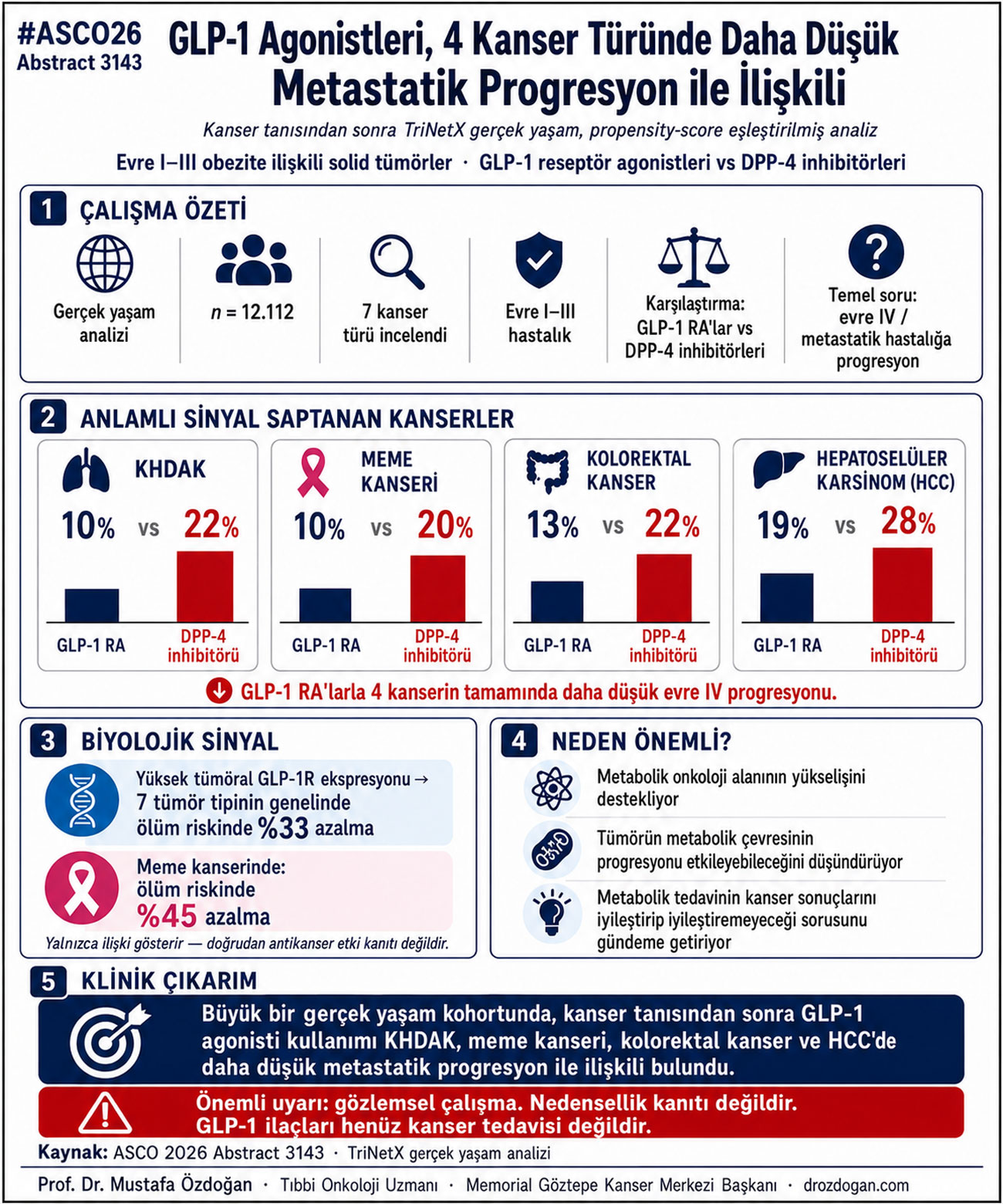
GLP-1 receptor agonist use was associated with a significant reduction in the risk of progression to stage IV disease in four cancer types: non-small cell lung cancer, breast cancer, colorectal cancer and hepatocellular carcinoma. In these four tumors, metastatic progression rates in the GLP-1 group were significantly lower than in the DPP-4 inhibitor group.
| Cancer type | Progression to stage IV with GLP-1 RA | Progression to stage IV with DPP-4 inhibitor | Absolute difference | Clinical interpretation |
|---|---|---|---|---|
| Non-small cell lung cancer | %10 | %22 | 12 percentage points | One of the most notable signals of reduced metastatic progression. |
| Breast cancer | %10 | %20 | 10 percentage points | Data strengthening the association between the metabolic environment and breast cancer prognosis. |
| Colorectal cancer | %13 | %22 | 9 percentage points | A biologically consistent signal with previous colorectal risk reduction data in the GLP-1 field. |
| Hepatocellular carcinoma | %19 | %28 | 9 percentage points | A highly relevant research area because of the axis linking metabolic liver disease, obesity and diabetes. |
| Prostate, pancreatic and renal cell cancer | Trend toward lower rates | Higher than the comparator arm | Not statistically significant | There is a trend toward reduction, but this study does not provide definitive results for these tumors. |
Brief Concept Note: What Does Metastatic Progression Mean?
Metastatic progressionmeans the progression of cancer from an early or locoregional stage to stage IV disease that has spread to distant organs. The main question in this study was whether exposure to GLP-1 drugs in people with stage I–III disease reduced the risk of progression to stage IV.
High GLP-1R Expression Appeared Associated With Better Survival
The researchers examined not only the association between drug use and clinical progression, but also the association between GLP-1 receptor expression in tumor tissue and survival. Across seven tumor types, high GLP-1R expression, compared with low expression, was associated with a %33 lower risk of death. This association was particularly pronounced in breast cancer; high GLP-1R expression was associated with a %45 reduction in the risk of death.
Brief Concept Note: What Does GLP-1R Expression Mean?
GLP-1R expressionrefers to how much GLP-1 receptor is present in tumor cells or tumor tissue. High GLP-1R levels in a tumor may suggest that GLP-1 signaling is associated with that tumor's biology. However, this does not mean that a GLP-1 drug directly treats the tumor; it provides only a signal of a biological association.
A Strong Signal, but Not Proof of Causality
This study provides very notable real-world data, but it is not a randomized controlled trial. It therefore cannot be stated with certainty that GLP-1 receptor agonists directly reduce cancer progression. In observational analyses, patient selection, weight loss, metabolic control, access to healthcare, follow-up frequency, differences in cancer treatment and unmeasured confounders may influence the results.
Nevertheless, the study's use of an active metabolic comparator such as DPP-4 inhibitors and matching for many clinical factors make the signal more meaningful. The observation of results in the same direction across four different solid tumors, in particular, shows that this area must be tested in prospective randomized studies.
Truecheck Note: GLP-1 Is Not Currently a Cancer Treatment
These data do not show that GLP-1 receptor agonists should be started as a cancer treatment. The study is observational and does not prove causality. At present, GLP-1 drugs should be considered in the context of their approved indications: type 2 diabetes, obesity and cardiometabolic risk management. However, the findings strongly remind us that metabolic health in a patient with cancer may be associated with oncological outcomes.
Balanced Messages That Can Be Drawn From This Study
- Metabolic health matters: Obesity, insulin resistance and diabetes form a biological environment that may influence the course of a patient with cancer.
- GLP-1 RAs are worth investigating: The signal of reduced metastatic progression is strong, particularly in lung, breast, colorectal and liver cancers.
- There is no causality: This study does not prove that GLP-1 drugs directly prevent cancer spread.
- A randomized study is essential: Which patient, which GLP-1 agent, what timing and which concurrent cancer treatment should be tested in prospective studies.
- Muscle loss must be monitored: When aiming for weight loss in a patient with cancer, sarcopenia, nutritional risk and treatment tolerance must be safeguarded.
Treating Not Only the Tumor, but Also the Metabolic Environment in Which It Lives
It is no coincidence that topics such as GLP-1 receptor agonists, short-term fasting, insulin changes and metabolic interventions came to the fore together at ASCO 2026. Oncology is increasingly becoming a field that considers not only tumor DNA, but also the systemic environment in which the tumor grows.
Obesity, prediabetes, diabetes, fatty liver, muscle loss, inflammation and cardiovascular risk in a patient with cancer should no longer be regarded simply as comorbidities. They may be associated with treatment tolerance, complication risk, quality of life and possibly the biological course of cancer.
How Should We Discuss This With a Patient?
“This study suggests that GLP-1 drugs used for diabetes or weight management may be associated with lower rates of progression to the metastatic stage in certain cancers. However, these drugs are not currently cancer treatments. If such a drug is considered for you, the main reason would be diabetes, obesity or metabolic risk management; possible effects on cancer are still being investigated.”
The Metabolic Environment Must Now Be Considered More Strategically in Cancer Treatment
Academic Assessment
These data strongly remind us that obesity, insulin resistance and diabetes are more than accompanying problems in a patient with cancer; they form an important metabolic environment that may influence the course of the disease.
The signal of reduced metastatic progression seen with GLP-1 receptor agonists supports the idea of intervening more deliberately and actively in metabolic processes during cancer treatment.
In the future, oncology practice may evolve toward a more holistic and personalized approach that strategically manages the patient's metabolic health alongside tumor-targeted treatments.
Positioning GLP-1 as a Tool for Metabolic Health, Rather Than as a Cancer Drug
At present, the most appropriate approach is not to add GLP-1 receptor agonists directly to cancer treatment. However, if a patient with cancer has obesity, diabetes or insulin resistance, active management of these conditions is becoming increasingly important. Endocrinology, medical oncology, dietetics and exercise physiology should work more closely together.
Particular caution is needed when planning GLP-1 use in patients receiving active cancer treatment. Nausea, vomiting, loss of appetite, rapid weight loss, muscle loss, dehydration and treatment tolerance must be considered. The goal in a patient with cancer is not simply to lose weight, but to reduce fat mass while preserving muscle mass, performance and treatment continuity.
Practical Safety Note
GLP-1 receptor agonists may be associated with adverse effects such as nausea, vomiting, diarrhea, constipation, loss of appetite and, rarely, pancreatitis. The decision to use them must be individualized in patients receiving active chemotherapy, with reduced appetite, weight loss, low muscle mass or gastrointestinal cancer.
Practical Lessons That Can Be Drawn Today
- Metabolic screening: At cancer diagnosis and during follow-up, HbA1c, fasting glucose, body mass index, waist circumference, fatty liver and muscle mass should be assessed more systematically.
- Obesity and diabetes must be actively managed: These conditions are part of oncological care, not solely a matter of internal medicine.
- Discuss GLP-1 when there is an indication: In patients with an indication for diabetes or obesity treatment, the GLP-1 option can be evaluated together with endocrinology.
- It does not replace cancer treatment: It is not an alternative to surgery, chemotherapy, immunotherapy, targeted therapy or radiotherapy.
- A randomized study must be awaited: Whether it truly reduces metastatic progression must be demonstrated in prospective studies.
Could GLP-1 Agonists Become a New Supportive Strategy in Oncology?
The real-world analysis of 12.112 patients presented at ASCO 2026 suggests that use of a GLP-1 receptor agonist after a cancer diagnosis may be associated with a reduced risk of metastatic progression in certain obesity-associated solid tumors. Progression to stage IV was reported as %10 versus %22 in NSCLC, %10 versus %20 in breast cancer, %13 versus %22 in colorectal cancer and %19 versus %28 in hepatocellular carcinoma.
High tumor GLP-1R expression was also associated with a lower risk of death across seven tumor types, with a particularly pronounced association in breast cancer. Although this finding suggests that GLP-1 signaling may be associated with cancer biology, it is not proof of causality.
The main message of this study is therefore that GLP-1 receptor agonists are not currently cancer treatments, but they provide a strong signal that more active management of metabolic health in patients with cancer who have obesity, diabetes or insulin resistance may be associated with oncological outcomes. The oncology of the future is moving toward a holistic approach that manages the patient's metabolic environment more deliberately alongside tumor-targeted treatments.
References
- ASCO Daily News. GLP-1 RA Exposure After Diagnosis Could Lead to Reduced Progression, Improved Survival in Multiple Malignancies. 21 May 2026.
- ASCO Press Center. GLP-1s May Reduce Metastatic Progression of Certain Obesity-Related Cancers. 21 May 2026.
- The ASCO Post. GLP-1 RAs May Reduce Metastatic Progression in Certain Obesity-Related Cancers. 21 May 2026.
- ASCO 2026 Abstract 3143. Can GLP-1 receptor agonists mitigate cancer progression? Real-world analysis of post-diagnosis exposure and metastatic progression.
- drozdogan.com. ASCO 2026 Önizlemesi – Onkoloji Pratiğini Değiştirecek Çalışmaların Klinik Pusulası. 17 May 2026.
- drozdogan.com. Kanserde Kısa Süreli Açlıkla Tümörü Değil, Yaşadığı Metabolik Ortamı Tedavi Etmek. 2026.
Was this article helpful?
Your feedback helps us improve our content.


Reader comments
Share your comment
Your name and comment are published only after administrator approval. Your email address is never shown to visitors.
Be the first to comment.