
Irinotecan's Power With Fewer Side Effects: Cancer Treatment With Nanotechnology-Based DEP-SN38

In this article
New Horizons in Nanotechnology and Cancer Treatment
Nanotechnologyinvolves controlling and designing matter at the nanometer scale (a billionth of a meter) . At this scale, drugs can be reengineered using special delivery systems to reach targeted tissues directly.
In cancer treatment, conventional chemotherapy drugs generally affect both tumor cells and healthy cells. This limits efficacy and causes side effects such as nausea, vomiting, diarrhea, hair loss, and bone marrow suppression. Nanotechnology approaches aim to overcome this problem in three main ways:
- Directing the drug to tumor tissue,
- Increasing efficacy,
- Minimizing side effects.
Summary: Nanotechnology prolongs a drug's circulation, enables selective tumor delivery and controlled release, and thus widens the therapeutic window .
Recently developed dendrimer-based nanoparticle systems (e.g., DEP-SN38) represent the advanced capabilities of nanotechnology. This approach was reported clinically on 1 August 2025 in Journal of Clinical Oncology in a phase-1 study.
🔹 An Early FDA-Approved Example: Nab-Paclitaxel (Abraxane)
One of the first major examples of nanotechnology entering clinical practice is a formulation in which paclitaxel is bound to albumin nanoparticles , called nab-paclitaxel (Abraxane) .
- FDA approval: 2005; breast, pancreatic, and lung cancer treatment uses.
- Clinical advantage: Compared with conventional paclitaxel, less solvent is required ⇒ lower risk of severe allergic reactions; drug delivery to the tumor is facilitated.
🔹 A More Recent FDA-Approved Example: Liposomal Irinotecan (Onivyde)
A contemporary example of nanotechnology is liposomal irinotecan (Onivyde) .
- FDA approval: 2015; metastatic pancreatic cancerafter gemcitabine—an important option.
- Mechanism: The liposomal structure keeps irinotecan in circulation longerand increases delivery of the active metabolite SN38 to the tumor ⇒ potential for improved efficacy.
⚠️ Two Critical Irinotecan Side Effects: Neutropenia and Diarrhea
Irinotecanis an effective chemotherapy agent used in many tumors, particularly colorectal cancer. However, alongside its efficacy, two critical side effects can complicate clinical practice: neutropenia and late-onset diarrhea. These toxicities are major limiting factors affecting both patient safety and treatment continuity.
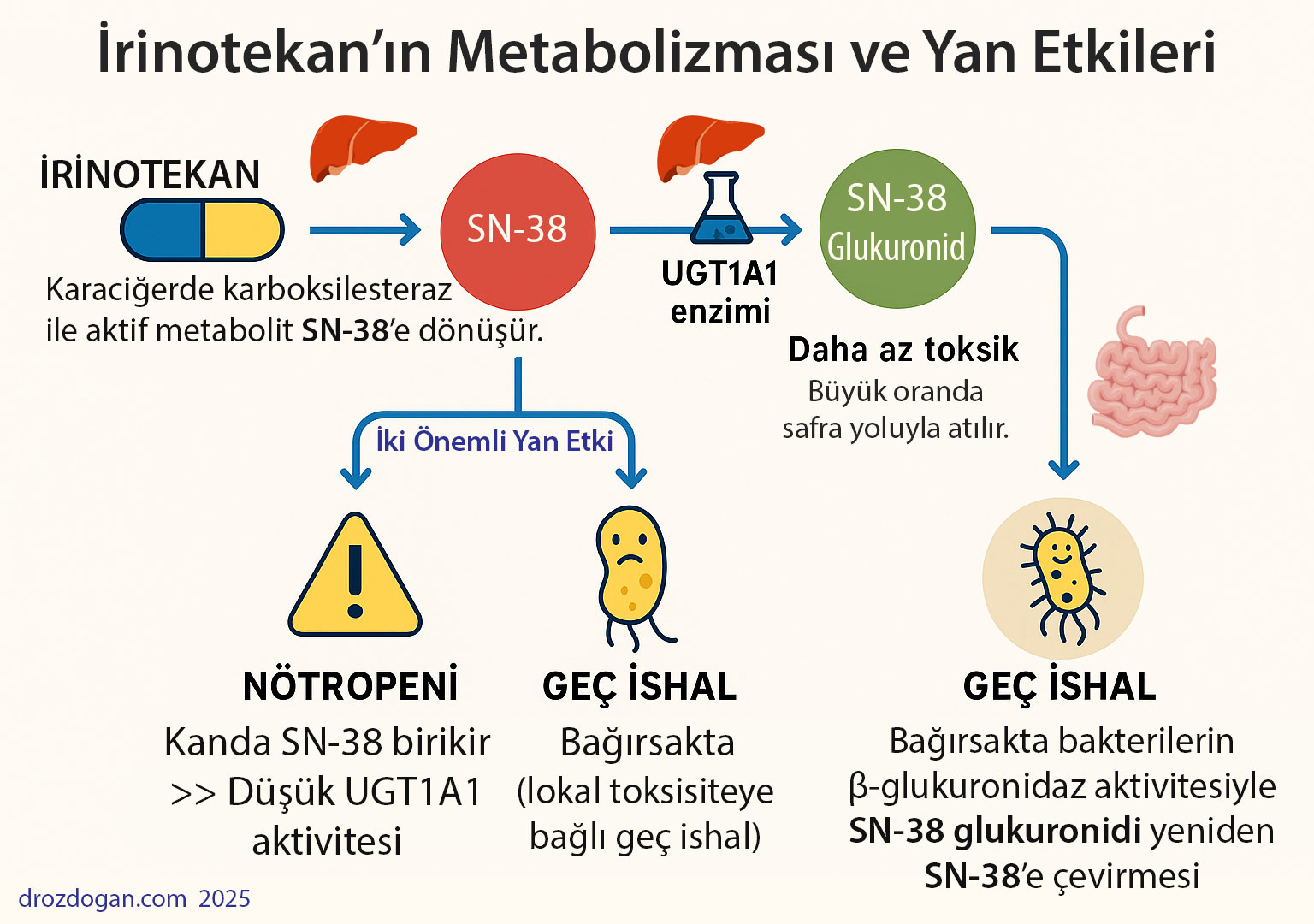
🔬 Mechanism 1: Neutropenia
- Irinotecan → SN38 (active metabolite)
SN38 formed in the liver provides the main tumor-killing effect. - SN38 → SN38-glucuronide (SN38G)
This conversion occurs through the UGT1A1 enzyme . SN38G is less toxic and is excreted in urine. - If UGT1A1 activity is low, SN38 cannot be adequately detoxified → SN38 accumulates in the blood → particularly causing neutropenia .
💡 Therefore, UGT1A1 genetic testingis used to predict irinotecan toxicity.
- Risk is particularly high in people with the UGT1A1 *28/*28 or *6/*6 polymorphism.
- The FDA recommends genotyping before starting irinotecan, particularly when high doses are planned.
🔬 Mechanism 2: Diarrhea
⚡ Early-Onset Diarrhea (<24 hours)
- Irinotecan inhibits acetylcholinesterase, causing cholinergic syndrome .
- This presentation may have diarrhea, abdominal cramps, sweating, salivation, rhinorrhea, and bradycardia as accompanying features.
- It is usually rapidly controlled with atropin treatment.
🐛 Late-Onset Diarrhea (≥24 hours)
- Irinotecan's active metabolite SN-38undergoes glucuronidation in the liver by the UGT1A1 enzyme → SN-38 glucuronide (SN38G) is formed.
- SN38G is normally less toxic and is excreted through bile and urine.
- However, intestinal bacterial β-glucuronidase enzymesconvert SN38G back to SN-38.
- The resulting active SN-38 damages the intestinal mucosa → severe delayed diarrhea may develop.
❓ Why Is It More Severe in Some People?
- Genetic differences: People with UGT1A1*28 or similar polymorphisms have reduced capacity to glucuronidate SN-38. Through bile, the intestines receive → more active SN-38 → more severe toxicity.
- Microbiota differences: The abundance of β-glucuronidase-producing gut bacteria varies between people. With high enzyme activity, more SN-38 is reactivated.
- Dose and concomitant treatments: High irinotecan doses, antibiotic use (altering the microbiota), or concomitant medications may increase diarrhea severity.
👉 In summary: Early diarrhea develops through a cholinergic mechanism, whereas late diarrhea depends on microbiota and UGT1A1 metabolism . Severe delayed diarrhea results from combined genetic and microbial factors.
🧪 Can Testing Predict It?
- For neutropenia:
- UGT1A1 genetic testing ✔️ — The FDA recommends irinotecan dose reduction, particularly in UGT1A1*28 homozygous individuals.
- This test is available in clinical practice and predicts the risk of serious hematologic toxicity (particularly neutropenia) .
- For diarrhea:
- Late diarrhea is primarily associated with intestinal bacterial β-glucuronidase activity .
- This mechanism is microbiota-dependent, rather than pharmacogenetic; UGT1A1 testing therefore does not predict diarrhea risk.
- There is no routine clinical test ❌for intestinal β-glucuronidase activity; stool enzyme measurements or microbiota analyses are available only in research.
- Because diarrhea risk cannot be predicted clinically, close monitoring and a high-dose loperamide protocol are standard.
📊 Summary Table: Irinotecan Toxicity and Testing
| Side Effect | Responsible Mechanism | Can Testing Predict It? |
|---|---|---|
| Neutropenia | Low UGT1A1 activity → SN38 accumulates in blood | UGT1A1 genetic testing ✔️ FDA recommends dose reduction in *28 homozygotes |
| Late Diarrhea | Intestinal bacterial β-glucuronidase activity → SN38 accumulates in the mucosa | No routine test ❌ (microbiota-based, research setting) |
| Early Diarrhea | Acute cholinergic effect → increased acetylcholine → intestinal peristalsis | Not predictable ❌ Can be prevented with atropine |
🌟 A Next-Generation Step: DEP-SN38
Recently developed dendrimer-based nanoparticle systems (e.g., DEP-SN38) represent the advanced capabilities of nanotechnology.
- Goal: Deliver irinotecan's potent but problematic metabolite SN38 directly to the tumor,
- Reducing side effects while increasing efficacy more safely.
Note: DEP-SN38 aims, by bypassing individual variation in irinotecan-SN38 conversion, to improve tumor localization and tolerability .
Used in cancer treatment, irinotecan (Camptosar)is a chemotherapy drug with proven efficacy, particularly in colon and lung cancer. However, one of the most frequent and troublesome treatment problems is severe diarrhea.
- On one hand, SN38 represents irinotecan's main tumor-killing power .
- On the other, this conversion process varies between individuals in the liver , making the side-effect profile difficult to predict.
💡 Note: At this point, dendrimer-based nanoparticle technology used to develop DEP-SN38could open a new chapter in cancer treatment.
DEP-SN38: Adapting Nanotechnology to Oncology
DEP-SN38 uses a polylysine-based dendrimer , a tree-branch-like nanoparticle system, to deliver SN38 directly.
Advantages include:
- Without requiring liver metabolism, it delivers the active drug directly to the tumor.
- Increases bioavailability and provides more controlled drug release.
- Reduces intestinal toxicity , minimizing side effects such as severe diarrhea and vomiting.
👉 This approach could overcome chemotherapy's “effective but intolerable” paradox.
📊 Study Design: Who Was Treated and How?
This phase-1 clinical trial had the following design:
- Level of evidence: Multicenter, phase-1, noncomparative, hypothesis-generating design.
- Participants: Between 2019–2023, 114 patientswith advanced or metastatic tumors.
- Median age: 60.5 (range 31–78 years); 65% were women.
- Previous treatments: A median of 4 lines; 60% of patients had previously received irinotecan.
Treatment arms:
- DEP-SN38 monotherapy – every 3 weeks
- DEP-SN38 monotherapy – every 2 weeks
- DEP-SN38 + 5-FU/leucovorin combination – every 2 weeks
Dose: For all regimens, 12.5 mg/m² was identified as the recommended dose.
⚖️ Safety: Less Diarrhea, Less Vomiting
- 89.7% of side effects were mild to moderate.
- Neutropeniawas the most common serious side effect and dose-limiting factor (48% of grade 3–4 side effects).
- Severe gastrointestinal side effects were almost absent:
- Grade 3 diarrhea and vomiting: <1%
- Grade 3 nausea: <2%
- Cholinergic symptoms (e.g., excessive sweating, abdominal cramps) were not observed at all.
- Only 3.5% of patients stopped treatment because of side effects.
- Some patients were able to continue treatment for more than 6 months.
👉 These results strongly show DEP-SN38 is safer than irinotecan .
🚀 Efficacy Results: In Which Tumors Did It Stand Out?
- Monotherapy (every 2 weeks): Response rate %21.4, disease control rate %71.4.
- Combination (DEP-SN38 + FU/LV): Response rate %12.5, disease control rate %81.3.
- Monotherapy (every 3 weeks): Low response rate (%1.8).
💡 Notable findings by tumor type:
- Colorectal Cancer: With monotherapy (every 2 weeks), 42.9% objective response.
- Platinum-Resistant Ovarian Cancer: With combination therapy, 42.9% response.
- Prolonged progression-free survival:
- Pancreatic cancer: 10.2 months
- NSCLC: 8.4 months
- Breast cancer: 16.6 months and 6 months
🔍 Clinical Significance
These results offer several key messages:
- Irinotecan's efficacy can be harnessed safely by administering SN38 directly.
- High response rates are particularly promising in colorectal and platinum-resistant ovarian cancer .
- Even in heavily pretreated, highly resistant patients, long-term control can be achieved.
- Neutropenia stands out as the only serious toxicity requiring attention .
📝 Conclusion and Future Perspective
DEP-SN38 shows how transformative nanoparticle-based drug delivery systems can be in cancer treatment.
- Safer,
- more effective,
- longer-lasting responses could redefine chemotherapy through this approach.
🔮 If confirmed in larger patient groups in phase II–III trials, DEP-SN38 could become a new standard replacing irinotecan in the coming years.
Sources
DOI:10.1200/JCO-25-00236
Was this article helpful?
Your feedback helps us improve our content.




Reader comments
Share your comment
Your name and comment are published only after administrator approval. Your email address is never shown to visitors.
Be the first to comment.