
Puxitatug Samrotecan: High Response Rates in Endometrial-Ovarian Cancer With a B7-H4-Targeted ADC

In this article
Why is B7-H4 an interesting target?
B7-H4 is an immune-regulatory protein from the B7 family that may be highly expressed on tumor cells in a substantial proportion of endometrial and ovarian cancers. Its more limited expression in normal tissues makes it attractive for targeted therapies. The central idea is this: an antibody binding to B7-H4 on the tumor cell surface can carry a potent cytotoxic payload into the cancer cell.
Puxitatug samrotecan, also known as Puxi-Sam or AZD8205, is an antibody-drug conjugate directed against B7-H4. Its payload belongs to the topoisomerase 1 inhibitor class. The drug therefore aims to deliver a powerful DNA-damaging therapeutic effect in a targeted manner to tumor cells expressing B7-H4.
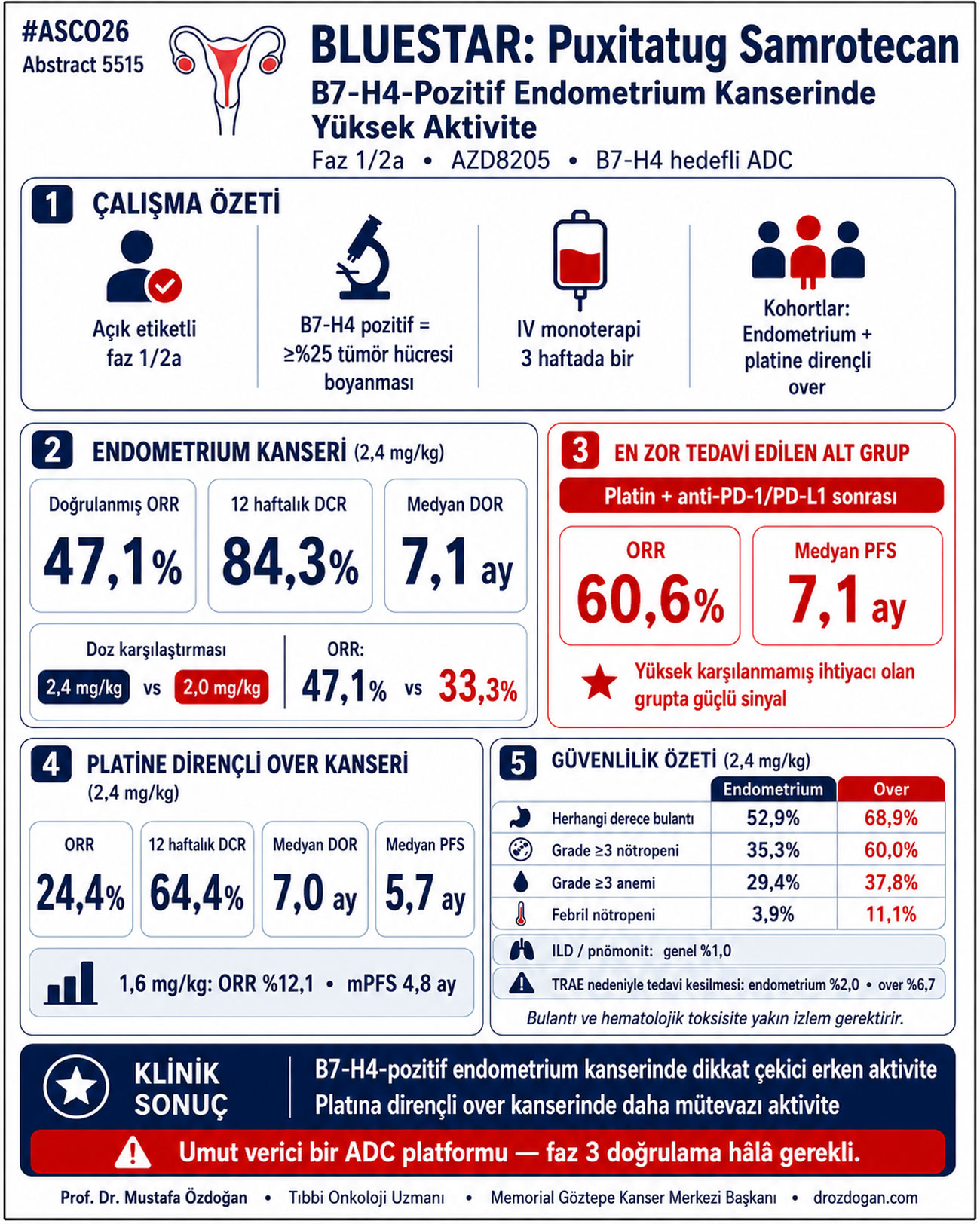
In BLUESTAR, B7-H4 positivity was defined as B7-H4 staining in at least %25 of tumor cells on central immunohistochemical assessment. This threshold shows that treatment was evaluated in patients selected by a biomarker.
Study design: how was BLUESTAR conducted?
BLUESTAR is a first-in-human, open-label phase 1/2a study evaluating intravenous puxitatug samrotecan monotherapy in B7-H4-positive advanced or metastatic solid tumors. Treatment was administered every 3 weeks. The analysis updated at ASCO 2026 focused particularly on the endometrial cancer and platinum-resistant ovarian cancer cohorts.
| Cohort | Dose | Number of patients | Patient profile | Main objective |
|---|---|---|---|---|
| Endometrial cancer | 2,0 mg/kg | 42 | B7-H4-positive advanced / metastatic disease | Safety and early efficacy |
| Endometrial cancer | 2,4 mg/kg | 51 | Patients previously exposed to platinum and mostly to immunotherapy | Main dose signal for further development |
| Platinum-resistant ovarian cancer | 1,6 mg/kg | 33 | Progression during platinum treatment or within 6 months of the last platinum dose | Dose-response assessment |
| Platinum-resistant ovarian cancer | 2,4 mg/kg | 45 | Heavily pretreated; prior PARP and VEGF/VEGFR treatment common | Efficacy and safety signal in ovarian cancer |
In the endometrial cancer 2,4 mg/kg cohort, the median age was 65. Histological subtypes included endometrioid tumors in %58,8, serous tumors in %25,5, carcinosarcoma in %9,8, and clear cell histology in %2,0. Of the patients, %98 had previously received platinum-based chemotherapy and %64,7 had received anti-PD-1/PD-L1 treatment.
In the platinum-resistant ovarian cancer 2,4 mg/kg cohort, the median age was 59. Serous histology was present in %68,9 of patients. The prior treatment burden was substantial: all patients had previously received platinum; %57,8 had received a PARP inhibitor and %64,4 had received VEGF/VEGFR-targeted treatment.
Efficacy in endometrial cancer: a notable response rate
In the endometrial cancer 2,4 mg/kg cohort, the confirmed objective response rate with puxitatug samrotecan was %47,1 . The 12-week disease control rate was %84,3, the median duration of response was 7,1 monthsand median progression-free survival was 7,2 months .
The response rate was even more notable in the endometrial cancer subgroup previously treated with both platinum-based chemotherapy and anti-PD-1/PD-L1: confirmed ORR was %60,6and median PFS was 7,1 months . These results were presented as data supporting the FDA Breakthrough Therapy Designation process.
Comparison with a lower dose: why did 2,4 mg/kg stand out?
Activity was also observed at 2,0 mg/kg in endometrial cancer, but a stronger response signal was seen at 2,4 mg/kg. In the 2,0 mg/kg cohort, confirmed ORR was %33,3, 12-week DCR was %71,4, median DOR was 6,0 months and median PFS was 5,7 months . At 2,4 mg/kg, however, ORR increased to %47,1 and mPFS to 7,2 months .
Efficacy in platinum-resistant ovarian cancer
Puxitatug samrotecan was evaluated in platinum-resistant ovarian cancer as well as endometrial cancer. At 2,4 mg/kg in the platinum-resistant ovarian cancer cohort, confirmed ORR was %24,4, 12-week DCR was %64,4, median DOR was 7,0 months and median PFS was 5,7 months .
In the serous histology subgroup at 2,4 mg/kg, confirmed ORR was %22,6and median PFS was 5,8 months . At the lower 1,6 mg/kg dose, confirmed ORR across ovarian cancer was %12,1and median PFS was 4,8 months . These results also supported a dose-response relationship in ovarian cancer.
| Patient group | Dose | ORR | 12-week DCR | Median DOR | Median PFS |
|---|---|---|---|---|---|
| Endometrial cancer | 2,4 mg/kg | %47,1 | %84,3 | 7,1 months | 7,2 months |
| Endometrial cancer | 2,0 mg/kg | %33,3 | %71,4 | 6,0 months | 5,7 months |
| Platinum-resistant ovarian cancer | 2,4 mg/kg | %24,4 | %64,4 | 7,0 months | 5,7 months |
| Platinum-resistant ovarian cancer | 1,6 mg/kg | %12,1 | Not specified | 5,8 months | 4,8 months |
Response by B7-H4 expression level
Activity in BLUESTAR was observed across different ranges of B7-H4 expression. Responses therefore did not appear limited to patients with very high B7-H4 staining. This suggests that the B7-H4 positivity threshold may cover a broader patient group in clinical development.
However, caution is needed here: B7-H4 expression alone may not explain all the biology of response. In ADCs, antibody delivery to the tumor, internalization, payload sensitivity, tumor heterogeneity, previous treatments, and bone marrow reserve may affect outcomes as well as target density.
The presence of the target protein in a tumor is important, but an ADC's effect depends on many factors, including target abundance, the capacity for uptake into the cell, the efficacy of the cytotoxic payload, penetration into tumor tissue, and the patient's organ/bone marrow reserve following previous treatments.
Safety: nausea and hematological toxicity predominate
Nausea was one of the most common treatment-related adverse effects of puxitatug samrotecan at 2,4 mg/kg. It was reported in the endometrial cancer cohort at a rate of %52,9and in the ovarian cancer cohort at %68,9 . Most of these events were low grade and managed with prophylactic antiemetic treatment.
The other important group of adverse effects was hematological toxicity. In the endometrial cancer 2,4 mg/kg cohort, any-grade neutropenia occurred at a rate of %45,1, grade 3 or higher neutropenia at %35,3; any-grade anemia at %51,0and grade 3 or higher anemia at %29,4 . Hematological toxicity was more pronounced in the ovarian cancer 2,4 mg/kg cohort: any-grade neutropenia occurred at a rate of %68,9, grade 3 or higher neutropenia at %60,0; any-grade anemia at %62,2and grade 3 or higher anemia at %37,8.
At 2,4 mg/kg, treatment-related febrile neutropenia was reported in endometrial cancer at a rate of %3,9and in ovarian cancer at %11,1 . Treatment-related interstitial lung disease / pneumonitis was rare across BLUESTAR: among all treated patients, %1,0 or 3/292 patients. Permanent treatment discontinuation due to a treatment-related adverse effect at 2,4 mg/kg occurred in endometrial cancer at a rate of %2,0and in ovarian cancer at %6,7 .
A practical safety message
Although puxitatug samrotecan is a targeted ADC, the most important management issues in clinical practice are nausea, neutropenia, anemia, and the risk of febrile neutropenia. Blood counts, infection education, growth factor use, and algorithms for dose interruption / reduction will be critical, especially in heavily pretreated patients with ovarian cancer.
Why does it appear stronger in endometrial cancer?
The most striking efficacy signal in the BLUESTAR data was observed in endometrial cancer. At 2,4 mg/kg, ORR was %47,1, rising to %60,6 in the subgroup after platinum + immunotherapy. By contrast, ORR in platinum-resistant ovarian cancer was %24,4.
There may not be a single explanation for this difference. B7-H4 expression density, tumor biology, prior treatment burden, payload sensitivity, and the tumor microenvironment may differ in endometrial cancer. In the ovarian cancer cohort, heavier prior treatment, exposure to PARP and anti-VEGF/VEGFR therapies, bone marrow reserve, and platinum-resistant biology may affect the efficacy and safety profile.
Critical reading: how should these data be interpreted in a balanced way?
- These are early-phase data: BLUESTAR is a phase 1/2a study; randomized phase 3 results are not yet available.
- The signal in endometrial cancer is strong: At 2,4 mg/kg, ORR was reported as %47,1, and %60,6 in the subgroup after platinum + anti-PD-1/PD-L1.
- Efficacy in ovarian cancer is more modest: In platinum-resistant ovarian cancer at 2,4 mg/kg, ORR was %24,4; this is meaningful but less striking than in endometrial cancer.
- The B7-H4 expression threshold is important: B7-H4 positivity in the study was defined as ≥%25 tumor cell staining; these results cannot be generalized to patients with lower expression.
- Hematological toxicity is substantial: Neutropenia, anemia, and febrile neutropenia in particular must be managed carefully.
- ILD/pneumonitis appears rare: It was reported as %1,0 across the entire BLUESTAR population; however, this issue should not be removed from monitoring in the ADC class.
- Phase 3 results must be awaited: BLUESTAR-Endometrial01 will be the main study determining whether this drug becomes an actual clinical standard.
Moving to phase 3: BLUESTAR-Endometrial01
Following the BLUESTAR data, puxitatug samrotecan moved into a phase 3 study in B7-H4-selected advanced / metastatic endometrial cancer. BLUESTAR-Endometrial01 compares puxitatug samrotecan monotherapy with physician's choice of chemotherapy in patients whose disease progressed after platinum-based chemotherapy and anti-PD-1/PD-L1 treatment.
The control arm of the phase 3 study includes standard options such as doxorubicin or paclitaxel. Approximately 700 patients are targeted. The main question now is: will this high early-phase response rate translate into gains in PFS, OS, and quality of life at the randomized phase 3 level?
| Phase 3 category | BLUESTAR-Endometrial01 |
|---|---|
| Patient group | B7-H4-selected advanced / metastatic endometrial cancer; progression after platinum and anti-PD-1/PD-L1 |
| Experimental arm | Puxitatug samrotecan, IV every 3 weeks |
| Control arm | Physician's choice of chemotherapy: doxorubicin or paclitaxel |
| Randomization | 1:1 |
| Target number of patients | Approximately 700 patients |
| Critical question | Will the early-phase response signal translate into an advantage in PFS/OS and quality of life in a randomized study? |
The message for clinical practice
Puxitatug samrotecan is not currently a standard treatment for endometrial or ovarian cancer. However, the BLUESTAR data strongly suggest that B7-H4 may be a clinically meaningful ADC target in gynecological cancers. In particular, ORR exceeding %60 in endometrial cancer progressing after platinum and immunotherapy points to an important unmet need in this patient group.
This study also shows the expansion of the era of biomarker-selected ADCs in gynecological cancers. B7-H4 is joining targets such as HER2, folate receptor alpha, Trop-2, and Claudin 6 as a strong candidate. Identifying the right target in the right patient will be one of the key steps in treatment success in the period ahead.
How should this be explained to patients?
“This treatment can be viewed as an intelligent delivery system that binds to a target called B7-H4 on the cancer cell and carries a powerful drug into the cell. The early study showed high rates of tumor shrinkage, particularly in endometrial cancer patients previously treated with chemotherapy and immunotherapy. However, this drug is still investigational; phase 3 results must be awaited before it becomes a standard treatment.”
Drozdogan Academic Commentary
The puxitatug samrotecan data are an important ASCO 2026 result showing that the ADC era in gynecological cancers will not be limited to HER2 or folate receptor alpha, and that new surface targets such as B7-H4 may also have clinical relevance.
A confirmed ORR of %47,1 at 2,4 mg/kg in endometrial cancer and an ORR of %60,6 in the subgroup after platinum + anti-PD-1/PD-L1 are particularly notable in this patient group with limited treatment options.
However, we should interpret these data as a strong rationale for phase 3, rather than as a result that already changes the standard. Its actual clinical value will be clarified through PFS, OS, quality of life, hematological toxicity management, and patient selection in BLUESTAR-Endometrial01.
Conclusion
The BLUESTAR phase 1/2a study presented at ASCO 2026 showed that the B7-H4-targeted ADC puxitatug samrotecan could demonstrate strong antitumor activity, particularly in B7-H4-positive recurrent or progressive endometrial cancer. In the endometrial cancer 2,4 mg/kg cohort, ORR was %47,1, DCR %84,3, and mPFS 7,2 months; in the subgroup after platinum and anti-PD-1/PD-L1, ORR was %60,6.
In platinum-resistant ovarian cancer, a meaningful but more modest efficacy signal was also observed at 2,4 mg/kg, with ORR %24,4 and mPFS 5,7 months. Nausea and hematological toxicities predominated in the safety profile; ILD/pneumonitis was rare.
These data strongly position B7-H4 among next-generation ADC targets in gynecological cancers. However, the phase 3 BLUESTAR-Endometrial01 results must be awaited before establishing a definitive clinical standard.
- OncLive. Puxitatug Samrotecan Elicits High Response Rate in Select Endometrial Cancers. 30 May 2026.
- ASCO 2026 Abstract 5515. Updated safety and efficacy of puxitatug samrotecan in endometrial cancer or ovarian cancer: phase 1/2a BLUESTAR study.
- AstraZeneca. ASCO 2026 presentation list including puxitatug samrotecan BLUESTAR study.
- National Cancer Institute. BLUESTAR-Endometrial01 phase 3 trial: puxitatug samrotecan vs physician’s choice chemotherapy.
- ClinicalTrials.gov. BLUESTAR-Endometrial01 / NCT07044336.
- ClinicalTrials.gov. BLUESTAR phase 1/2a / NCT05123482.
Was this article helpful?
Your feedback helps us improve our content.


Reader comments
Share your comment
Your name and comment are published only after administrator approval. Your email address is never shown to visitors.
Be the first to comment.