
The Future of Home Health Monitoring – CES 2022 and Featured Digital Health Technologies

A bath mat that talks to your toothbrush, a bed that tells you how to sleep better, a camera that measures your stress level... At the annual Consumer Electronics Show (CES 2022), inventors introduced dozens of new devices to monitor people's health as they went about their daily activities.
These innovations offered a glimpse of a day when dozens of previously inanimate household objects, powered by artificial intelligence, begin monitoring their owners' every heartbeat and reporting wirelessly to specialists—a day probably closer than we think.
Thomas Serval, CEO of the Baracoda Group, which launched a bathroom scale embedded in a bath mat, said: “In short, at Baracoda Daily Health Tech, we focus on reinventing everyday objects to make them a companion to your daily health." (See the photograph below.)

Serval and other entrepreneurs argue that, by collecting a continuous stream of measurements, this monitoring could provide a more complete and consistent picture than occasional doctor visits.
New health-monitoring devices introduced at CES include:
- Omron’s VitalSight: A combination of a scale and blood pressure cuff that sends data directly to a specialist's electronic medical record system without requiring Wi-Fi or a cellular connection (see the video below).
- Smart Meter: Adds blood glucose monitoring to weight and blood pressure measurements using AT&T’s Internet of Things cellular technology.
- FaceHeart: A camera-based system designed to measure heart rate, heart rate variability, blood pressure, blood oxygen level, respiratory rate and stress index by analyzing a person's facial image in 60 seconds or less (see the photograph below).

- Aktiia’s Blood Pressure Monitor: A tool currently in a clinical study that provides 7/24 (round-the-clock) measurements through a wristband. According to a company statement, “Aktiia’s solution automatically triggers 150 measurements per week, during sleep and wakefulness and in multiple body positions. It may be the only solution for measuring a patient’s blood pressure over ‘time intervals’—the only solution that can measure the percentage of time blood pressure is in a healthy range."
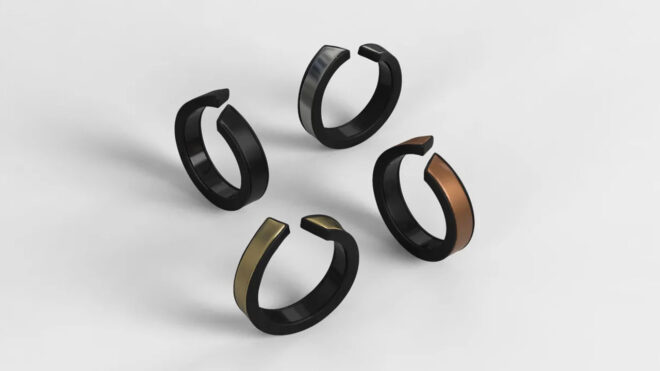
- Movano’s finger ring: For patients who find a wristband too bulky, Movano's "smart, stylish and comfortable" ring is designed to measure heart rate, heart rate variability, sleep, respiration, temperature, blood oxygen, steps and calories—the ring's next stage will include glucose and blood pressure measurements (see the photograph below).
- Ergomotion’s smart bed: A bed that monitors heart rate and breathing, including snoring.
In addition to BBalance, a bath mat that weighs and analyzes you, the company also makes a mirror called Aretmis that can flag a potentially cancerous spot, a thermometer called BCool, and, in partnership with Colgate, a Smart Rhythm toothbrush that tells you whether any of your teeth are missing.
Serval says it is too early to know what the devices might reveal if measurements are consolidated into one large database.
Daniel Kraft, founder of Digital.Health, which helps individuals find which types of home health monitoring to use, says this is where artificial intelligence comes in. Speaking about health and wellness technology on a CES panel, Kraft said: “Nobody wants raw data. We want insight.” When raw health data are properly analyzed, he said, data from different devices could be used to create a kind of overall health score for the body.
Kraft said the new data streams could also play a role in research. “We can all have a role in healthcare by working collectively as a crowd, just as we do when driving with Google Maps or Waze. In healthcare, we can be not just blood donors but data donors too.”
Dr. Ami Bhatt of Harvard Medical School and the American College of Cardiology said the new data could indeed be useful for doctors. “Continuous blood pressure monitoring, if easy, accessible and reliable, will be very important because hypertension continues to be an epidemic in our country—the United States—and worldwide.”
However, overwhelming ourselves with raw data from home monitoring devices may also bring hidden hazards. Too many measurements can cause anxiety. Bhatt cited anxiety-prone patients with a low risk of atrial fibrillation as an example. “I would not want them measuring their heart rates, because worrying will raise their heart rates even more.” Bhatt therefore emphasizes that patients should always consult specialists about what they are monitoring and why. “It is important to discuss it.”
Sources
Was this article helpful?
Your feedback helps us improve our content.




Reader comments
Share your comment
Your name and comment are published only after administrator approval. Your email address is never shown to visitors.
Be the first to comment.