
The Supposedly Undruggable RAS Overcome: A New Era with Daraxonrasib in Pancreatic Cancer

In this article
RASolute 302 Study: Survival Doubled with Daraxonrasib
Study design
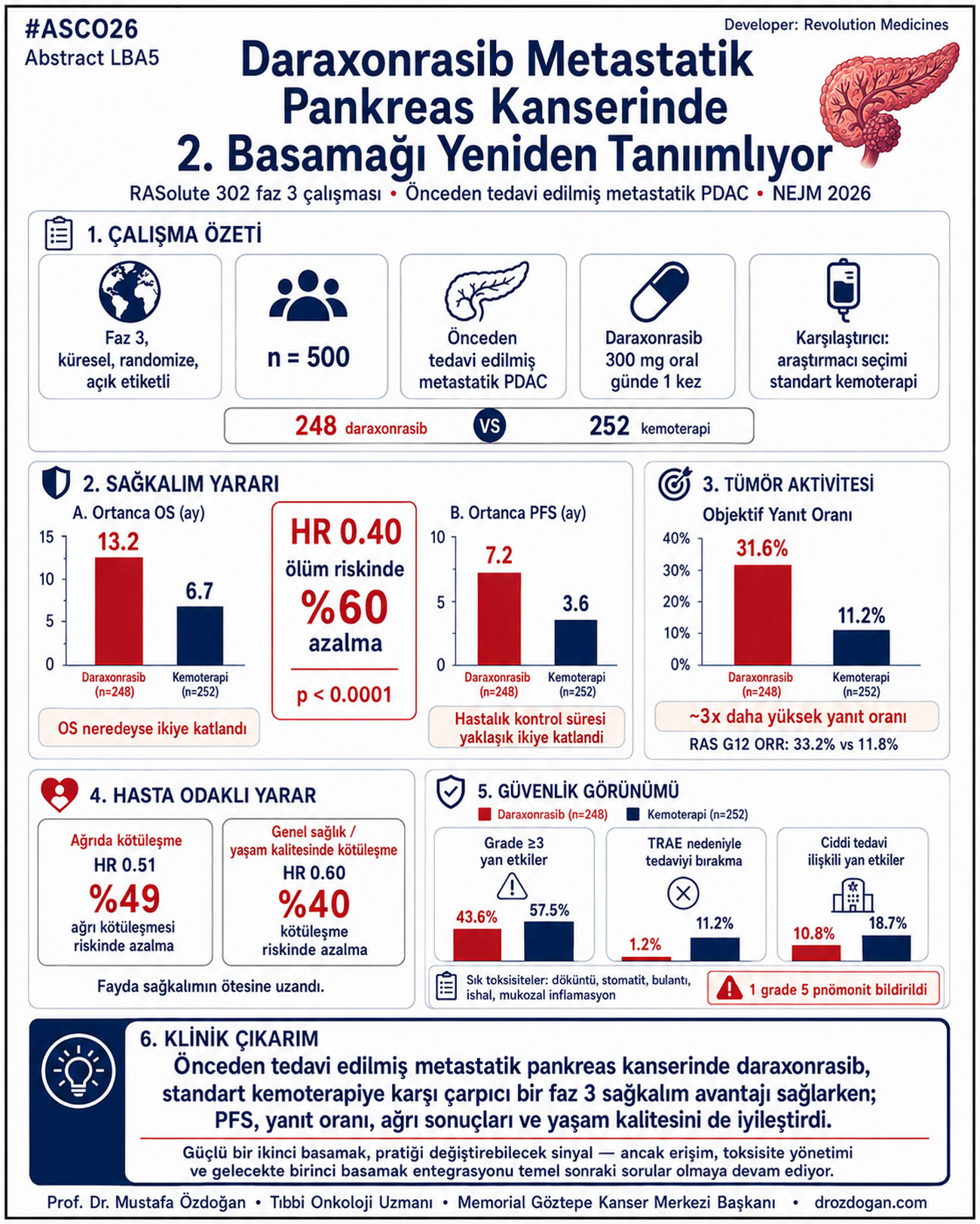
RASolute 302 is a global, open-label, randomized phase 3 study. It enrolled patients with metastatic pancreatic ductal adenocarcinoma who had previously received one line of chemotherapy for metastatic disease. Patients were randomized to daraxonrasib 300 mg orally once daily or investigator-selected standard cytotoxic chemotherapy.
| Aspect | Daraxonrasib arm | Chemotherapy arm | Clinical meaning |
|---|---|---|---|
| Number of patients | 248 patients | 252 patients | Global phase 3 registration study enrolling 500 patients. |
| Treatment | Daraxonrasib 300 mg orally, 1 time daily | Investigator's choice of one of four different standard chemotherapy regimens | An oral targeted therapy was compared with standard second-line chemotherapy. |
| Patient profile | Metastatic PDAC after one previous line of chemotherapy | These results apply directly to the second-line metastatic pancreatic cancer setting. | |
| Primary endpoints | OS and PFS assessed by BICR in the RAS G12 population | Efficacy was primarily tested in patients carrying a RAS G12 mutation. | |
| Secondary endpoints | OS/PFS, ORR, DOR and patient-reported quality of life in the ITT population | Whether the benefit extended to the entire population was assessed. | |
RAS proteins are among the main signaling switches that govern cell growth. In the great majority of pancreatic cancers, the KRAS/RAS pathway is continuously active. Daraxonrasib is a highly selective oral RAS(ON) inhibitor developed to suppress signaling by RAS proteins in their active, or ON, state.
Main efficacy results
The study met all primary and key secondary endpoints. In the ITT population, median overall survival was, with daraxonrasib, 13,2 months, and with chemotherapy, 6,7 months . The reported HR was 0,40 and p<0,0001. The result was equally strong in the RAS G12 population: OS was 13,2 vs 6,6 months, HR 0,40.
PFS also improved significantly. In the ITT population, median PFS was, with daraxonrasib, 7,2 months, and with chemotherapy, 3,6 months . The objective response rate in the entire population was %31,6 vs %11,2; in the RAS G12 population, it was %33,2 vs %11,8 as reported.
| Outcome | Daraxonrasib | Chemotherapy | Clinical interpretation |
|---|---|---|---|
| OS, ITT | 13,2 months | 6,7 months | HR 0,40; %60 relative reduction in the risk of death. |
| OS, RAS G12 | 13,2 months | 6,6 months | Strong and consistent OS benefit also in the primary population. |
| PFS, ITT | 7,2 months | 3,6 months | The risk of disease progression decreased substantially. |
| ORR, ITT | %31,6 | %11,2 | The tumor response rate was approximately 3 times higher. |
| ORR, RAS G12 | %33,2 | %11,8 | Strong response rate in the RAS G12 subgroup. |
| Patient-reported outcomes | Later deterioration | Earlier deterioration | Delay favoring daraxonrasib in pain, global health and quality of life deterioration. |
What did the study show about quality of life and pain?
In metastatic pancreatic cancer, not only survival but also pain and daily functioning are critically important. In RASolute 302, daraxonrasib significantly delayed the time to pain deterioration compared with chemotherapy. The HR for pain was 0,51, and the HR for global health status and quality of life was 0,60 as reported.
Safety
Daraxonrasib showed a generally manageable safety profile, and treatment discontinuation was less frequent than with chemotherapy. Nevertheless, it is not a treatment without side effects. The most frequent problems included rash, stomatitis/oral inflammation, nausea, diarrhea and mucosal inflammation. In the full results reported by Reuters, rash of any grade occurred at a rate of %86,3 as reported.
Skin and mucosal side effects can be common with drugs targeting the RAS/MAPK pathway. Although they are often manageable, early recognition, supportive treatment, dermatology input and dose management are important to maintain treatment.
Enthusiasm and caution coexist
RASolute 302 became one of the most discussed studies at ASCO 2026. Some experts called the data a gamechanger, a grand slam and landscape-changing. The reason for this enthusiasm is clear: second-line median OS exceeding 13 months and a %60 reduction in the risk of death in pancreatic cancer represent an effect of a magnitude not previously seen at the randomized phase 3 level.
Critical comments also matter, however. Some academics pointed out that, before ASCO, the data were first announced in a press release, warning against medicine by press release. The NEJM publication has now largely addressed this concern, but the core debate remains valid: details of toxicity, emerging resistance, real-world feasibility, access, cost and applicability to the first-line setting must be followed carefully.
Critical reading: How should these data be interpreted in a balanced way?
- This is a second-line study: Patients had received one previous line of chemotherapy for metastatic disease. The results should not be directly extrapolated to first-line treatment.
- The drug is not yet approved: Daraxonrasib is investigational. The FDA has permitted an expanded access program, but this does not mean routine approval.
- This is not a cure: Although OS doubled, median survival is 13,2 months. Pancreatic cancer remains a fatal disease, and the development of resistance should be expected.
- Toxicity should not be underestimated: Rash, stomatitis, diarrhea and mucosal inflammation may affect patients' quality of life. Better tolerated than chemotherapy does not mean free of side effects.
- RAS variants and biology matter: Although the benefit appears consistent in the RAS G12 and ITT populations, resistance and response patterns in G12D, G12V, G12R, G13, Q61 or RAS-unidentified groups require more detailed analysis.
- The access debate will begin: Following such strong data, the greatest issues will be approval, pricing, reimbursement and rapid patient access to the drug.
Why is this so important?
In pancreatic cancer, KRAS/RAS was considered undruggable for many years. Daraxonrasib represents a new approach that targets not only a particular KRAS variant but, more broadly, the active RAS(ON) state. RASolute 302 could therefore open a door not only for pancreatic cancer but also for RAS-dependent lung and colorectal cancers.
How should this be explained to a patient?
“This drug targets a growth signal called RAS, which is very often active in pancreatic cancer. In the study, survival was substantially longer than with standard chemotherapy in patients with metastatic pancreatic cancer who had previously received chemotherapy. However, the drug is not yet routinely approved, has side effects and may not be appropriate for every patient. Its clinical role will be determined as the approval and access processes become clearer.”
Drozdogan Academic Commentary
RASolute 302 is a historic study showing that the long-awaited idea of targeting RAS in pancreatic cancer has, for the first time, translated into a very strong survival benefit at the randomized phase 3 level.
OS of 13,2 months versus 6,7 months and a reduction in the risk of death with HR 0,40 represent an effect of a truly practice-changing magnitude for second-line metastatic pancreatic cancer.
However, we should read these data as the opening of a new treatment class for pancreatic cancer rather than as a miracle. The next critical questions will concern first-line use, combination strategies, resistance mechanisms, toxicity management and global access.
Conclusion
RASolute 302 showed that daraxonrasib substantially improved both overall survival and progression-free survival compared with standard chemotherapy in previously treated metastatic pancreatic cancer. In the ITT population, median OS was 13,2 months versus 6,7 months; PFS was 7,2 months versus 3,6 months; and the objective response rate was %31,6 versus %11,2.
These data make daraxonrasib a candidate for a new standard in second-line metastatic PDAC. More broadly, RASolute 302 is among the strongest pieces of evidence that RAS biology, once considered undruggable, can now be targeted clinically.
- Wolpin BM et al. Daraxonrasib or Chemotherapy in Previously Treated Metastatic Pancreatic Cancer. New England Journal of Medicine. 2026.
- ASCO 2026 LBA5. RASolute 302: daraxonrasib vs chemotherapy in previously treated metastatic pancreatic adenocarcinoma.
- Revolution Medicines. ASCO Plenary presentation and NEJM publication of RASolute 302. 31 May 2026.
- Dana-Farber Cancer Institute. RAS(ON) inhibitor doubles median overall survival in phase 3 metastatic pancreatic cancer trial. 31 May 2026.
- Reuters. Revolution's pancreatic cancer drug doubles survival, boosts quality of life. 31 May 2026.
- The Guardian. Daily pill can double survival time for world’s deadliest cancer, trial shows. 31 May 2026.
- The Oncology Shot. RASolute 302 in metastatic pancreatic cancer: a revolution? 4 May 2026.
- ClinicalTrials.gov. RASolute 302 / NCT06625320.
- drozdogan.com. Daraxonrasib Phase 3 Results: Survival Difference in Metastatic Pancreatic Cancer.
- drozdogan.com. FDA Access Authorization for Daraxonrasib: A 40-Year Silence Broken in Pancreatic Cancer.
Was this article helpful?
Your feedback helps us improve our content.


Reader comments
Share your comment
Your name and comment are published only after administrator approval. Your email address is never shown to visitors.
Be the first to comment.