
What Is a Sister Mary Joseph Nodule? Where Does Its Name Come From?

What Is a Sister Mary Joseph Nodule?
A Sister Mary Joseph nodule (RMJN) represents metastasis in the navel region and is a palpable subcutaneous lesion. RMJNs have been described in 1% to 3% of patients with cancers of abdominopelvic (abdominal and groin) origin.
The most common cancers of origin
- In men;
- Stomach (30%)
- Colorectal (25%)
- Pancreatic (18%)
- In women;
- Ovarian / ovary (34%),
- Uterine / endometrial (12%),
- Colorectal (12%)
The tumor's origin is unknown in 14% to 33% of cases with a Sister Mary Joseph nodule.
RMJNs are generally hard and firm and may be white, red or purple. These nodules can become necrotic or ulcerated, causing discharge onto the skin. Although usually painless, they can cause pain if they ulcerate. They generally indicate a high tumor burden in the abdomen and groin and are associated with a poor prognosis (disease course).
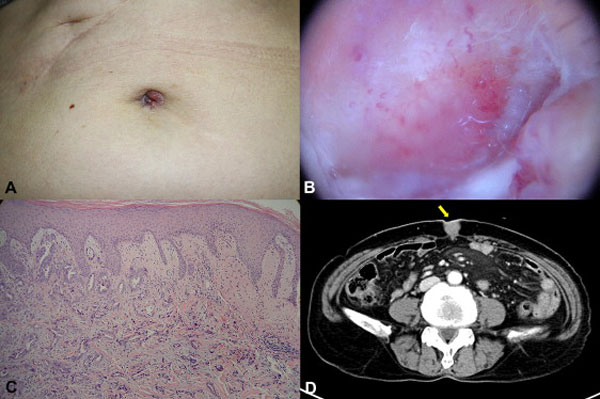
Below are macroscopic, dermatoscopic, histopathological and computed tomography images of a Sister Mary Joseph nodule.
Where Does the Name Sister Mary Joseph Nodule Come From?
Julia Dempsey was born in New York in 1856 and joined the religious community called Our Lady of Lounders in Rochester, Minnesota, in 1878. There she was called Sister Mary Joseph.
Sister Joseph began working at St. Mary’s Hospital in Roochester, Minnesota, in 1889, where she received nursing training. In 1890, she became Dr. William James Mayo's first surgical assistant. She was promoted to nursing superintendent in 1892 and held this position until her death in 1939.
While working as a surgical assistant, Sister Mary Joseph reported umbilical nodules (masses around the navel) in a group of patients with stomach cancer. She also observed that patients with these nodules had advanced cancer and a poor prognosis. Sister Mary Joseph presented her findings to Dr. Mayo, who published the observations in the Mayo Clinic Reports. Dr. Mayo described these umbilical nodules as a "pants-button" umbilicus.
The term "Sister Mary Joseph nodule" emerged after her death. In 1949, the British surgeon Hamilton Bailey used it in his textbook Demonstrations of Physical Signs in Clinical Surgery to describe these nodules.
Sources
Was this article helpful?
Your feedback helps us improve our content.




Reader comments
Share your comment
Your name and comment are published only after administrator approval. Your email address is never shown to visitors.
Be the first to comment.