
Why is the death rate from novel coronavirus disease low in Germany?

At present, one of the most discussed issues worldwide concerning novel coronavirus disease COVID-19 is Germany’s markedly low death rate, even though its population structure is very similar to Italy’s (the current death rate is 0.4% in Germany and 9.2% in Italy). Some experts attribute this to extensive testing in Germany, but it is quite clear that testing alone cannot explain the situation...
Note: the scientific name of the novel coronavirus is SARS-CoV-2, while the disease caused by this virus has been named COVID-19.
As COVID-19 spreads across Europe, Germany’s relatively low death rate is leaving everyone wondering. Some question the methodology behind data collection, while others argue that the country’s high testing rates allow a more accurate assessment of the threat posed by the novel coronavirus.
As the outbreak hits Germany with full force, 24,873 cases had been confirmed by Monday morning, with only 94 deaths reported so far.
Germany currently has the lowest death rate among the 10 countries most severely affected by the COVID-19 pandemic: 0.4%, compared with 9.2% in Italy and 4.9% in the UK.
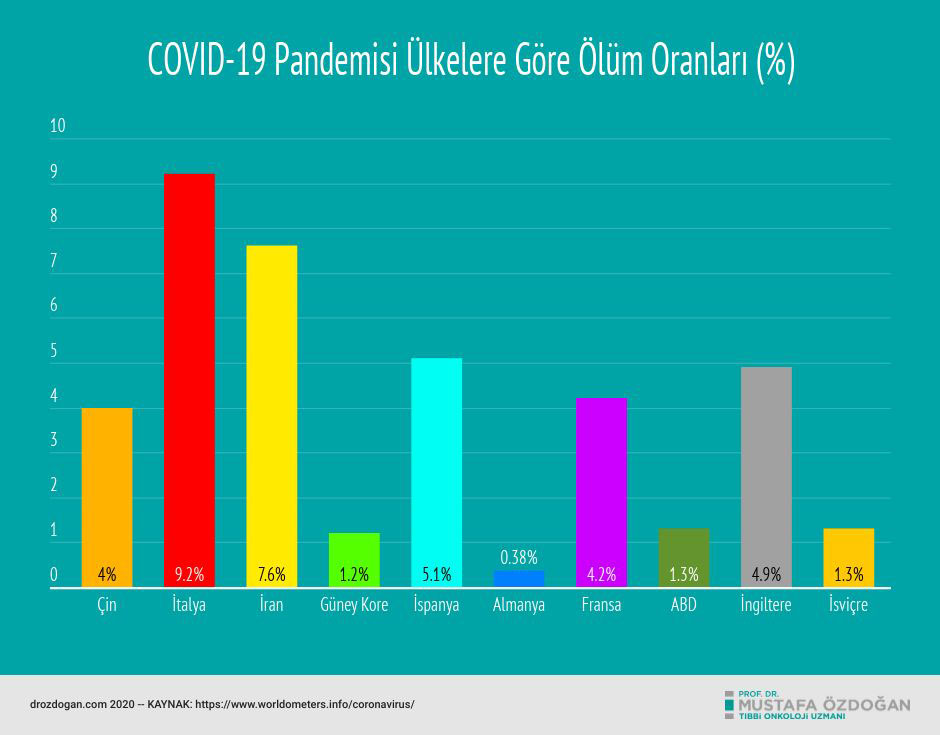
The fact that Italy and Germany are the two European countries with the highest proportion of citizens aged 65 and over makes this difference in death rates even more interesting. If the difference largely persists, it could mean that Germans have a healthier lifestyle than Italians.
What is the reality?
German politicians and senior health officials are reluctant to comment on the low death rate while events are developing so rapidly. Lothar Wieler, head of the Robert Koch Institute (RKI), the government’s central public health organisation, said that he did not expect a significant long-term difference between death rates in Italy and Germany.
Marylyn Addo, who heads the infectiology department at the University Medical Centre Hamburg, commented: "When it comes to saying whether Germany was better prepared medically for the COVID-19 outbreak than other countries, it is still too early", she said.
Offering a possible explanation for the discrepancy in the figures, Addo said: "When hospitals in northern Italy were overwhelmed with new patients, German hospitals had not yet reached full capacity, and we had more time to clear beds, stock equipment and redeploy staff", she explained.
"One advantage Germany had was that, when the first cases were reported, we began professional contact tracing", Addo said. "This gave us some time to prepare our clinic for the approaching storm." The most successful country at contact tracing during the novel coronavirus outbreak is Singapore.
Most importantly, Germany began testing people with relatively early symptoms at an early stage, allowing confirmed cases to be isolated quickly and reducing their likelihood of transmitting the infection to older people.
The videographic below shows how the spread of COVID-19 is affected by avoiding and not avoiding social contact:
160,000 tests are carried out in Germany each week
Germany has been testing its citizens since the early stages of the outbreak, in other words, for more than 1 month. In this respect, Germany may be thought to resemble South Korea and Singapore. The outbreak also spread dramatically in China, but South Korea and Singapore, having carefully analysed the situation in China, had the time and vision to address it. However, contrary to some claims, Germany is not the country performing the most tests per day or the country with the greatest testing capacity! Yesterday, the USA reported 9339 new cases and Italy reported 5560; test positivity is around 10%, meaning that they are performing far more tests.
The age profile of those affected in Germany in the first few weeks was also younger than in other countries. Many were healthy people returning from ski resorts in Austria or Italy, which helps explain the low death rate.
Drosten, who advises the German health ministry, also warned that, as high-risk areas become harder to identify and testing capacity increases, Germany’s death rate will rise in the coming weeks.
"It appears that the virus is becoming more dangerous; current statistics will not hold true in the future. This 0.4% death rate reflects what has already happened: we are missing more and more infections..."
The methodology behind Germany’s data collection process may also account for the discrepancy between the Italian and German figures.
If a patient in Germany tests positive for COVID-19, the doctor informs the local health authority, which then transfers the data digitally to the Robert Koch Institute (RKI). The delay in this process explains why its figures are lower than those from Johns Hopkins University, which updates its daily data tables more frequently. For example, by 10 in the morning on Sunday, the RKI had recorded only 55 deaths in Germany.
Unlike Italy, Germany currently does not routinely conduct widespread post-mortem testing for the novel coronavirus. This means that when someone dies without having been diagnosed before death, testing is not carried out even if COVID-19 is suspected. The Robert Koch Institute says that people who were not tested for COVID-19 during their lifetime but are suspected of having been infected with the novel coronavirus can be tested after death, although in Germany’s decentralised healthcare system this is not yet routine practice, according to the institute.
Conclusion
There appear to be many reasons why Germany’s death rate from COVID-19 is low "for now". Some notable reasons can be listed as follows:
- Starting testing at an early stage and performing more than 15 thousand tests daily
- Taking early measures, particularly in healthcare, after observing the situation in Italy
- Starting professional contact tracing when the first cases were reported, which kept the outbreak relatively less severe
- Using data methodologies that differ from those in Italy and other European countries
- Delayed data transfer because of a decentralised healthcare system
- Missing the COVID-19 diagnosis in some deaths
- The possibility that older Germans have a healthier lifestyle than their Italian peers
Let us recall the prevailing view of German officials on the current situation: "German politicians and senior health officials are reluctant to comment on the low death rate while events are developing so rapidly. Lothar Wieler, head of the Robert Koch Institute (RKI), the government’s central public health organisation, said that he did not expect a significant long-term difference between death rates in Italy and Germany."
Taking these factors into account, we can make both positive and negative predictions for Turkey . It is not difficult to say that we will not be like Italy. The most important factors behind this are:
- Having a prepared healthcare system and being among the world’s most advantaged countries in terms of intensive care bed capacity,
- The median age being 31.5 in Turkey compared with 46.5 in Italy. Looking at the population pyramids, Turkey has 7.2 million people aged over 65, while Italy has 13.9 million.

On the other hand, Turkey could not carry out large numbers of tests in the early stages of the outbreak, and the public’s efforts to avoid social contact were quite weak.
We will see the effects of the outbreak on Turkey and the world much more clearly in the coming weeks. Until then, as a society we should stay at home as much as possible.
Let us end our article with these words from historian Yuval Noah Harari, one of the world’s leading thinkers, known for his books "Sapiens", "Homo Deus" and "21 Lessons for the 21st Century": "After this crisis, the world will never return to the way it was; it will be a different world. It could also be a better world; not everything will be bad. Decisions taken now will have consequences 20-30 years from now."
*
- ALL OUR CORONAVIRUS ARTICLES -
*
Sources
Germany's low coronavirus mortality rate intrigues experts
theguardian.com - 22 March 2020
Was this article helpful?
Your feedback helps us improve our content.


Reader comments
Share your comment
Your name and comment are published only after administrator approval. Your email address is never shown to visitors.
Be the first to comment.