A Gene from a Human Tumour: Cloning the RAS Oncogene, 1982
In this article
A Gene from a Human Tumour: Cloning the RAS Oncogene, 1982
Yesterday, on Day 169, we saw one virus open the door for another. Today we begin where there is no virus at all: in DNA taken from a human bladder tumour. Our chain already holds Rous's chicken sarcoma virus (Day 97), Bishop and Varmus showing that the oncogene is also present in the normal cell (Day 160) and Knudson's two-hit idea (Day 151). In 1982 these three threads met in a human tumour.
A plasma in London, a second virus in Chicago
The story begins with a rat. In London, Jennifer Harvey was passing Moloney's leukaemia virus along; she took the plasma of a leukaemic rat that had been inoculated as a newborn with this virus, filtered it and injected it into newborn BALB/c mice. According to the note in Nature, volume 204, 1964, pp. 1104-1105, only 6 of the 15 mice survived to weaning; by day 32, 5 of them had tumours at or near the injection site, and all had enlarged spleens (from the abstract on the Springer page). This agent is counted as the first of the retroviruses that carry a ras gene; I did not verify that "first" claim in a primary source. Three years later in Chicago, Kirsten and Mayer described a related but separate virus (J Natl Cancer Inst, volume 39, 1967, pp. 311-335). Both viruses had arisen by infecting rats with high doses of murine leukaemia virus. That is where the name comes from: RAS, "rat sarcoma" (according to Robin Weiss's 2020 editorial).
In those years these were laboratory curiosities. As with Rous's virus (Day 97), a virus carrying a cancer gene did not seem relevant to human tumours. In 1976 Bishop and Varmus had shown that the gene did not belong to the virus but was a cell's own gene carried over into it (Day 160). The question was this: could such a gene also be found in a human tumour, without any virus?
Transfection: testing healthy cells with a tumour's DNA
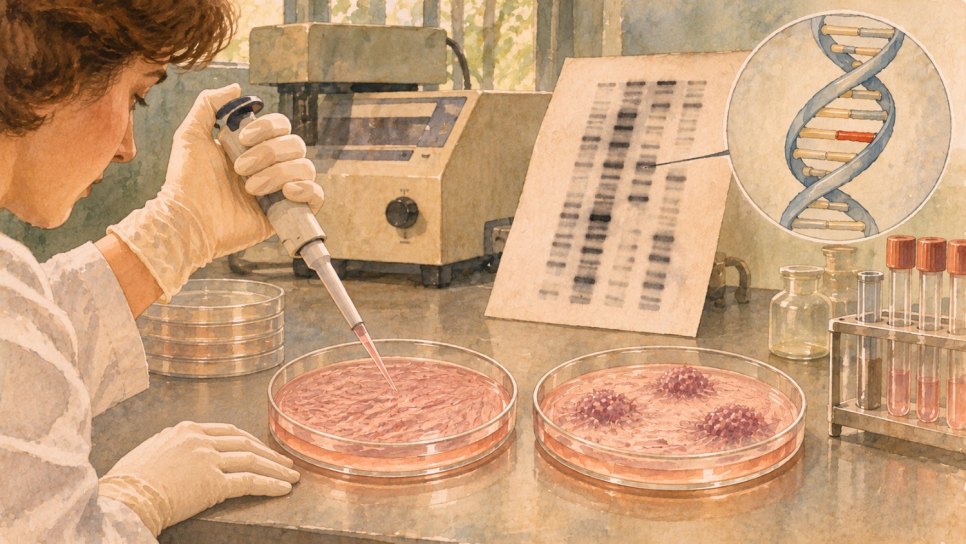
The method rested on a simple idea. DNA is extracted from tumour cells and given with calcium phosphate to mouse fibroblasts that look healthy (NIH 3T3); if the recipient cells multiply without restraint and form clusters called "foci", the DNA contains a transforming gene. In 1979 Weinberg and colleagues applied this in PNAS (volume 76, pp. 5714-5718) to the DNA of 15 chemically transformed mouse and rat cell lines: the DNA of five produced foci, the others did not, and the authors concluded that the appearance acquired by the chemical was encoded in the DNA and behaved dominantly in the recipient cell. In 1981 Krontiris and Cooper reported transforming activity in human tumour DNA by the same approach (PNAS 1981; I took the citation from Weiss's account and did not verify the volume and pages of the primary paper).
So by 1982 the method was ready and the question was clear. Three groups bent over the same kind of cells, bladder carcinoma cell lines.
Spring and summer: the gene is found, the gene is recognised
In order of publication, it ran as follows. From Cold Spring Harbor, Goldfarb, Shimizu, Perucho and Wigler reported that the DNA of T24 bladder carcinoma cells caused morphological transformation in NIH 3T3 cells and that the responsible gene had been cloned by "gene rescue" techniques: the gene was of human origin, smaller than 5 kilobase pairs, and homologous to a polyadenylated RNA of about 1,100 bases found in T24 and HeLa cells (Nature, volume 296, pp. 404-409; received 31 December 1981, published 1 April 1982; I could read only the abstract). In May 1982 Shih and Weinberg wrote that a transforming sequence had been isolated from a human bladder carcinoma cell line (Cell, volume 29, pp. 161-169). In June, Der, Krontiris and Cooper showed that the transforming genes of a human bladder and a human lung carcinoma cell line were homologous to the ras genes of the Harvey and Kirsten sarcoma viruses respectively (PNAS, volume 79, pp. 3637-3640). From Weinberg's group, Parada and colleagues reported that the EJ bladder carcinoma oncogene was the homologue of the Harvey sarcoma virus ras gene (Nature, volume 297, pp. 474-478). On 22 July 1982 Santos, Tronick, Aaronson, Pulciani and Barbacid wrote that the T24 oncogene was an "activated" form of the normal human homologue of the transforming genes of the BALB and Harvey sarcoma viruses, and that activation came through "rather subtle genetic alterations" (Nature, volume 298, pp. 343-347).
What this paragraph says is simple: within a few months of the same year, three separate laboratories took from a human tumour, with no virus involved, the human counterpart of a gene of a rat virus. That fastened what had been an idea in 1976 (Day 160) to a concrete gene in a human tumour.
A single letter
In the same issue of Nature (volume 300), two papers back to back: Tabin, Bradley, Bargmann, Weinberg and colleagues, "Mechanism of activation of a human oncogene" (pp. 143-149; received 13 September, accepted 5 October) and Reddy, Reynolds, Santos and Barbacid, "A point mutation is responsible for the acquisition of transforming properties by the T24 human bladder carcinoma oncogene" (pp. 149-152).
The summary of Tabin and colleagues is this: the oncogene of the EJ bladder carcinoma cell lines had arisen by a change in a cellular proto-oncogene; the genetic lesion was localised; it did not change how much the gene was expressed but changed the structure of the protein the oncogene encodes. Reddy and colleagues reported that activation in T24 cells came from a single point mutation, a guanosine turned into a thymidine, that this put valine in place of glycine at the twelfth amino acid of the p21 protein, and that a single amino acid change was enough to give the protein transforming properties. From Cold Spring Harbor, Taparowsky and colleagues likewise wrote that the H-ras-1 gene cloned from T24 transformed NIH 3T3 cells, that the same gene in normal human DNA did not, and that the difference was a single base change altering one amino acid (Nature, volume 300, pp. 762-765; received 26 October, published 23 December 1982). According to a Nature Milestone page, by the end of the year all three groups had found the same glycine-to-valine change.
Proto-oncogene and point mutation
A proto-oncogene is a gene that has a task in the normal cell and relays growth signals. An oncogene is the same gene in an altered form, out of control. Here the change was that a single letter of the DNA in one copy of the gene turned into another letter; as a result, one amino acid at position 12 of the protein changed. The gene's location, its expression and its amount stayed the same; the structure of the protein changed. So we do not say "a new gene was acquired" but "a normal gene was damaged". In 1983 Santos and colleagues predicted that a G-to-A transition at the same position in the same gene would turn amino acid 12 into aspartic acid, and wrote, on the basis of computer-aided structural analysis, that any substitution at position 12 would have a similar structural consequence (PNAS, volume 80, pp. 4679-4683; as a prediction). Later work, according to Weiss, showed that somatic mutations especially at codons 12 and 61 lock RAS in the active state.
Not one cell line, but a gene family
The first question was whether this was merely an oddity of a bladder cell line that had been grown in laboratories for years. On 9 December 1982 Pulciani, Santos, Lauver, Long, Aaronson and Barbacid reported that transforming genes also exist in unmanipulated solid human tumours: two colon carcinomas, a lung carcinoma, a pancreatic carcinoma and an embryonal rhabdomyosarcoma. The oncogene shared by the lung, pancreatic and rhabdomyosarcoma samples was related to that of the Kirsten sarcoma virus (Nature, volume 300, pp. 539-542). In 1983 Shimizu, Wigler and colleagues reported three separate human transforming genes related to the viral ras oncogenes: the gene in a bladder cell line was the human homologue of v-H-ras, the gene in a colon and two lung cell lines that of v-K-ras, and the third gene, in a neuroblastoma cell line, showed only weak similarity to the two and was named "N-ras" (PNAS, volume 80, pp. 2112-2116). According to Weiss, the transforming gene that Marshall, Hall and Weiss found in 1982 in two human sarcoma lines, with no clear retroviral counterpart, was identified in 1983 by Hall and colleagues as the NRAS gene on chromosome 1.
Cost and limits
This finding has limits. First, the method was artificial: transformation was measured not in a human cell but in a mouse fibroblast line, through the strong and dominant effect of a single gene. This method catches only genes that meet those conditions; that is, it does not see all the genes that explain a tumour. Second, finding an oncogene does not mean a cancer has been explained: over the years it became clear that other damage was needed too, as with Knudson's two-hit idea (Day 151) and p53 (Day 165). Third, the finding did not become a drug for a long time. According to a secondary source, mutations in the RAS pathway are today among the most common oncogenic alterations, and KRAS G12C inhibitors targeting mutant RAS were developed in later years; I will tell that story on the relevant day, with primary sources. Finally, the sharing of credit: the three groups of the period worked almost simultaneously, and Weiss's 2020 editorial does not mention Barbacid's group; but the primary papers in Nature show plainly the group's part in this finding.
What remained
- A normal gene can become an oncogene through a change of a single letter
- Transforming genes can be isolated from human tumours without looking for a virus
- RAS is a gene family: H-, K- and N-
- The same gene recurs in different cancers: bladder, lung, pancreas, colon, sarcoma
What fell or was limited
- The idea that cancer genes are only foreign genes arriving with a virus
- Huebner and Todaro's 1969 hypothesis that most cancers arise from the expression of retroviral genes (according to a Nature Reviews Cancer Milestone page, it did not prove true in its strict form)
- The view that a single oncogene is enough to explain a cancer
Four groups in 1982. The axis shows the month numbers of 1982 (1-12). Blue: exact publication date (Goldfarb 1 April; Santos 22 July; Tabin and Reddy 11 November; Pulciani 9 December; Taparowsky 23 December); amber: only the month is known (Shih and Weinberg, May; Der et al., June; both placed mid-month). The publication date of Parada et al. could not be verified, so it is not in the chart. Each row is a group leader; the names are the first authors of the papers.
The road from the discovery of a gene to the patient
I found no verified Türkiye-specific link for this article, and I do not invent a local one. As a general inference: between the discovery of a gene in 1982 and the moment this knowledge became a patient's decision there were decades; how far that road has been travelled in a given country today depends on access to molecular testing and to targeted drugs. To interpret the situation in Türkiye, one would need to look at national registry and access data.
From 1964 to 1983
What was verified, what stayed uncertain
- Day 158: Köhler and Milstein has not yet been written; the promise in Day 157's "tomorrow" box was not kept.
- DOIs and titles: the titles and DOIs of the Goldfarb (296:404) and Taparowsky (300:762) papers were verified against the publisher and CSHL archive pages; I did not verify the DOIs of the other papers in this session, so I did not list them.
- Citations: the citations and dates of the Nature papers (296:404; 297:474; 298:343; 300:143, 149, 539, 762) come from publisher pages; Harvey 1964 from the Springer page. Only the abstract of the Goldfarb paper was read. The abstracts were mostly read through a summarising tool; I give them as conceptual summaries.
- Parada et al., Nature 297:474-478: no publication date appeared on the page; I inferred the year (1982) from the volume number and left it out of the chart.
- Shih and Weinberg, Cell 29:161-169: the citation and "May 1982" come from a database record and Weiss's reference list; the record did not state the journal name explicitly, and Weiss's list says Cell. I did not verify the DOI.
- Krontiris and Cooper, PNAS 1981: only from Weiss's account; volume and pages not verified.
- T24 and EJ: Santos, Reddy, Goldfarb and Taparowsky speak of "T24", Parada and Tabin of "EJ". I did not verify in this session whether these are the same cell line; the fact that both found a Harvey ras homologue and arrived at the same glycine-to-valine change does not alter the account in this article.
- "Three groups found the same change": from a Nature Milestone page (which gives no citations); read together with the abstracts of the Tabin, Reddy and Taparowsky papers only.
- RAS = rat sarcoma, the 1979 experiments, Marshall, Hall and Weiss 1982, NRAS 1983, codons 12 and 61: only from Weiss's 2020 editorial (a single secondary source). Weiss's text does not mention Barbacid's group; this can be read as an omission, and the primary papers show the contribution.
- Santos et al., PNAS 1983: "G-to-A transition" and "aspartic acid" are a prediction; the abstract was read through a summarising tool.
- KRAS G12C and "among the most common oncogenic alterations": only from a secondary page; to be verified with primary sources on the relevant day.
- The Huebner-Todaro hypothesis: from a Nature Reviews Cancer Milestone page, a single secondary source.
- Prizes and priority: I could not verify any prize dispute over this finding, so I did not write one.
The stomach and a bacterium: Warren, Marshall and Helicobacter pylori, 1982-84
Today we saw the single letter of a gene; tomorrow we meet a bacterium. A pathologist was seeing a curved bacterium in stomach biopsies; a young physician managed to grow it in the laboratory; its relation to stomach ulcer, and later to stomach cancer, was much disputed. Before writing, I will verify the citations and dates of Warren and Marshall's 1983 and 1984 publications, the date of Marshall's experiment of infecting himself, the 2005 Nobel Prize, and when and on what evidence the bacterium's link to cancer was accepted. The prevention of stomach cancer after 2005 has its own place in the plan; tomorrow I will tell the first discovery.
Author's note: I paid attention to two things in this article. First, to show, without entering a priority quarrel, that behind the sentence "a gene was found" stand three separate groups, three separate papers and results published months apart. Second, to say together how much a single changed letter explained and how little it solved on its own.
Sources and Further Reading
- Harvey JJ. An unidentified virus which causes the rapid production of tumours in mice. Nature 1964;204:1104-1105 (Springer page).
- Kirsten WH, Mayer LA. Morphologic responses to a murine erythroblastosis virus. J Natl Cancer Inst 1967;39:311-335 (citation from Weiss's reference list).
- Shih C, Shilo BZ, Goldfarb MP, Dannenberg A, Weinberg RA. Passage of phenotypes of chemically transformed cells via transfection of DNA and chromatin. PNAS 1979;76(11):5714-5718, PMID 230490.
- Goldfarb M, Shimizu K, Perucho M, Wigler M. Isolation and preliminary characterization of a human transforming gene from T24 bladder carcinoma cells. Nature 1982;296:404-409, doi:10.1038/296404a0.
- Shih C, Weinberg RA. Isolation of a transforming sequence from a human bladder carcinoma cell line. Cell 1982;29(1):161-169 (database record and Weiss's reference list).
- Der CJ, Krontiris TG, Cooper GM. Transforming genes of human bladder and lung carcinoma cell lines are homologous to the ras genes of Harvey and Kirsten sarcoma viruses. PNAS 1982;79(11):3637-3640, PMID 6285355.
- Parada LF, Tabin CJ, Shih C, Weinberg RA. Human EJ bladder carcinoma oncogene is homologue of Harvey sarcoma virus ras gene. Nature 1982;297:474-478.
- Santos E, Tronick SR, Aaronson SA, Pulciani S, Barbacid M. T24 human bladder carcinoma oncogene is an activated form of the normal human homologue of BALB- and Harvey-MSV transforming genes. Nature 1982;298:343-347.
- Tabin CJ, Bradley SM, Bargmann CI, Weinberg RA, ... Chang EH. Mechanism of activation of a human oncogene. Nature 1982;300:143-149.
- Reddy EP, Reynolds RK, Santos E, Barbacid M. A point mutation is responsible for the acquisition of transforming properties by the T24 human bladder carcinoma oncogene. Nature 1982;300:149-152.
- Taparowsky E, Suard Y, Fasano O, ... Wigler M. Activation of the T24 bladder carcinoma transforming gene is linked to a single amino acid change. Nature 1982;300:762-765, doi:10.1038/300762a0.
- Pulciani S, Santos E, Lauver AV, Long LK, Aaronson SA, Barbacid M. Oncogenes in solid human tumours. Nature 1982;300:539-542.
- Santos E, Reddy EP, Pulciani S, Feldmann RJ, Barbacid M. Spontaneous activation of a human proto-oncogene. PNAS 1983;80(15):4679-4683; Shimizu K, Goldfarb M, Suard Y, ... Wigler MH. Three human transforming genes are related to the viral ras oncogenes. PNAS 1983;80(8):2112-2116.
- Weiss RA. A perspective on the early days of RAS research. Cancer Metastasis Rev 2020, doi:10.1007/s10555-020-09919-1 (editorial; secondary).
- Mukherjee S. The Emperor of All Maladies: A Biography of Cancer. New York: Scribner; 2010 (general context; the relevant pages were not re-read for this article).
This article is Day 170 of the "365 Days of Cancer History" series and presents the finding of the RAS oncogene in 1982 as a historical reading. It is historical-popular content; it is not a recommendation on diagnosis, treatment or prevention. For questions about genetic testing or cancer risk, consult your physician. The sources have been verified; details that rest on a single secondary source, a summarising tool or an unreadable text are marked in the fact-check notes.
Was this article helpful?
Your feedback helps us improve our content.