A Short Report, a Long Silence: AIDS and Kaposi Sarcoma, 1981
In this article
A Short Report, a Long Silence: AIDS and Kaposi Sarcoma, 1981
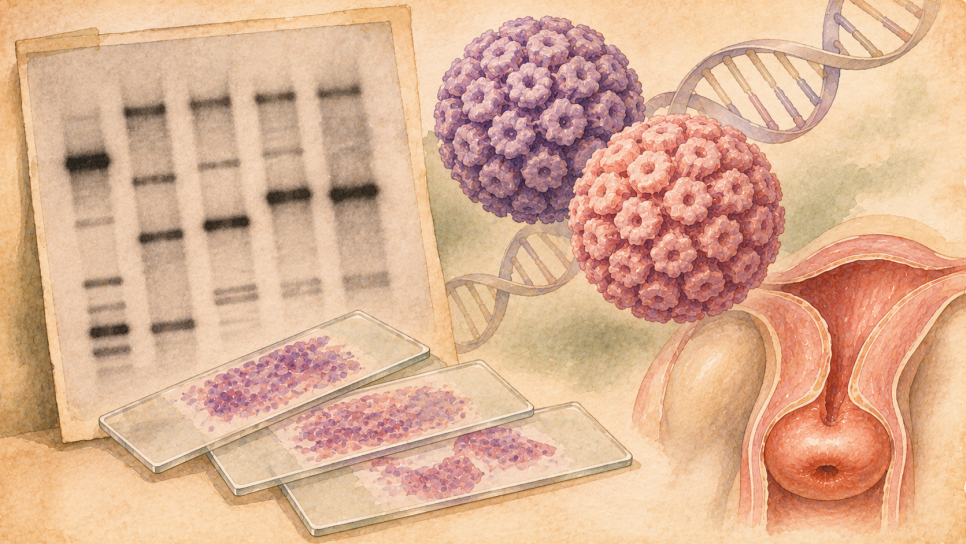
Yesterday, on Day 168, we discussed how much of cancer is attributed to which cause; today we go to a moment when a cause did not yet even have a name. In our virus-cancer chain we have seen Rous (Day 97), Epstein and Barr (Day 140), reverse transcriptase (Day 149), zur Hausen's HPV trail (Day 161) and, two days ago, the hepatitis B vaccine (Day 167). Now a strange link is added to the chain: one virus collapses the immune system, another virus makes the cancer.
A skin disease in Vienna
Kaposi sarcoma is not a disease that appeared in 1981. Its first description on record belongs to the Viennese dermatologist Moritz Kaposi: “Idiopathisches multiples Pigmentsarkom der Haut” (idiopathic multiple pigmented sarcoma of the skin), Archiv für Dermatologie und Syphilis, volume 4, 1872, pp. 265-273. This classic form began as purple-brown patches and nodules on the legs; it was usually seen in elderly men, mostly around the Mediterranean, and spread quietly over years. The Institut Pasteur's disease page also lists a more widespread “endemic” form observed in East Africa around 1950 and a third form in transplant patients taking immunosuppressive drugs (for immunosuppression in transplantation see Day 134).
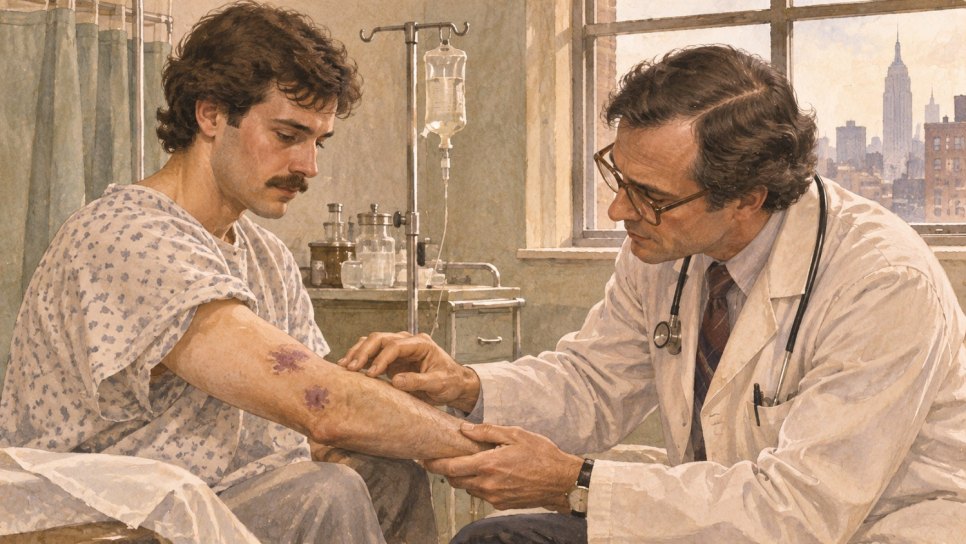
That is why the news of 1981 lay not in the name of the cancer but in the age of the patient, the speed of the disease and what accompanied it: the same disease, this time in young men, with a fast course and severe infections.
Four pages of a weekly bulletin
On 5 June 1981 the weekly bulletin of the US Centers for Disease Control (MMWR) reported five men in Los Angeles who had had Pneumocystis pneumonia; I take this from amfAR's timeline and did not read that text itself. The real turning point is the issue about four weeks later.
Twenty-six men, thirty months
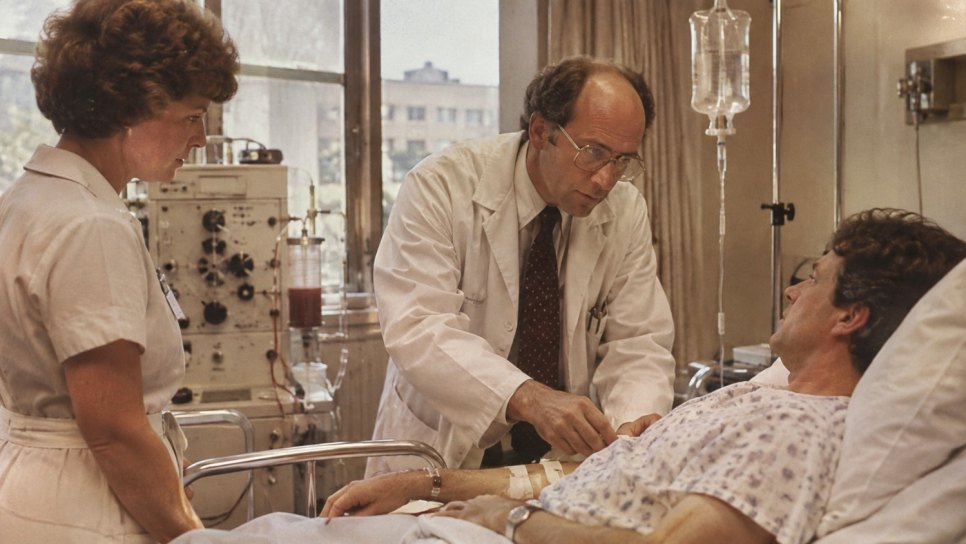
MMWR volume 30, issue 25, pp. 305-308: “Kaposi's Sarcoma and Pneumocystis Pneumonia Among Homosexual Men — New York City and California” (the report's own wording). According to the report, 26 cases of Kaposi sarcoma had been identified in homosexual men over the past thirty months: 20 in New York, 6 in California. Ages ranged from 26 to 51, mean 39; all were confirmed by tissue examination. Eight patients had lost their lives within 24 months of diagnosis. The reporting physicians included A. Friedman-Kien and K. Hymes of New York University. The report also mentions 15 cases of Pneumocystis pneumonia from California since September 1979.
The editorial note says two things. First, the course of this cancer in young men was unusual, and “no previous association between Kaposi's sarcoma and sexual preference had been reported.” Second, weakened immunity and cytomegalovirus (CMV) infection are named as possible contributors, and it was suggested that activation of an oncogenic virus during immune suppression might trigger Kaposi sarcoma. The report ends by urging physicians to be alert to this picture (I read the text through a summarising tool; I give the sentences as a conceptual summary, not verbatim).
The same day the New York Times carried a story under Lawrence K. Altman's byline: “Rare Cancer Seen in 41 Homosexuals”. Noticing that the 41 in the headline does not match the 26 in the MMWR, I reached an inference from a secondary page: the sum of 26 Kaposi and 15 Pneumocystis cases. I could not verify this; the page itself offers it as a guess. According to the same secondary account the story was placed on an inside page and the paper ran only two more such stories that year; Altman is reported to have written in 2001 that doctors, the public, journalists and governments were “shockingly slow” to recognise the emerging epidemic. The cost of the headline and of the silence was to be paid later.
A syndrome: not one disease, but a pattern
A syndrome is the name for findings that occur together even when the cause is unknown. All that existed in 1981 was a pattern: in young men who seemed to have collapsed immunity, a pneumonia and a cancer normally seen only in people with very weak immunity. This can be read as the reverse of the idea of immune surveillance we met on Day 133: if surveillance collapses, a sleeping tumour may wake. But in 1981 this reading was a hypothesis; the evidence was to come in later years.
Writing the definition
The MMWR of 24 September 1982 (volume 31, issue 37, pp. 507-513), titled “Update on Acquired Immune Deficiency Syndrome (AIDS) — United States”, publishes a CDC case definition and name: a disease at least moderately predictive of a defect in cell-mediated immunity, with no known cause for that defect. Between 1 June 1981 and 15 September 1982, 593 cases had been reported and 243 of them (41 per cent) had lost their lives. In roughly 30 per cent of cases there was Kaposi sarcoma alone, in 7 per cent Kaposi sarcoma together with Pneumocystis pneumonia; that is, about 37 per cent involved Kaposi sarcoma. A footnote says the condition had previously been referred to as Kaposi's sarcoma and opportunistic infections in previously healthy persons. I could not verify that this was the first use of the name.
Meanwhile names such as “gay-related immune deficiency” (GRID) and “gay cancer” were circulating in the media and elsewhere. amfAR's timeline notes that these names wrongly implied that homosexuality itself caused the disease. Attaching the disease to one group stigmatised the patients and may also have delayed recognition of cases in other groups; this last point is my own inference.
The first virus: the one that collapses immunity
On 20 May 1983, in Science (volume 220, issue 4599, pp. 868-871), the team at the Institut Pasteur in Paris, which included Françoise Barré-Sinoussi, Jean-Claude Chermann and Luc Montagnier, reported isolating a T-lymphotropic retrovirus from a patient at risk of AIDS. Their summary placed the virus in the HTLV family but clearly distinct from earlier isolates (for the story of reverse transcriptase see Day 149). According to the Karolinska Institutet's page, Robert Gallo's group in the US reported the virus in 1984 under the name HTLV-III; the name was unified as HIV in 1986, and the priority dispute was settled in 1987 with Reagan and Mitterrand stepping in. In 2008 Barré-Sinoussi and Montagnier received the Nobel Prize in Physiology or Medicine for the discovery of HIV; the prize was shared that year with zur Hausen's HPV work (Day 161). Gallo was not among the laureates.
But HIV was not the direct cause of Kaposi sarcoma. The reading adopted later was that HIV, by weakening immunity, let the effect of another virus emerge. Finding that virus took eleven more years.
The second virus: the one that makes the cancer
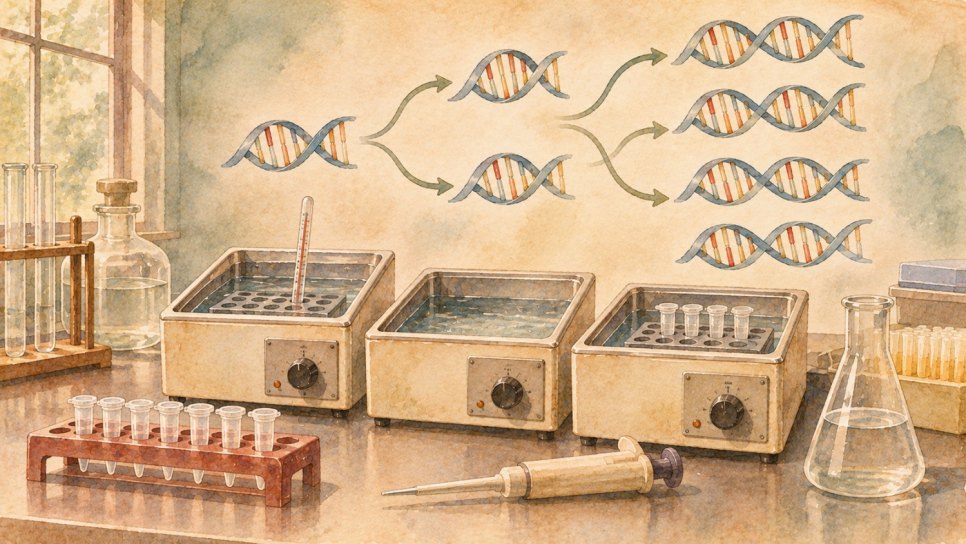
On 16 December 1994, in Science (volume 266, issue 5192, pp. 1865-1869), Yuan Chang, Ethel Cesarman, Melissa Pessin and Patrick Moore with colleagues used a method called representational difference analysis to look for DNA sequences present in AIDS-associated Kaposi sarcoma tissue but not in healthy tissue. According to the abstract (read through a summarising tool), these sequences were present in more than 90 per cent of Kaposi sarcoma tissues from AIDS patients, absent from tissues of non-AIDS patients and found in about 15 per cent of non-Kaposi tissues from AIDS patients. The sequences resembled, but differed from, the capsid and tegument protein genes of the gamma-herpesviruses, that is Epstein-Barr virus and herpesvirus saimiri; the authors proposed that they had found a new human herpesvirus. Today it is called Kaposi sarcoma-associated herpesvirus (KSHV, human herpesvirus 8, that is HHV-8).
According to the Institut Pasteur's disease page, HHV-8 is found in the lesions of all known forms of Kaposi sarcoma, infection precedes disease by months or years, and antibody prevalence in adults tracks the incidence of Kaposi sarcoma across regions; the virus is also linked to primary effusion lymphoma and multicentric Castleman disease. The 1981 report's hypothesis of “activation of an oncogenic virus”, without saying which virus, thirteen years later found an address in general form. This is not a prophecy but a hypothesis meeting evidence; in 1981 the virus had no name.
Cost and limits
The cost of this story has several layers. First, the patients themselves: of the 26 men in the 1981 report, eight lost their lives within two years of diagnosis; of the 593 cases reported by September 1982, 41 per cent. Second, stigma: giving the disease the name of a group distorted the way medicine served that group and others. Third, silence: four pages of a report and an inside page of a newspaper were not proportionate to the size of an epidemic.
There are also limits. Kaposi sarcoma fell markedly after antiretroviral treatment became widespread (the chart below), but the Pasteur page writes that in Central and Southern Africa it remains among the most common cancers and affects both sexes. The numbers in the chart come from a single Swiss cohort; the same fall cannot be expected between countries, in places where access to treatment differs. Nor is this article a treatment recommendation.
What remained
- That a short clinical report can reveal an epidemic from an unusual cluster of a rare cancer
- That the visible “cause” of a cancer may be immune collapse, while its actual trigger may be a virus
- That some human cancers are linked to infections; KSHV was added to this chain
- That antiretroviral treatment measurably lowers the frequency of Kaposi sarcoma
What fell or was limited
- The names “gay cancer” and GRID and the idea that the disease belonged to one group
- The thought that Kaposi sarcoma is a direct product of HIV
- The idea that the 1981 “oncogenic virus” hypothesis, with no name attached, was a sufficient explanation by itself
Kaposi sarcoma in the treatment era. The axis is new Kaposi sarcoma cases per 1,000 person-years (0-40). Blue: incidence by period (from 33.3 to 5.1, then 1.4: about a 96 per cent relative reduction, in absolute terms about 32 cases per 1,000 person-years); amber: in the same cohort, those not using treatment (15.0) and those using it (1.3; adjusted hazard ratio 0.11, that is about an 89 per cent reduction, in absolute terms about 13.7 cases per 1,000 person-years). Single source: Franceschi et al., Br J Cancer 2008; Swiss HIV Cohort Study, 1984-2006, 12,638 people, 73,412 person-years, 597 cases.
When the cause of a cancer is a virus, the question is access
I found no verified Türkiye-specific link for this article, and I do not invent a local one. As a general inference: where a cancer's link to an infection is known, the frequency of that cancer changes with access to testing, treatment and follow-up for the infection. To interpret the distribution of Kaposi sarcoma or HIV-related cancers in Türkiye one has to look at national cancer and HIV registries; the Swiss numbers in this article are not evidence for that.
From 1872 to 2008
What was verified, what stayed uncertain
- Day 158: Köhler and Milstein have not yet been written; the promise in the “tomorrow” box of Day 157 was not kept.
- MMWR 3 July 1981 (30:305-308): the numbers (26, 20/6, ages 26-51, mean 39, eight lost lives, thirty months, 15 Pneumocystis cases), the mention of Friedman-Kien and Hymes and the editorial note were read from the CDC Stacks PDF through a summarising tool; I gave the sentences as a conceptual summary, not verbatim. If needed, return to the primary text.
- Report of 5 June 1981: only from amfAR's timeline (five cases, Los Angeles); I did not read the MMWR text or its citation.
- New York Times, 3 July 1981: author and headline from the Box Turtle Bulletin page (a blog; the spelling “Altman” from the page's citation). “41 = 26 + 15” is the page's own inference; I could not verify it. The “inside page”, the “two more stories” and Altman's 2001 assessment also come only from this single secondary source, as a conceptual summary.
- MMWR 24 September 1982 (31:507-513): 593 cases, 243 (41 per cent), the 30 and 7 per cent shares and the footnote: from the CDC Stacks PDF through a summarising tool. I did not verify that this report was the first use of the name “AIDS”.
- GRID and “gay cancer”: from amfAR's timeline. The year-end US count (159) is from the same page, a single secondary source; I left it out of the text.
- Barré-Sinoussi et al., Science 1983: the citation (220(4599):868-871, PMID 6189183) and abstract from the Pasteur publication record through a summarising tool; the page contained neither “LAV” nor “lymphadenopathy”, and I did not write them.
- Gallo, HTLV-III, 1984, the 1986 naming, the 1987 settlement and the 2008 Nobel Prize: from the Karolinska Institutet's “Discovery of HIV” page; the page leaves the 1984 date and the “same issue” detail unclear, so I did not write a full publication date. The nobelprize.org and NBC pages did not open; zur Hausen's share was not re-verified in this session (covered on Day 161).
- Chang et al., Science 1994: citation and date (266(5192):1865-1869, 16 December 1994, PMID 7997879, DOI 10.1126/science.7997879) from two catalogue records. The abstract's content (more than 90 per cent, absent from non-AIDS tissues, about 15 per cent) is a summarising-tool reading. The author list is incomplete (“...”).
- The forms of KSHV, transmission and the relation of HHV-8 to other diseases: only from the Pasteur disease page (a single secondary source). I did not verify that KSHV is a “necessary cause” nor the IARC classification; I did not write them.
- Franceschi et al., Br J Cancer 2008;99(5):800-804: read from the PMC page through a summarising tool; the rates and the hazard ratio come from there. The 96 and 89 per cent and the absolute differences are my calculation. The Swiss cohort is a single country; the result cannot be generalised.
- Kaposi's 1872 citation: from the historyofmedicine.com record (volume 4, pp. 265-273); the phrase “first description” is that record's characterisation.
A gene from a human tumour: RAS, 1982
Today we saw how one virus awakens a cancer through another; tomorrow there is a place where no virus is involved at all. In 1982 several laboratories showed that DNA from human tumour cells, transferred into healthy cells, could transform them, and that the gene behind this was related to an oncogene previously recognised in rat sarcoma viruses. Before writing I will verify the citations and dates of the publications of the Weinberg, Barbacid and Wigler groups, the link of the RAS gene to the Harvey and Kirsten sarcoma viruses, and what a single point mutation means; and how it fits with the Bishop-Varmus oncogene we told on Day 160.
Author's note: I had two concerns in this article. The first was not to lose sight of what the name given to a disease does to patients: a medical name can become a stigma. The second was to keep it clear that the sentence “a virus caused a cancer” joins the work of two separate viruses: one collapsed the immune system, the other transformed the cell.
Sources and Further Reading
- Kaposi M. Idiopathisches multiples Pigmentsarkom der Haut. Arch Dermatol Syph (Prag) 1872;4:265-273 (historyofmedicine.com record).
- CDC. Kaposi's sarcoma and Pneumocystis pneumonia among homosexual men — New York City and California. MMWR 1981;30(25):305-308 (CDC Stacks PDF; read through a summarising tool).
- CDC. Update on acquired immune deficiency syndrome (AIDS) — United States. MMWR 1982;31(37):507-513 (CDC Stacks PDF; read through a summarising tool).
- Barré-Sinoussi F, Chermann JC, Rey F, ... Montagnier L. Isolation of a T-lymphotropic retrovirus from a patient at risk for acquired immune deficiency syndrome (AIDS). Science 1983;220(4599):868-871, PMID 6189183 (Pasteur publication record).
- Chang Y, Cesarman E, Pessin MS, ... Moore PS. Identification of herpesvirus-like DNA sequences in AIDS-associated Kaposi's sarcoma. Science 1994;266(5192):1865-1869, doi:10.1126/science.7997879 (Weill Cornell record and historyofmedicine.com record).
- Franceschi S, Dal Maso L, Rickenbach M, ... (Swiss HIV Cohort Study). Kaposi sarcoma incidence in the Swiss HIV Cohort Study before and after highly active antiretroviral therapy. Br J Cancer 2008;99(5):800-804, doi:10.1038/sj.bjc.6604520 (PMC page; read through a summarising tool).
- Institut Pasteur. Kaposi's sarcoma, disease fact sheet, pasteur.fr (read; secondary).
- Karolinska Institutet. Discovery of HIV, faceofaids.ki.se (read; secondary).
- amfAR. 1981 timeline, amfar.org; Box Turtle Bulletin. Today in History, 1981: Rare Cancer Seen in 41 Homosexuals (read; secondary, single-source details in the fact-check notes).
- Mukherjee S. The Emperor of All Maladies: A Biography of Cancer. New York: Scribner; 2010 (general context; the relevant pages were not re-read for this article).
This article is Day 169 of the "365 Days of Cancer History" series and presents the story of AIDS and Kaposi sarcoma between 1981 and 2008 as a historical reading. It is historical-popular content; it is not a recommendation on diagnosis, treatment or prevention. For questions about HIV, Kaposi sarcoma or related matters, consult your physician. Sources have been verified; details resting on only a single secondary source, a summarising tool or a text that could not be read are marked in the fact-check notes.
Was this article helpful?
Your feedback helps us improve our content.