Multiplying a Piece of DNA Into the Billions: Mullis, the Cetus Team and the Polymerase Chain Reaction, 1983-1988
In this article
Multiplying a Piece of DNA Into the Billions: Mullis, the Cetus Team and the Polymerase Chain Reaction, 1983-1988
Yesterday (Day 172) we searched for a virus's DNA with a probe, and saw that the numbers were small and that every percentage meant "this probe, this condition". The weak point of that method was clear: the target was a needle in the human genome, and finding it required enough tissue in hand. Today I am writing not about the search but about the method that multiplies what is searched for: the polymerase chain reaction (PCR). As I promised at the end of Day 172, I first tried to separate who said what, when, and with which citation; because in the story of PCR, "a single brilliant idea" and "a method built by a team" are easily mixed together.
The calculation done at the wheel
In his 1993 Nobel lecture, Kary Mullis told how the idea came to him. This is a self-account, given about ten years after the event and together with the prize, and it is a single source; what follows should be read as "according to Mullis". According to the account, on a Friday night he was driving from Berkeley to his cabin in Mendocino. On Highway 128, at mile marker 46.7, he stopped the car and wrote the arithmetic out on paper.
Two primers, two opposite strands
In Mullis's own words, summarised (conceptual summary): he had started from the thought of extending oligonucleotides on a DNA target. Then he realised that two primers bound to opposite strands of the DNA could be cycled again and again. Each round would double the signal; he could also choose the length of the product; and after a few rounds most of the copies would be the same size. Of those around him, the one person he names as sharing his enthusiasm in the early days is Ron Cook, founder of Biosearch, a small company that made oligonucleotides. Henry Erlich's laboratory was next door; Mullis was coming from the problem of detecting point mutations.
In Mullis's account the first attempt came in September: a reaction with human DNA and nerve growth factor primers gave no product. Then he moved to a short fragment of the pBR322 plasmid and gives the first success as "December 16th". The lecture text gives no year; from context I read it as 1983, and I note this below in the fact-check box. Fred Faloona, a technician he had hired at Cetus, helped set up the first successful reaction.
Cycle arithmetic: doubling, in theory and in measurement
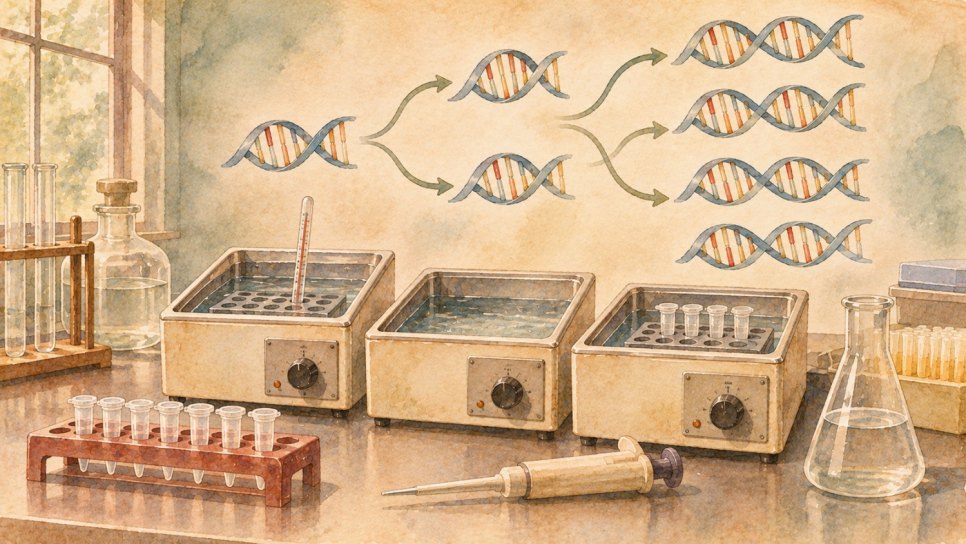
Heating separates the double strand; cooling lets the primers bind to the target; the polymerase enzyme extends a new strand from the end of each primer. At the end of one round the target is two copies. At full efficiency, after n rounds the copy number is 2 to the power n: 1,024 after 10 rounds, 1,048,576 after 20, 1,073,741,824 after 30. A real reaction does not reach this theoretical ceiling. In the first publication, 20 rounds gave a measured increase of about 220,000-fold; this is consistent with an efficiency of about 85 percent per round (1.85 to the power 20). So the measured gain is about one fifth of the theoretical 20-round value; even so, it is enough to make a single target visible among millions of cells.
A paper with seven authors
The first scientific publication of the method belonged not to Mullis but to the Cetus team: the paper by Saiki, Scharf, Faloona, Mullis, Horn, Erlich and Arnheim appeared in the issue of Science dated 20 December 1985 (volume 230, pages 1350-1354). Its title was "Enzymatic amplification of β-globin genomic sequences and restriction site analysis for diagnosis of sickle cell anemia". According to the abstract, two new methods were described: the first, primer-mediated enzymatic copying that amplified β-globin sequences in genomic DNA about 220,000-fold; the second, an oligonucleotide probe distinguishing the βA and βS alleles in the amplified DNA. The genotype could be determined in under one day from less than 1 microgram of DNA. In the body of the paper the reaction is called the "polymerase chain reaction (PCR)"; the term does not appear in the abstract.
The enzyme used in the paper was the Klenow fragment of E. coli DNA polymerase I. Because heat destroyed this enzyme in every round, fresh enzyme had to be added after each denaturation; this was the detail that made the method laborious, and it was also the reason for the next step. Mullis published his own detailed account later, at the 1986 Cold Spring Harbor symposium and in Methods in Enzymology in 1987. According to a secondary source (an article published in National Geographic), Mullis was aggrieved at not being first author on the Science paper, and his detailed text went to Methods in Enzymology after Nature and Science did not take it; I read this from a single secondary source. Mullis's own lecture also says that his first paper was rejected by Science.
According to the same article, Stephen Scharf, Fred Faloona and Randall Saiki were the ones who produced reproducible data, and the company's senior management was at first doubtful. The difference between idea and method appears here: the idea itself, according to Mullis, was a single night's reasoning; turning it into a working diagnostic method was the work of a team, done by trial and error and with publishable data. I do not set the two against each other; both were real.
"Repair replication" in Khorana's laboratory
Throughout the series we have followed the "precursor" motif; for PCR too, a precursor's name circulates. The paper by Kleppe, Ohtsuka, Kleppe, Molineux and Khorana, "Studies on polynucleotides. XCVI. Repair replications of short synthetic DNA's as catalyzed by DNA polymerases", is in volume 56 of the Journal of Molecular Biology, in the issue of 1 March 1971 (pages 341-361). A history-of-medicine bibliography states in one of its records that the process was first described by Kjell Kleppe and H. Gobind Khorana. I could not read the text of the paper; the page has no abstract either. I verified that the citation and title exist; I cannot say how close this work came to the idea of two primers, repeated cycles and exponential amplification.
An enzyme from a heat-loving bacterium
The turning point was the enzyme. The paper by Saiki, Gelfand, Stoffel, Scharf, Higuchi, Horn, Mullis and Erlich, "Primer-directed enzymatic amplification of DNA with a thermostable DNA polymerase", appeared in the issue of Science dated 29 January 1988 (volume 239, pages 487-491; received 9 October 1987, accepted 17 December 1987). The authors replaced the heat-sensitive Klenow fragment with Taq polymerase, obtained from the bacterium Thermus aquaticus. The enzyme could withstand 95 °C for a long time; so it did not need to be added again in each round. When the extension step was carried out at about 70 °C, poorly matched primer-template pairs dissociated and unwanted products decreased; raising the annealing temperature to 55 °C increased specificity further. The paper reports that single-copy genomic sequences were amplified more than 10-million-fold, that fragments up to 2,000 base pairs were obtained, and that a target present once in 100,000 cells could be detected.
Why the prize went to one person
The 1993 Nobel Prize in Chemistry was shared equally: one half to Kary B. Mullis "for his invention of the polymerase chain reaction (PCR) method", the other half to Michael Smith for establishing the foundations of oligonucleotide-based, site-directed mutagenesis and for extending its use in the study of proteins. The word in the citation is "invention", and I read this as a prize given to the originator of the idea. This reading does not erase the share of the team members; I also did not verify in this article, against a source, general rules such as the Nobel Prize being given to at most three people in a field. The most honest answer I have to why one name came to the front is a reading drawn from the citation's wording: the prize commemorates the idea and the invention, while the publication citations distribute the labour of the method among many people.
A tissue section instead of a biopsy
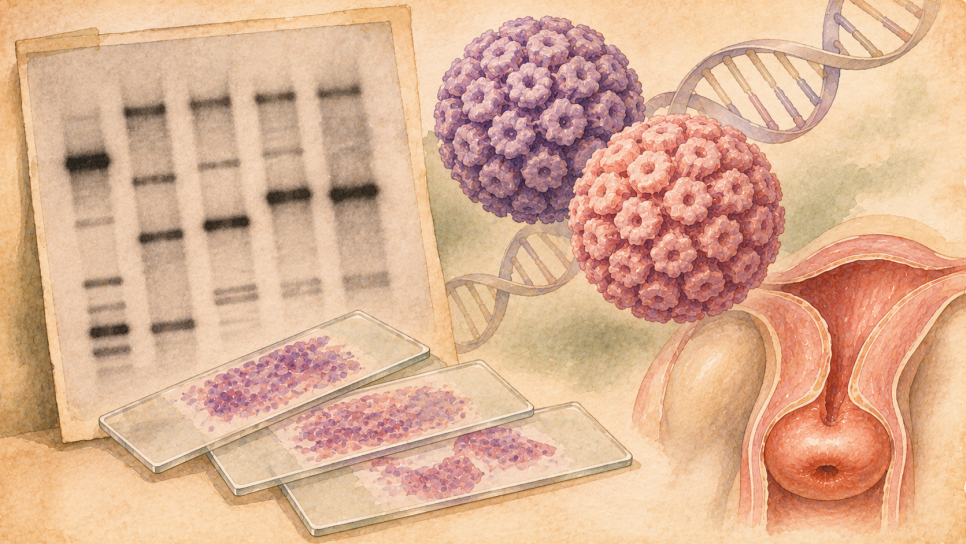
On Day 172 I wrote that in 1983 Dürst took DNA from a cervical cancer biopsy to clone HPV-16. Five years later Shibata, Arnheim and Martin detected HPV by PCR in paraffin-embedded tissue, in the issue of the Journal of Experimental Medicine dated 1 January 1988 (volume 167, issue 1, pages 225-230). According to the abstract, a single tissue section 5-10 micrometres thick could be examined within 24 hours; the method detected HPV 16 and 18, did not cross-react with HPV 6 and 11, and could detect a target as small as "20 viral copies". Norman Arnheim's name is also among the authors of the seven-author paper of 1985; the method's passage from the diagnostic laboratory to virus detection can be traced in these two citations by following the same name.
This is the link I promised on Day 172: PCR changed the input of HPV searching. Where cloning required a biopsy, amplification needed first a section. Methods that catch many types at once with consensus primers came in the following years (a patent record mentions MY09 and MY11 primers directed at the L1 region of HPV); I did not verify these in detail for this article.
Cost and limits
Greater sensitivity cuts both ways. A method that can amplify a single molecule can also amplify a single foreign molecule carried into the laboratory; this is a general warning that follows from the logic of the method and is not a finding based on one of the papers I read for this article. Detecting 20 viral copies does not say what those copies mean clinically: HPV positivity alone is not a diagnosis of cancer. PCR is a measurement method: the meaning of a result depends on which primer, how many rounds and which sample were used. The person to interpret a result is the physician.
Cycle number and copy gain. Bar length is logarithmic; full length corresponds to 2 to the power 30. The blue bars are theoretical values assuming exact doubling in every cycle; the amber bar is the roughly 220,000-fold measured at 20 cycles by Saiki and colleagues in 1985. On a logarithmic scale the gap between theoretical and measured looks small, but in reality it is about five-fold.
"From 61 percent to 99.7 percent": method or reality?
On Day 172 I cited Dürst's 61.1 percent (11/18) in German biopsies, and on Day 161 Walboomers's 99.7 percent of 1999, side by side, and said "I will verify the relationship between methods tomorrow." What I could verify is this. According to a press report, a study directed by Manos and Bosch in 1995, examining cervical tumours from 22 countries (Journal of the National Cancer Institute), found viral evidence in 93 percent of cancers; the report does not name the method used, and I could not verify from the sources I read whether this study used PCR. A 2020 review (Medical Journal of Australia) writes that Walboomers's 99.7 percent was reached with additional methods that found HPV missed by standard assays and by excluding negative specimens with quality problems; in a 2017 Australian study using less intensive methods the figure was 92.9 percent.
I draw this from it: the percentages rising from 1983 to 1999 reflect also the sensitivity of the measurement, the quality of the samples and which samples were counted; 61.1 and 99.7 are not two measurements of the same sample set but studies done in different years and different sets. PCR is part of this story; but I have no source with which to build the sentence "PCR raised the figure to 99.7 percent".
I found no verified local link
I found no verified source on the first use of PCR in Türkiye or on an early HPV-PCR study from Türkiye; so I draw no such link. A general inference: when a test result is read, the question "which method, which threshold, which sample" should be asked. If the same HPV test is done in two laboratories with different primers and different sample types, the method details need to be known before the results can be compared directly.
From 1971 to 1999
What was verified, what stayed uncertain
- Day 158: Köhler and Milstein has not yet been written; the promise in Day 157's "tomorrow" box was not kept.
- Mullis's account: the Friday night, the mile marker, the failed first attempt in September, the "December 16th" success, and the details about Ron Cook and Fred Faloona were read, with a summarising tool, from the text of the Nobel lecture; it is his own account and a single source. The lecture text has no year: that the idea came in 1983 was taken from a secondary source, and the year of "December 16th" was written as 1983 by inference.
- Saiki 1985 and 1988: authors, volume, pages, dates, the Klenow and Taq details and the figures (220,000-fold, 95, 70 and 55 °C, 2,000 base pairs, 10-million-fold) were read, with a summarising tool, from PDFs on a university page. I separately calculated that 1.85 to the power 20 comes to about 220,500.
- Kleppe 1971: the citation from a bibliography site, the title from a database record; the text and abstract were not read. The phrase "first to describe the process" comes from a bibliography note.
- Nobel 1993: the equal sharing and the citations from the Nobel summary page. I did not write the patent numbers; I did not verify them.
- Shibata 1988 and the patent: citation, findings and the mention of MY09/MY11 from a journal site's abstract page and the Google Patents page, with a summarising tool; the patent page marks its priority date as an "assumption", and I did not write the date.
- 93 percent, 22 countries (1995): from a newspaper report; the method and the use of PCR were not verified. 99.7 percent and 92.9 percent: from a review. The question "method or reality" is not resolved in this article.
The discovery of a receptor in breast cancer: HER2, 1984
Today we described multiplying a piece of DNA; tomorrow we enter the story of how a tumour gene later became the target of a drug: HER2. Before writing, I will verify why the same gene is known by different names, the citations and dates of the discovery of 1984, and which laboratories found the same gene by independent routes; I want to write separately about the distance between the discovery and the drug and how many years that distance took.
Author's note: In this article I paid attention to two things. First, separating "idea" from "method": giving Mullis's account as an account and the citations of the Science papers as citations. Second, saying openly that I do not know how much of the rise in a table (from 61 percent to 99.7 percent) came from measurement.
Sources and Further Reading
- Mullis KB. Nobel lecture (Chemistry 1993), nobelprize.org (read with a summarising tool; his own account).
- Nobel Prize Outreach. The Nobel Prize in Chemistry 1993, summary page, nobelprize.org (shares and citations).
- Saiki RK, Scharf S, Faloona F, Mullis KB, Horn GT, Erlich HA, Arnheim N. Enzymatic amplification of β-globin genomic sequences and restriction site analysis for diagnosis of sickle cell anemia. Science 1985;230:1350-1354.
- Saiki RK, Gelfand DH, Stoffel S, Scharf SJ, Higuchi R, Horn GT, Mullis KB, Erlich HA. Primer-directed enzymatic amplification of DNA with a thermostable DNA polymerase. Science 1988;239:487-491.
- Kleppe K, Ohtsuka E, Kleppe R, Molineux I, Khorana HG. Studies on polynucleotides. XCVI. Repair replications of short synthetic DNA's as catalyzed by DNA polymerases. J Mol Biol 1971;56(2):341-361 (citation verified; text not read).
- Shibata DK, Arnheim N, Martin WJ. Detection of human papilloma virus in paraffin-embedded tissue using the polymerase chain reaction. J Exp Med 1988;167(1):225-230 (from the abstract page).
- National Geographic. The eccentric scientist behind the gold-standard Covid-19 PCR test, nationalgeographic.com (journalism; secondary and single source).
- Medical Journal of Australia. Understanding the proportion of cervical cancers attributable to HPV, 2020, mja.com.au (methods notes on Walboomers 1999).
- Google Patents. US5447839, Detection of human papillomavirus by the polymerase chain reaction (Manos et al.; page read with a summarising tool).
- Mukherjee S. The Emperor of All Maladies: A Biography of Cancer. New York: Scribner; 2010 (general context; the relevant pages were not re-read for this article).
This article is Day 173 of the "365 Days of Cancer History" series and presents the history of the polymerase chain reaction as a historical reading. It is historical-popular content; it is not a recommendation on diagnosis, screening, treatment or vaccination. For HPV tests, cervical screening and cancer risk, consult your physician. The sources have been verified; details that rest on a single secondary source, a summarising tool or an unreadable text are marked in the fact-check notes.
Was this article helpful?
Your feedback helps us improve our content.