Calling the Immune Cells: Rosenberg, Interleukin-2 and LAK Cells, 1985
In this article
Calling the Immune Cells: Rosenberg, Interleukin-2 and LAK Cells, 1985
On Day 158 an antibody with a selectable target was born in the laboratory, and on Day 174 a drug built on that idea (trastuzumab) was approved. This article is the other face of the same years: the story of a surgeon who tried to direct the body's own defence cells at cancer instead of sending a molecule to the target. A warning first: the impressive percentage in this article's first report shrank markedly in later years. The lesson of the story lies in that shrinkage.
The fluid that kept T cells alive
According to the NIH's own page, a group led by Robert Gallo kept T cells alive in culture for more than nine months and found a growth factor in the culture fluid: T-cell growth factor, today's interleukin-2 (IL-2). Citation: Morgan, Ruscetti and Gallo, Science 193(4257):1007-1008, 1976. The NIH page says this discovery made it possible to grow and study T cells, which led on to the discovery of HTLV, the first retrovirus found in humans; the page does not draw a link to cancer treatment.
IL-2 was born not as a drug but as a laboratory tool. Its link to cancer was made when someone asked: "could this signal multiply the cells that work against a tumour?"
The first sixty-six patients
According to the profile in NIH Catalyst, Steven Rosenberg returned to the NIH in 1974 as chief of the NCI Surgery Branch; soon after the T-cell growth factor was described, he began to study whether IL-2 could generate cells with anti-cancer activity in the laboratory and in tumour-bearing mice. The same page reports that the first 66 patients with metastatic cancer showed no sign that the treatment worked, and all lost their lives to progressing cancer. In 1984 the 67th patient received a new high-dose IL-2 regimen and the tumour regressed completely; according to the page this response was still continuing in 2018, 33 years later. This is from a single source, and I do not know whether this patient is the one in the 1985 paper below; I do not claim it.
The same page calls IL-2 the FDA's first approval of a cancer immunotherapy. I did not write that "first": I recall earlier examples such as BCG (bladder cancer) and interferon-alpha, though I did not verify them separately for this article. For the story of interferon, see Day 135.
Stimulating cells outside the body, giving them back
Rosenberg et al., N Engl J Med 313(23):1485-1492
The paper's title is "Observations on the systemic administration of autologous lymphokine-activated killer (LAK) cells and recombinant interleukin-2 to patients with metastatic cancer". According to the abstract it was a preliminary report; the approach rested on the same combination having shrunk established lung and liver metastases in mice. Twenty-five patients with metastatic cancer who had not benefited from standard therapy received 1.8 to 18.4 x 10^10 autologous LAK cells, made from lymphocytes collected by repeated leukapheresis, and up to 90 doses of IL-2. Eleven of the 25 patients (44 percent) had objective regression, defined as a reduction of tumour volume of more than 50 percent: a complete response in one patient with metastatic melanoma (lasting up to 10 months), partial responses in nine patients with melanoma, colon or kidney cancer, and a partial response in one patient with an unresectable primary lung adenocarcinoma. The main side effect was "severe fluid retention", and all side effects resolved when IL-2 was stopped. The authors stated that the approach needed further development and longer follow-up before its therapeutic value could be judged.
IL-2, the LAK cell and capillary leak
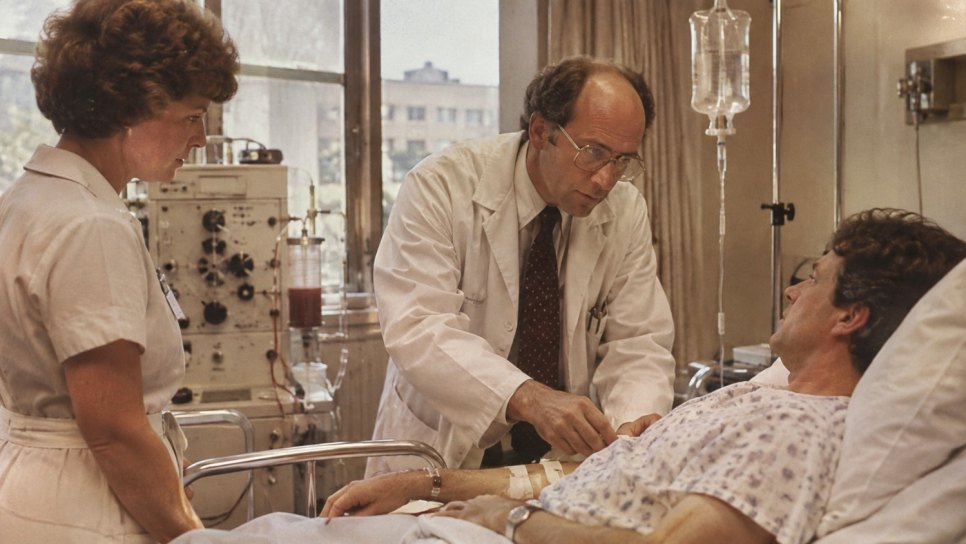
IL-2 is a signalling molecule that multiplies T cells and related cells. LAK cells are lymphocytes collected from the patient's blood, stimulated with IL-2 in the laboratory and given back (autologous: the patient's own cells). The cost of the approach is the leak that the same signal causes in the capillaries: fluid passes out of the vessels, blood pressure falls, and blood flow to organs is reduced. For this reason the treatment is given in hospital under intensive monitoring.
From forty-four percent to fifteen
On 9 April 1987 the same group published a progress report on 157 patients (N Engl J Med 316(15):889-897): 108 patients received LAK cells plus IL-2, 49 received high-dose IL-2 alone. According to the abstract, among 106 evaluable patients in the LAK plus IL-2 group, 8 had a complete, 15 a partial and 10 a minor response; among 46 evaluable patients in the IL-2-alone group, 1 had a complete, 5 a partial and 1 a minor response. If I add complete and partial responses, that comes to about 22 percent (23/106) in the first group and about 13 percent (6/46) in the second; these two percentages are my own calculation. The same abstract reports that seven of the nine complete responses were continuing, and that four patients lost their lives to treatment-related causes.
Whether LAK cells were really necessary was tested in a randomized trial: Law et al., Cancer 1995;76(5):824-832. Seventy-one patients with advanced renal cell carcinoma were assigned to continuous intravenous IL-2 alone (36 patients) or IL-2 plus LAK (35 patients). According to the abstract, four patients (6 percent) had a major response (two complete, two partial); there was no difference in response between the two arms (P=0.61), median survival was 13 months in both, and pulmonary toxicity was more frequent in the LAK arm (P=0.008). The authors wrote that this dose and schedule showed low antitumour activity. This trial used a continuous-infusion schedule; so it can be said not that LAK "did not work", but that it showed no added benefit on this schedule.
Fifteen percent, but lasting for some
The current FDA label for Proleukin (aldesleukin, recombinant IL-2) states that initial US approval was in 1992 and that the drug is used in adults with metastatic renal cell carcinoma and metastatic melanoma. The clinical study data in the label are: in renal cell carcinoma, among 255 patients the objective response was 15 percent (complete 7 percent, partial 8 percent; median response duration 54 months, range 3 to 131+ months); in melanoma, among 270 patients the objective response was 16 percent (complete 6 percent, partial 10 percent; median duration 9 months, range 1 to 122+ months). This melanoma series matches the Journal of Clinical Oncology paper by Atkins et al. (1999;17(7):2105), which analysed 270 patients treated in eight trials between 1985 and 1993; there too the response rate was 16 percent, with a complete response in 17 patients (6 percent).
Let us read the absolute and relative effect together. Fifteen to 16 percent means that about 15 to 16 of every hundred patients have an objective response; that is, about 84 to 85 do not. A complete response occurs in six to seven of every hundred. But in the few who respond, the duration can be long: according to the label, the median response duration in the kidney series is 54 months. Approval for melanoma came in 1998 (NIH Catalyst and two other sources); a trade publication reports that the advisory committee voted unanimously earlier that year on benefit, and 6 to 3 (one abstention) for regular approval.
Price and limits
First, the 44 percent in 1985 was a small, preliminary, selected group of 25; the fall to 15 or 16 percent is not a "failure" but the usual result of moving from a small group to a broad one. Second, few respond and many do not: about 84 of every hundred patients do not respond. Third, the toxicity is severe: severe fluid retention in 1985, four treatment-related losses of life in the 1987 abstract, and in the label's boxed warning capillary leak syndrome, neurological toxicity and serious infections; the label says not to use it in people with significant heart, lung, kidney or liver impairment, and to give it in a hospital with intensive care facilities. Fourth, this intensity limits access: few centres can deliver this treatment. Fifth, the LAK-cell procedure showed no added benefit in the randomized trial; the prominent method of 1985 fell behind, and the drug itself (high-dose IL-2) remained.
The same question, different groups of patients. Bar length shows the objective response rate; the full length is 50 percent. The amber bars are the first two reports from Rosenberg's group (1985: 11/25; 1987: complete plus partial 23/106 in the LAK plus IL-2 arm, 6/46 in the IL-2-alone arm; these two rates are my calculation); the blue bar is the 1995 randomized kidney cancer trial (4/71, continuous-infusion schedule); the green bars are the kidney (255 patients) and melanoma (270 patients) data in the FDA label. Patient groups, response definitions and schedules are not the same; the bars show not one series but how the reported numbers changed.
I found no verified local link
I found no verified source on the use, availability or centres for high-dose IL-2 in Turkey, so I do not build such a link. General inference: because the treatment needs intensive-care support and an experienced team, it is not suitable for every patient or every centre; suitability can be decided only by the physician following the patient.
From 1974 to 1999
What was verified, what remains uncertain
- NEJM 1985: citation and abstract from an institutional record page via a summarizer tool; I read the key points, not the abstract verbatim, and did not read the full text. Numbers, date and publication details (5 December 1985, 313(23):1485-1492) are consistent with the DOI. The "shrinking established metastases in mice" basis is also from this abstract.
- NEJM 1987: from an academic record page, via a summarizer tool; the date 9 April 1987 was inferred from the date string in the DOI. I took "four treatment-related losses of life" from the abstract; details (which patients, which arm) were not read.
- Law et al. 1995: from the abstract on an institutional record page (via a summarizer tool). The abstract describes the study as a randomized phase III trial and does not give the method of randomization. The September 1995 date is from the DOI string.
- Percentage calculations: 11/25, 44 percent (the paper's own figure); 23/106 and 6/46 are my own calculation and exclude minor responses; 4/71 is 5.6 percent, the paper's "6 percent".
- FDA label: the current Proleukin label (a document with 2023 revisions) was read via a summarizer tool. Initial approval year 1992; day and month not verified. Another source page gives 1992 in the header and 1993 in the text; I relied on the label and the NIH page.
- Melanoma approval (1998): given as a year in NIH Catalyst and two other sources; the exact date was not verified. The advisory-committee votes are from a trade publication dated 1 February 1998 (Cancer Network); no exact meeting date.
- Atkins 1999: citation and abstract from a record page; 270 patients, 16 percent objective response, 17 complete (6 percent), 26 partial (10 percent).
- NIH Catalyst profile: Rosenberg's return as chief in 1974, the first 66 patients, the 67th patient and the response continuing in 2018 rest on a single source. I did not write the claim "FDA's first cancer immunotherapy approval"; the BCG and interferon-alpha examples are general knowledge and were not separately verified with a source for this article.
- 1976 discovery: from the NIH Intramural Research Program page; the year in which the name "interleukin-2" was given was not verified, and I did not write it.
- "First" claim: the 1985 paper calls itself a "preliminary report"; I used "first" only for the first publication of this report, and did not examine whether the method preceded other groups' work.
The same year, at another door: Greider, Blackburn and telomerase, 1985
Today we looked at the effort to direct immune cells at cancer; tomorrow, in the same year 1985, we turn to a quite different question: how is an enzyme that protects the ends of chromosomes from shortening related to the unlimited division of cancer cells?
Author's note: Writing this article I watched two things. First, not hiding that the percentage of the first report shrank in later reports; I showed this with numbers in the article. Second, giving the price of the treatment (capillary leak, intensive care, treatment-related loss of life) and the majority who did not respond the same weight as the minority who did.
Sources and Further Reading
- Rosenberg SA, Lotze MT, Muul LM, et al. Observations on the systemic administration of autologous lymphokine-activated killer cells and recombinant interleukin-2 to patients with metastatic cancer. N Engl J Med 1985;313(23):1485-1492 (from the record-page abstract).
- Rosenberg SA, Lotze MT, Muul LM, et al. A progress report on the treatment of 157 patients with advanced cancer using lymphokine-activated killer cells and interleukin-2 or high-dose interleukin-2 alone. N Engl J Med 1987;316(15):889-897 (from the record-page abstract).
- Morgan DA, Ruscetti FW, Gallo R. Selective in vitro growth of T lymphocytes from normal human bone marrows. Science 1976;193(4257):1007-1008; and NIH Intramural Research Program, "Discovery of interleukin-2 (IL-2)", irp.nih.gov.
- Law TM, Motzer RJ, Mazumdar M, et al. Phase III randomized trial of interleukin-2 with or without lymphokine-activated killer cells in the treatment of patients with advanced renal cell carcinoma. Cancer 1995;76(5):824-832 (from the record-page abstract).
- Atkins MB, Lotze MT, Dutcher JP, et al. High-dose recombinant interleukin 2 therapy for patients with metastatic melanoma: analysis of 270 patients treated between 1985 and 1993. J Clin Oncol 1999;17(7):2105 (from the record-page abstract).
- U.S. Food and Drug Administration. Proleukin (aldesleukin) prescribing information, accessdata.fda.gov (initial US approval 1992; boxed warning; clinical study data).
- NIH Catalyst. Steven A. Rosenberg, MD, PhD profile, irp.nih.gov/catalyst (1974, first 66 patients, 1984, approval years; single source).
- Cancer Network. Proleukin wins ODAC support for use in metastatic melanoma, 1 February 1998, cancernetwork.com.
- Mukherjee S. The Emperor of All Maladies: A Biography of Cancer. New York: Scribner; 2010 (general context; relevant pages were not re-read for this article).
This article is Day 175 of the "365 Days of Cancer History" series and presents the history of IL-2 and LAK-cell treatment as a historical reading. It is popular historical content; it is not a recommendation for diagnosis, screening or treatment. Please consult your physician about treatment options. Sources have been verified; details that rest on a single secondary source, on a record read via a summarizer tool or on an unreadable text are marked in the fact-check notes.
Was this article helpful?
Your feedback helps us improve our content.