The Curved Bacterium in a Stomach Biopsy: Warren, Marshall and Helicobacter pylori, 1979-1984
In this article
The Curved Bacterium in a Stomach Biopsy: Warren, Marshall and Helicobacter pylori, 1979-1984
Yesterday (Day 170) we saw a virus-free oncogene reduced to a single letter in DNA taken from a human tumour. Today we add another link to the chain between infection and cancer. Until now this chain has held only viruses: Rous's chicken sarcoma virus (Day 97), zur Hausen's papillomavirus idea (Day 161), Kaposi sarcoma and KSHV (Day 169). Today's story has no virus in it; it has a small bacterium, curled up in a stomach biopsy.
A slide at Royal Perth Hospital
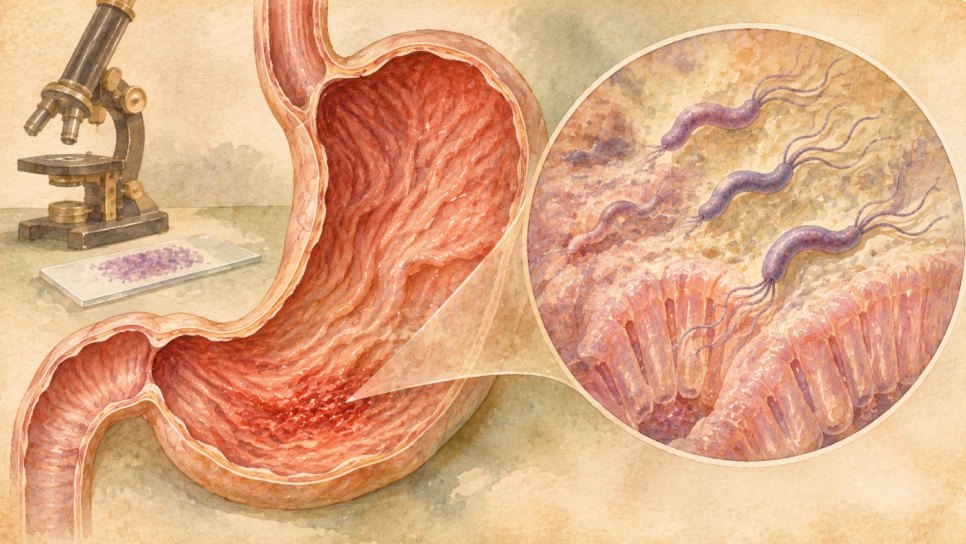
The story begins in a laboratory, under a microscope. J. Robin Warren, a pathologist at Royal Perth Hospital in Perth, signed the report of a gastroscopic biopsy on 12 June 1979; according to a history article on Springer this was the written record in which he first described the bacterium, and it said the bacteria had "the morphology of Campylobacter". This is not a claim of a "first observation": the same article mentions that Bizzozero saw spiral bacteria in the gastric mucosa in 1893, that other observations followed over the next century, and that the Greek physician John Lykoudis used an antibacterial treatment in the 1950s. So the bacterium had not been seen for the first time; what was new was linking it systematically to stomach disease.
In his letter published in the Lancet in 1983, Warren wrote that over three years he had seen small curved and S-shaped bacilli in 135 gastric biopsy specimens, and that about half of the patients undergoing gastroscopy and biopsy showed colonisation of the stomach. The bacilli lay close to the surface epithelium, within and between the gastric pits; they were hard to see on haematoxylin and eosin and stained well with the Warthin-Starry silver method. When he sorted biopsies into no inflammation, chronic gastritis and active chronic gastritis, the curved bacilli were almost always present in active chronic gastritis, often in large numbers, and most consistently in the antrum (the lower part of the stomach).
A trainee in general medicine knocks on the door
In 1981 Barry Marshall was a young registrar who had come to Royal Perth Hospital from general medicine for a gastroenterology rotation; according to the article on Springer, he was directed to Warren, who had been looking for a clinical collaborator. The Nobel Committee's 2005 announcement says the pair studied biopsies from 100 patients together and that the bacterium was discovered in 1982. The first culture, according to the Springer article and a PMC article, came in the microbiology laboratory after a "fortuitously long Easter weekend": one set of plates had been left in the incubator longer than intended, and the bacterium grew. (These sources give neither the year nor the patient number; "1982" is the Nobel Committee's dating.)
This detail matters. Warren's letter too explains the bacterium's absence from two major gastrointestinal microbiology studies by its "unusual atmospheric requirements and slow growth in culture". Isolating the bacterium and growing it in culture turned it from a "curious sight" into a living organism open to scientific study; the Nobel announcement stresses the same point.
Turned away from a meeting in Perth
Marshall and Warren submitted an abstract to the Australian gastroenterology society's meeting due in Perth in May 1983. According to the Springer article the abstract was one of only 12 rejected (56 had been accepted). The Lasker Foundation's account points the same way: reviewers had ranked the abstract among the weakest of that year, and Marshall was not allowed to present a poster either (this second detail from the Lasker page alone). The same year, two separate letters by Warren and Marshall, under the heading "Unidentified curved bacilli on gastric epithelium in active chronic gastritis", appeared in the Lancet, volume 1, pages 1273-1275 (Warren's letter on p. 1273; Marshall's accompanying letter on pp. 1274-1275).
A hundred patients, fifty-eight with bacilli, eleven isolates
In the June 1984 issue of the Lancet (volume 1, issue 8390, pp. 1311-1315) Marshall and Warren published "Unidentified curved bacilli in the stomach of patients with gastritis and peptic ulceration". According to its abstract, biopsies from 100 patients undergoing gastric endoscopy showed spiral or curved bacilli in 58. Eleven cultured isolates were gram-negative, flagellated and microaerophilic and appeared to be a new species related to Campylobacter. The bacteria were present in nearly everyone with active chronic gastritis, duodenal ulcer or gastric ulcer; the authors suggested they "may play an important role" in these diseases (conceptual summary; I read only the abstract).
The difference between co-occurrence and causation
Finding a bacterium in a disease does not show it causes the disease. Robert Koch's well-known criteria (postulates) ask, in brief, that the organism be found in patients, be grown in pure culture, reproduce the disease when given to a healthy host, and be recovered again from that host. The 1984 paper met the first two steps in part: the bacterium had been grown in culture and was common in patients. To say "cause of stomach ulcer and gastritis" the third step was needed: giving the bacterium to a healthy stomach. Marshall took this step by swallowing the bacterium himself.
A Tuesday morning, a broth and two Petri dishes
According to the Lasker Foundation's account, on a Tuesday morning in July 1984 Marshall drank a beef broth containing bacteria scraped from two Petri dishes; he had cleared it neither with his superiors at the hospital nor with his wife. A few days later his wife and mother noticed that his breath smelled foul; he developed bloating and vomited every morning. An endoscopy ten days after he drank the bacteria showed H. pylori in the stomach tissue and signs of infection such as an invasion of white blood cells; no ulcer developed. He seemed to recover on his own, but took a course of antibiotics to clear any remaining infection.
The experiment was published in the Medical Journal of Australia on 1 April 1985 (volume 142, issue 8, pp. 436-439) under the title "Attempt to fulfil Koch's postulates for pyloric Campylobacter". According to the abstract on the publisher's page, a volunteer with histologically normal gastric mucosa was given the bacterium by mouth; a mild illness lasting 14 days developed and histologically proven gastritis was present on the tenth day (the rest of the abstract was cut off on the page). The volunteer is not named on the publisher's page; we know it was Marshall from the Lasker Foundation and the Springer article.
Gastritis, ulcer and then cancer
This article belongs in the series for one reason: the same bacterium was also tied to cancer. That link was not in Marshall and Warren's 1984 paper; it was built later, by other researchers. On 17 October 1991 Parsonnet, Friedman, Vandersteen, Chang, Vogelman, Orentreich and Sibley published in the New England Journal of Medicine (volume 325, pp. 1127-1131) a matched case-control comparison from a cohort of 128,992 people followed since the mid-1960s at a health maintenance organisation: 186 patients with gastric carcinoma were matched with 186 controls; 109 of them had confirmed gastric adenocarcinoma, and among those found to have H. pylori infection the odds ratio for gastric adenocarcinoma was 3.6 (95% confidence interval 1.8-7.3) (from the abstract). This is a relative increase; I draw no absolute-risk figure from the same abstract, because the source I read did not give one.
In 1994 the International Agency for Research on Cancer (IARC), in volume 61 of its Monographs, in its evaluation "Schistosomes, Liver Flukes and Helicobacter pylori", classified H. pylori infection as Group 1, that is, carcinogenic to humans, citing "sufficient evidence" of carcinogenicity in humans. The Nobel Prize in Physiology or Medicine announced on 3 October 2005 was awarded to Marshall and Warren "for their discovery of the bacterium Helicobacter pylori and its role in gastritis and peptic ulcer disease". Cancer is not in the prize citation; the announcement's explanatory text, however, ties the bacterium to stomach cancer through widespread inflammation in the corpus region of the stomach and mentions stomach cancer as the second largest cause of lives lost to cancer worldwide (according to the 2005 announcement).
Cost and limits
Marshall's experiment was an experiment on one person: in a single person, with a single bacterial strain, it produced a mild illness without an ulcer, and this was an indication of only part of Koch's postulates; it does not show that the bacterium is the cause of every ulcer or every cancer. According to the account, the experiment was done without consulting superiors at the hospital or the family; I found no record of an ethics committee approval. It should be read as a risk, not as an example of "courage", and not held up as a model for others. There is a scientific limit too: if the odds ratio in the 1991 study is 3.6, that does not mean most infected people develop cancer; absolute risk cannot be drawn from this abstract, and this article is not a recommendation for testing or treatment. Finally, a note on equity: diagnosis and treatment of an infection depend on access more than on knowledge, and access is not equal between countries (a general observation; I give no country data).
What remained
- A bacterium with a persistent infection can be linked to gastritis, ulcer and (later) stomach cancer
- A chain of evidence in which observation, culture and a controlled experiment complete one another
- Stomach cancer can be studied in part as an infectious disease too
- Growing a bacterium in culture makes it open to scientific study
What fell or was limited
- The impression that the curved bacteria were laboratory contamination or a trivial passenger (I did not verify how widespread this impression was; only the rejection of the abstract in 1983 is documented)
- The idea that this bacterium is the single cause of every chronic gastritis or every stomach cancer
- The idea that one person's observation on himself can stand in for evidence
Marshall and Warren, Lancet, June 1984. Bar length is the number of patients; the top bar (100 patients) shows full length. Of 100 patients undergoing gastric endoscopy, 58 showed curved bacilli and 11 isolates were grown in culture (from the abstract only). The numbers show the first description of a discovery; they do not show that the bacterium causes the disease.
The road from the finding of a bacterium to the patient
I found no verified Türkiye-specific link for this article, and I do not invent a local one. As a general inference: between growing a bacterium in culture in 1984 and its becoming practice in the prevention and treatment of stomach cancer there were decades; how far this road has been travelled in a country today depends on access to diagnosis and treatment. To interpret the situation in Türkiye, one would need to look at national data sources.
From 1979 to 2005
What was verified, what stayed uncertain
- Day 158: Köhler and Milstein has not yet been written; the promise in Day 157's "tomorrow" box was not kept.
- Lancet 1984: the citation (volume 1, issue 8390, pp. 1311-1315, June 1984) and the DOI 10.1016/s0140-6736(84)91816-6 come from the Europe PMC record; 100 patients, 58 bacilli and 11 isolates from the abstract only (read through a summarising tool).
- Lancet 1983: the content of Warren's letter (135 biopsies, three years, colonisation in half) was read from a PDF copy; I note that the PDF gave no journal, date or volume. The citation "volume 1, pp. 1273-1275, 1983" comes from the Springer article and a bibliography record; I did not verify the issue number and the day. I did not verify the title of Marshall's accompanying letter.
- The 12 June 1979 report, Bizzozero 1893, Lykoudis, Marshall's position in 1981, the May 1983 abstract (12 rejected, 56 accepted): all from one secondary source (the history article on Springer, read through a summarising tool). The long Easter weekend appears in this article and in a PMC article (I did not verify its title and author). The year of Easter is not in the sources; only the Nobel Committee dates the discovery to 1982.
- July 1984, the broth, an endoscopy ten days later, no ulcer, antibiotics: only from the Lasker Foundation's account (secondary); the "Tuesday morning" detail and the lack of consultation with his wife come from it too. No exact day is given; other sources may name other days, so I give month and year.
- MJA 1985: the citation (volume 142, issue 8, pp. 436-439, 1 April 1985) and the abstract (an illness of 14 days, gastritis on the tenth day) from the publisher page's truncated abstract. I could not verify the author list on this page; that the volunteer was Marshall we know from two secondary sources (Lasker, Springer).
- Parsonnet 1991: the source did not state explicitly that the measurement was serological, so in the text I said "found to have infection". The authors, citation (volume 325, pp. 1127-1131, 17 October 1991), the cohort of 128,992, 186 cases and 186 controls, 109 adenocarcinomas and the odds ratio 3.6 (1.8-7.3) are from the abstract on a bibliography page; I deliberately left out the higher ratios in subgroups (women, Black participants). Absolute risk cannot be drawn from this source.
- IARC 1994: "Group 1" and "sufficient evidence" from the summary page on INCHEM (volume 61, p. 177); the meeting date is not on the page.
- Nobel 2005: the announcement date (3 October 2005), the citation and the explanatory text from the Nobel site; the text has no 1979, 1981 or self-experiment. The phrase "stomach cancer second in the world" is from the 2005 announcement; I did not verify today's ranking.
- Ethics of Marshall's experiment: "without consulting superiors and family" is from the Lasker account; I looked for and found no formal ethics committee record, so I did not state the absence of approval as fact.
- Counter-readings: that the bacterium is not the cause of every stomach cancer is general knowledge; I gave no figure in this article.
The cause of cervical cancer: zur Hausen, HPV-16 and HPV-18, 1983-84
Today we saw the link between a bacterium and cancer; tomorrow we return to the cause front of cervical cancer, the line I began on Day 161. On that day I told zur Hausen's hypothesis of 1976; tomorrow I will write the moment that hypothesis became evidence in 1983 and 1984: two papillomavirus types cloned from cervical cancer tissue. Before writing, I will verify the citations and dates of the 1983 and 1984 papers, the 2008 Nobel Prize, and how this finding differs from what was told on Day 161. The vaccine has its own place in the plan; tomorrow I will tell only the cause.
Author's note: I paid attention to two things in this article. First, to write down the steps that the "Nobel discovery" story often skips: the earlier observations, the rejected abstract and the limits of an experiment on one person. Second, to separate clearly that the bacterium's link to cancer lies not in these two scientists' 1984 paper but in the epidemiological and evaluation work of later years.
Sources and Further Reading
- Warren JR, Marshall B. Unidentified curved bacilli on gastric epithelium in active chronic gastritis. Lancet 1983;1:1273-1275 (Warren's letter p. 1273; Marshall's accompanying letter pp. 1274-1275).
- Marshall BJ, Warren JR. Unidentified curved bacilli in the stomach of patients with gastritis and peptic ulceration. Lancet 1984;1(8390):1311-1315, doi:10.1016/s0140-6736(84)91816-6, PMID 6145023.
- Marshall BJ et al. Attempt to fulfil Koch's postulates for pyloric Campylobacter. Med J Aust 1985;142(8):436-439, doi:10.5694/j.1326-5377.1985.tb113443.x (author list not verified on this page).
- Parsonnet J, Friedman GD, Vandersteen DP, Chang Y, Vogelman JH, Orentreich N, Sibley RK. Helicobacter pylori infection and the risk of gastric carcinoma. N Engl J Med 1991;325(16):1127-1131.
- IARC. Schistosomes, Liver Flukes and Helicobacter pylori. IARC Monographs on the Evaluation of Carcinogenic Risks to Humans, volume 61. Lyon: IARC; 1994 (summary evaluation: INCHEM, p. 177).
- Nobel Prize Outreach. The Nobel Prize in Physiology or Medicine 2005, press release, 3 October 2005 (nobelprize.org).
- The Lasker Foundation. Gut feeling (the story of Marshall and Warren), laskerfoundation.org (secondary).
- The Rediscovery of H. pylori Bacteria in the Gastric Mucosa by Robin Warren, and Implications of this Finding for Human Biology and Disease. Springer, doi:10.1007/s10620-013-2863-y (history article; secondary).
- Mukherjee S. The Emperor of All Maladies: A Biography of Cancer. New York: Scribner; 2010 (general context; the relevant pages were not re-read for this article).
This article is Day 171 of the "365 Days of Cancer History" series and presents the discovery of Helicobacter pylori as a historical reading. It is historical-popular content; it is not a recommendation on diagnosis, treatment or prevention. For questions about stomach complaints, infection tests or cancer risk, consult your physician. The sources have been verified; details that rest on a single secondary source, a summarising tool or an unreadable text are marked in the fact-check notes.
Was this article helpful?
Your feedback helps us improve our content.