
A New Era in Early Detection of HPV-Related Head and Neck Cancer: HPV-DeepSeek Liquid Biopsy

In this article
Head and neck cancers are aggressive tumors that can progress silently and are often diagnosed late; HPV-associated forms can also affect young adults. Conventional tissue biopsy is invasive, may be inadequate at an early stage, and has high false-negative rates. Minimally invasive, highly sensitive blood-based diagnostic methods are therefore critically important.
Developed jointly by Massachusetts Eye and Ear and the Broad Institute, the liquid biopsy test “HPV-DeepSeek” has produced groundbreaking results using a whole-genome sequencing (WGS)-based approach. The findings were published on May 20, 2025, in Clinical Cancer Research .

Image explanation: Developed for early detection of HPV-related head and neck cancers, this method analyzes circulating tumor DNA (ctDNA) in the blood to detect disease at a very early stage. The process involves the following steps:
- First, a standard blood sample is collected from the patient. Cell-free DNA (cfDNA) is isolated from the sample. Small tumor DNA fragments that may originate from HPV (ctHPVDNA) are then separated from this cfDNA. These fragments are tagged with special adapters to create a “library” suitable for sequencing.
- The prepared DNA library undergoes a specialized stage in which target regions, such as the HPV genome, are selected and enriched. This makes the small amount of HPV-specific genetic material easier to detect. The samples are then sequenced with high sensitivity using whole-genome sequencing (WGS) equipment.
- The sequencing data are evaluated using advanced bioinformatic analyses. These examine the number of HPV genome reads, HPV integration sites, whole-genome coverage, specific variants (SNPs) in viral and human DNA, and DNA fragmentation patterns.
- These data are ultimately used to determine whether a person has HPV-related head and neck cancer. This innovative molecular test offers high accuracy and could be used for early diagnosis and screening, particularly in asymptomatic individuals.
HPV-DeepSeek: Much More Sensitive Than Existing Diagnostic Methods
98.7% Sensitivity and 98.7% Specificity!
“HPV-DeepSeek” is a WGS-based test developed to identify HPV-associated head and neck squamous cell carcinomas (HNSCC) through circulating tumor DNA (ctDNA). It demonstrated significantly greater sensitivity and specificity than existing liquid biopsy tests, used either alone or in combination.
- WGS (Whole Genome Sequencing)is an advanced genomic technology that analyzes all genetic information in the DNA of an organism or tumor cell by reading it at the base level. It can identify genetic changes comprehensively in diseases such as cancer, supporting the development of diagnostic and targeted treatment strategies.
- ddPCR (Droplet Digital PCR)is a molecular testing method that amplifies and quantitatively measures specific DNA or RNA sequences with very high sensitivity. In cancer diagnosis, it offers the ability to detect specific mutations or viral DNA, such as HPV, in blood samples even at low levels.
Results:
-
HPV-DeepSeek:
-
Sensitivity: 98.7%
-
Specificity: 98.7%
-
-
Comparator methods:
-
Single ddPCR: 94.2% sensitivity
-
Multiplex ddPCR: 90.6% sensitivity
-
HPV protein antibodies: 87.4% sensitivity
-
This high performance was maintained even during the asymptomatic phase. HPV-DeepSeek therefore has the potential to detect cancer in people without symptoms.
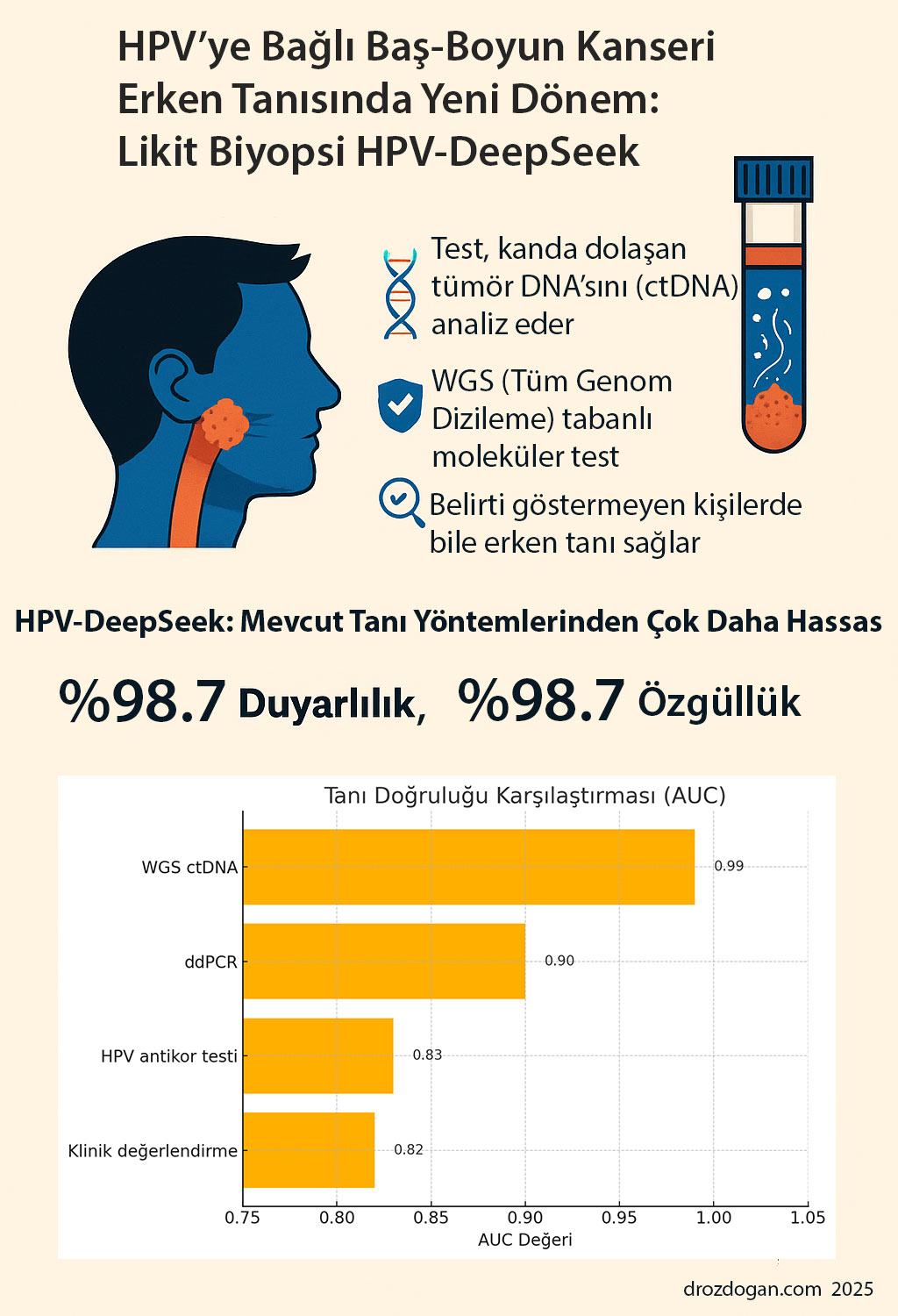
Peak Diagnostic Accuracy: Strong Comparisons Using AUC Values
The WGS ctDNA method is also clearly ahead of its comparators in diagnostic accuracy:
-
WGS HPV-ctDNA: AUC 0.99
-
ddPCR: AUC 0.90
-
HPV antibody tests: AUC 0.83
-
Clinical assessment: AUC 0.82
(P < 0.001 in all comparisons)
This suggests that accurate diagnosis is possible even in early-stage patients.
Screening Modeling: Fewer People Screened, Greater Certainty
The researchers also modeled potential screening in men aged 55-74. In this model, HPV-DeepSeek achieved:
-
Number of people needing screening: 2,903
-
Positive predictive value (PPV): 2.6 (the highest)
In other words, more accurate results could be obtained by screening fewer people than with other methods.
Could Diagnosis Be Possible Up to 10 Years Earlier?
The researchers tested HPV-DeepSeek, in another study, using samples collected 1.3 to 10.8 years before cancer diagnosis: 28 blood samples in total. The results were striking:
-
Signs of HPV-associated oropharyngeal cancer were detected in 22 of 28 cases.
-
100% detection rate 4 years before diagnosis
-
Longest lead time: 7.8 years
-
With a model developed through machine learning, diagnostic success within 10 years: 96% (27/28 cases)
This could open the door to preventive oncology in clinical practice.
MRD Detection with MAESTRO in Non-HPV Head and Neck Cancers
The same research team, in HPV-negative HNSCC patients, developed a new test to identify postoperative measurable residual disease (MRD): MAESTRO. Its study was published at the same time.
MAESTRO Test Features:
-
WGS-based, tumor-informed, mutation-enrichment approach
-
Tested in 24 patients
-
Positive predictive value (PPV): 92.9%
-
Negative predictive value (NPV): 80%
Early MRD detection was directly associated with recurrence and overall survival. The test is expected to guide adjuvant treatment decisions.
Looking Ahead: Personalized Cancer Management
With these liquid biopsy approaches, we can now search for hundreds or even thousands of needles in a haystack, dramatically increasing diagnostic accuracy. This technology will allow us to offer patients earlier, more precise treatments with fewer adverse effects.
Conclusion
WGS-based liquid biopsy technologies promise a revolutionary advance in diagnosing and screening for HPV-associated head and neck cancers. The superior performance of HPV-DeepSeek in particular offers the prospect of screening asymptomatic people and takes personalized oncology a step further. Integrating these tests into clinical practice in the coming years may enable earlier diagnosis, less treatment, and a better quality of life in head and neck cancer.
The Research Team Behind HPV-DeepSeek and MAESTRO: Faden Lab

Faden Labis a translational research laboratory focused on head and neck cancer, based at Massachusetts Eye and Ear, a Harvard Medical School affiliate. Its work centers particularly on early detection, minimal residual disease (MRD) detection, and liquid biopsy-based genomic analyses in HPV-associated head and neck squamous cell carcinomas. Its advanced molecular tools include WGS (whole-genome sequencing), cfDNA analyses, fragmentomic approaches, and integromic approaches.
The laboratory is the research center behind the recently developed HPV-DeepSeek and MAESTRO tests. HPV-DeepSeek uses WGS-based liquid biopsy for early detection of HPV-associated head and neck cancers, while MAESTRO was developed to detect postoperative measurable residual disease (MRD) in HPV-negative tumors. The principal investigator of both studies and director of Faden Lab, a Harvard Medical School faculty member and otolaryngology surgeon at Massachusetts Eye and Ear, is Dr. Daniel L. Faden.
Sources
Was this article helpful?
Your feedback helps us improve our content.




Reader comments
Share your comment
Your name and comment are published only after administrator approval. Your email address is never shown to visitors.
Be the first to comment.