
ASCO 2026: Ivonescimab Reduced the Risk of Progression by %40 in Squamous Lung Cancer

In this article
HARMONi-6: Could Targeting PD-1 + VEGF Become a New Standard in Squamous Lung Cancer?
Why is the study attracting attention?
Anti-VEGF strategies were used more cautiously for many years in squamous NSCLC because of the risk of bleeding. Ivonescimab is a new bispecific antibody targeting PD-1 and VEGF in a single molecule. This approach aims to strengthen the immune response while also modulating the tumor's vascular microenvironment.
A bispecific antibody is an antibody that can bind two different targets simultaneously. Ivonescimab targets both the PD-1 and VEGF pathways. It therefore has a different biological rationale from conventional single-target immunotherapies.
Key data
| Outcome | Ivonescimab + chemotherapy | Tislelizumab + chemotherapy | Clinical interpretation |
|---|---|---|---|
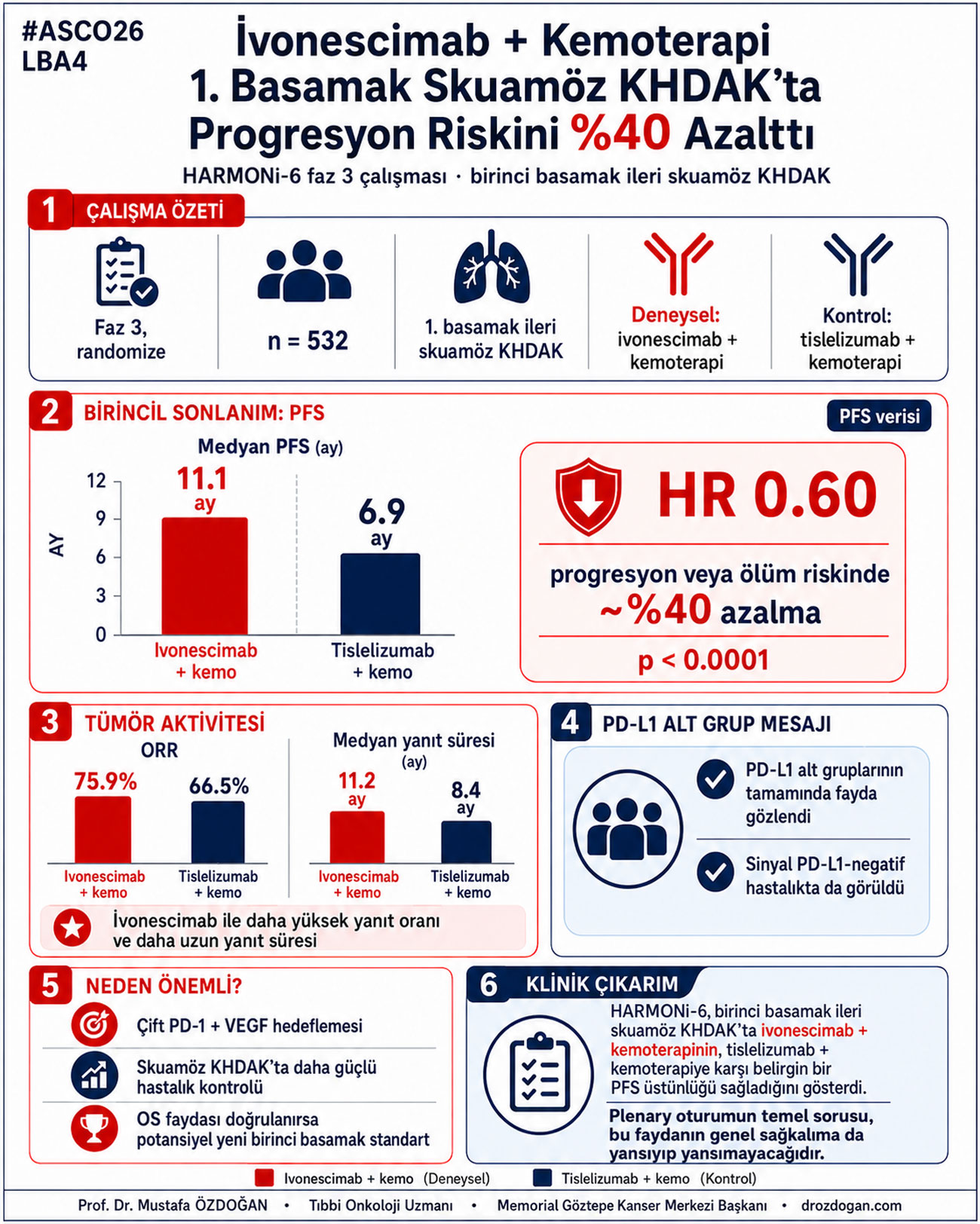
| Median PFS | 11,14 months | 6,90 months | An absolute PFS gain of approximately 4 months. |
| PFS HR | 0,60; P<0,0001 | Approximately %40 reduction in the risk of progression or death. | |
| Objective response rate | %75,9 | %66,5 | The response rate was higher in the ivonescimab arm. |
| Median duration of response | 11,2 months | 8,4 months | Responses lasted longer. |
| PD-L1 subgroups | Benefit was observed regardless of PD-L1 level | There is also a significant PFS signal in PD-L1-negative patients. | |
The central question of the ASCO 2026 Plenary presentation
The PFS benefit appears strong and consistent. However, in an aggressive disease such as squamous NSCLC, the key question that will determine the treatment's true clinical importance is: Does this PFS benefit translate into an overall survival benefit? The presentation of HARMONi-6 OS results in the ASCO 2026 Plenary session is therefore very important.
Points to consider
HARMONi-6 was conducted only in China. Results from international studies such as HARMONi-3 will therefore be important for generalizing the findings to global patient populations. Because of VEGF targeting, bleeding, hypertension, proteinuria and vascular side effects must also be monitored carefully.
Drozdogan Academic Commentary
HARMONi-6 opens an important biological door by combining VEGF targeting, long approached cautiously in squamous lung cancer, with PD-1 blockade in the same molecule.
PFS, response rate and duration of response data strongly favor ivonescimab. However, the study's true practice-changing value will depend on whether the OS data are positive.
If an overall survival benefit becomes clear, ivonescimab + chemotherapy could become a candidate for a new first-line standard redefining the immunotherapy–angiogenesis axis in squamous NSCLC, and could receive FDA approval in the near future.
Conclusion
HARMONi-6 showed that ivonescimab + chemotherapy was superior to tislelizumab + chemotherapy for PFS, response rate and duration of response in first-line advanced squamous NSCLC. The OS data presented in the ASCO 2026 Plenary session will determine whether this advantage truly changes clinical practice. Today's clear message: Ivonescimab brings dual PD-1 + VEGF targeting firmly into focus in squamous lung cancer.
- ASCO 2026 LBA4. HARMONi-6 overall survival results.
- OncLive. Ivonescimab Plus Chemo Might Be a New SOC in Advanced Squamous NSCLC.
- Chen Z et al. HARMONi-6: Ivonescimab plus chemotherapy versus tislelizumab plus chemotherapy in advanced squamous NSCLC. The Lancet. 2025.
- Akeso. HARMONi-6 OS data selected for ASCO 2026 Plenary Session.
- drozdogan.com. Lung Cancer Treatment with Ivonescimab Targeting PD-1 and VEGF Together: HARMONi-6.
Was this article helpful?
Your feedback helps us improve our content.


Reader comments
Share your comment
Your name and comment are published only after administrator approval. Your email address is never shown to visitors.
Be the first to comment.