
Central Nervous System Germinoma

Central nervous system germinomas are germ cell tumors occurring predominantly in pediatric (childhood) patients. These are the most common pineal region tumors and occur more often in males than females.
What are the other names for this disease?
- CNS Germinoma
- Germinoma of the central nervous system
- Intracranial germinoma
What is Central Nervous System Germinoma?
- Central Nervous System Germinomas are germ cell tumors occurring predominantly in pediatric patients. This is the most common type of pineal region tumor and occurs more often in males than females.
- It accounts for % 3 of pediatric brain tumors.
- Approximately % 80-90 of Central Nervous System Germinomas occur in the pineal gland (in the pituitary gland in the brain). Central Nervous System
- Germinoma may also occur as suprasellar masses, but these are less frequent.
- CNS Germinoma symptoms depend on the tumor site and may include headache, vision problems (inability to move the eyes up / down), hydrocephalus (fluid buildup in the brain) and diabetes insipidus (excessive water drinking).
- The tumor is usually treated with radiation and / or chemotherapy. The prognosis (disease course) of Central Nervous System Germinoma is good, with % 90 surviving for 5 years or longer.
- Germinoma cells can directly infiltrate adjacent tissue or spread through the cerebrospinal fluid (CSF) in the brain's ventricles.
Age and sex distribution for Central Nervous System Germinoma)
- Central Nervous System Germinoma is a rare disease. In most cases, symptoms appear in late childhood; approximately % 90 are under 20 years of age.
- Both males and females may be affected. However, the most common type (pineal region germinoma) occurs more often in males than females (at a ratio of approximately 5:1).
- Individuals of all racial and ethnic groups worldwide may be affected.
What are the risk factors and causes of Central Nervous System Germinoma? (Preventive Factors)
- Currently, no clear risk factor (cause) has been identified for Central Nervous System Germinoma.
- Having a particular risk factor for a disease does not necessarily mean that the disease will develop. A risk factor increases the chance of developing the condition compared with an individual without that risk factor. Some risk factors are more important than others.
- The exact underlying cause of Central Nervous System Germinoma is currently unknown.
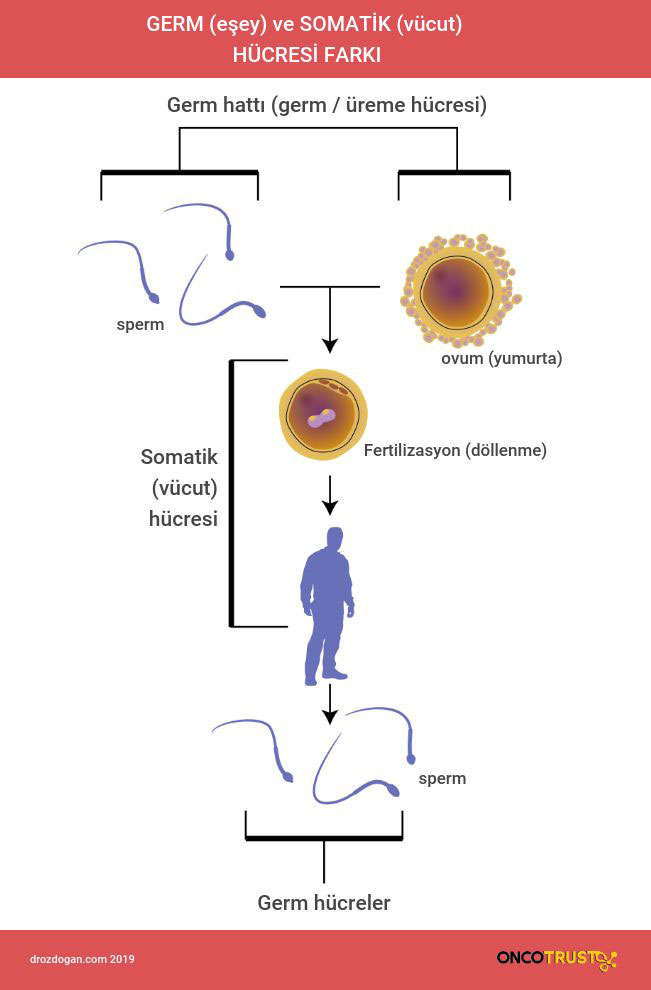
- These tumors are believed to arise from migration of germ cells or transformation of existing germ cells.
Note: A germ cell is any biological cell that enables a sexually reproducing organism to produce gametes (for example, sperm and eggs).
What are the signs and symptoms of Central Nervous System Germinoma?
The signs and symptoms of Central Nervous System Germinoma depend on the tumor site and may vary among affected individuals. Signs and symptoms may include:
Hydrocephalus (fluid buildup in the brain cavities), causing:
- Lethargy, sleepiness
- Irritability, headache
- Blurred vision, swollen optic nerve, "sunsetting" of the eyes
- Vomiting and nausea
- Unsteady gait, loss of balance
- Dementia, memory loss, cognitive and coordination problems, speech impairment
- Seizures
- Urinary incontinence
- Vision problems (inability to move the eyes up / down)
Diabetes insipidus leads to:
- Dry mouth
- Loss of skin pressure (turgor pressure)
- Sunken eyes
- Frequent urination
- Loss of energy and fatigue
- Mood changes
- Muscle cramps and pain
- Loss of appetite
- Decreased body weight
- Tachycardia: Increased heart rate in response to reduced blood pressure due to fluid loss
How is Central Nervous System Germinoma diagnosed?
Central Nervous System Germinoma is diagnosed based on the following information:
- Complete physical examination
- Comprehensive assessment of medical history
- Evaluation of signs and symptoms
- Laboratory tests
- Imaging studies
- Biopsy studies if necessary
Germ cell tumors may secrete measurable oncoproteins such as β human chorionic gonadotropin (Beta-HCG) and α-fetoprotein (AFP) into serum or CSF. Pure germinomas, by definition, secrete only HCG. Serum and CSF α-fetoprotein levels are normal.
Germinomas are potentially malignant in biological behavior, both infiltrating normal brain tissue and spreading throughout the central nervous system. Therefore, every patient should undergo standard staging procedures, including brain and spinal magnetic resonance imaging, access between the lumbar vertebrae and analysis of CSF fluid for cytology and tumor markers .
Standard staging criteria;
- M0: used when there is no evidence of metastatic disease
- M1: describes positive cytology in CSF fluid only
- M2: indicates intracranial metastases, and
- M3: indicates the presence of spinal/spinal cord metastases.
What are the possible complications of Central Nervous System Germinoma?
- Hypernatremia or increased blood sodium due to urinary fluid loss
- Fainting episodes due to severe dehydration (fluid loss)
- Early puberty
- Delayed puberty
- Mood changes leading to behavioral changes
- Spinal cord paralysis resulting from spinal cord metastasis of the tumor
- Metastasis due to displacement of tumor tissue during surgery
How is Central Nervous System Germinoma treated?
Treatment for Central Nervous System Germinoma may include:
- Radiation therapy:
Radiotherapy, is used only at relatively high doses and volumes and generally offers a curative treatment (complete cure) option for most patients. However, late adverse effects of treatment have motivated clinical study groups to investigate the efficacy and safety of combining chemotherapy with low-volume, low-dose radiotherapy. Consequently, validating this combined treatment approach is the main aim of most clinical studies. - Chemotherapy:
For CNS germinomas, Children’s Oncology Groupcurrently recommends in its protocol four cycles of chemotherapy with carboplatin and etoposide, followed by lower-dose whole-ventricular radiotherapy to the primary tumor. However, the BEP protocol also appears to be an appropriate option for germ cell tumors. - Surgery:
It may be considered for reducing intracranial pressure and obtaining a biopsy. Because this is a hypervascular (highly vascular) tumor and because of its anatomical location, complete surgical removal is often not possible, and surgery is not one of the standard main treatments for central nervous system germinoma.
Sources
dovemed.com/diseases-conditions/central-nervous-system-germinoma/ (Erişim tarihi: 08.08.2019)
2. Diana S Osorio & Jeffrey C Allen.
Management of CNS germinoma.
CNS Oncol. July 2015.
Was this article helpful?
Your feedback helps us improve our content.




Reader comments
Share your comment
Your name and comment are published only after administrator approval. Your email address is never shown to visitors.
Be the first to comment.