
Do probiotics help with weight loss and burning abdominal fat?

Probiotics are living, health-promoting microorganisms. They occur naturally in fermented products and can also be taken as supplements. Scientific studies suggest that probiotics have positive effects on digestive health, heart health, and immune function. It is also thought that gut bacteria play an active role in regulating body weight and, as a result, may help with weight loss and burning belly fat.
The digestive system contains hundreds of different microorganisms. Most of these bacteria are friendly bacteria. They play a role in producing many important nutrients, including vitamin K and some B vitamins. They also help break down fiber the body cannot digest, converting it into beneficial short-chain fatty acids such as butyrate.
Does the balance of bacteria in our gut determine our weight?
Bacteroidetes and Firmicutes are the main bacterial families in the gut. Body weight is thought to be associated with the balance of these two bacterial families. Many scientific studies in both humans and animals suggest that people of normal weight have different gut bacteria from people who are overweight or obese.
The common conclusion of these studies is that:
- Obese individuals, compared with people of normal weight, have more “firmicutes” and fewer “bacteroidetes” bacteria.

How do probiotics affect changes in weight?
Some probiotics are thought to reduce the absorption of dietary fat and increase the amount of fat excreted in stool. In other words, it is thought that fewer calories will be obtained from the foods consumed in the diet. For example, certain bacterial strains from the Lactobasillus family are said to be able to produce this effect.
In 2014, The British Journal of Nutrition published a randomized controlled study conducted over 24 weeks with 125 participants. The participants were divided into two groups. One group was the control group, while the other took 2 capsules a day of the Lactobacillus strain Lactobacillus rhamnosus.
The study concluded that:
- Women who took 2 tablets of the Lactobacillus rhamnosus strain daily lost 50% more weight than the control group.
In 2013, Journal of Functional Foods published a study conducted with 28 overweight participants. Participants were placed in 3 different groups. The control group consumed plain yogurt, participants in the 2nd group consumed yogurt containing the Lactobacillus amylovorus strain, and the 3rd group consumed yogurt containing the Lactobacillus fermentum strain.
At the end of 6 weeks:
- A 3-4% decrease in body fat was observed in participants who consumed yogurt containing Lactobacillus fermentum or Lactobacillus amylovorus.
As a result of the studies conducted, the Lactobacillus gasseri strain is considered the most promising for weight loss. In 2013, The British Journal of Nutrition published a study conducted with 210 participants who had abdominal fat. Participants were randomly divided into groups. The probiotic group consumed fermented milk containing the Lactobacillus gasseri strain, while the control group consumed plain fermented milk.
After 12 weeks of the study:
- Abdominal fat in the group that drank probiotic milk decreased by 8.5%, while no change was found in the control group. However, after the study, when participants stopped taking probiotics, they were observed to regain the fat they had lost within one month.
The most effective way to combat obesity is not to lose weight, but to prevent weight gain in the first place
We have examined studies suggesting that probiotic use supports weight loss. Now let us look together at the effect of probiotic use on preventing weight gain.
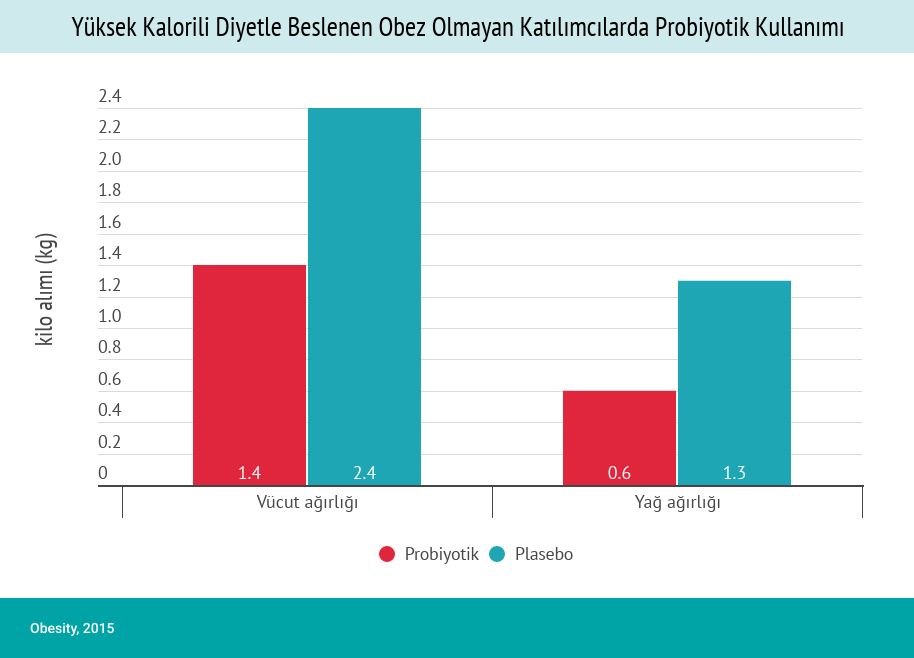
In 2015, Obesity published a study conducted with 30 people who were not obese. The study aimed to evaluate the relationship between probiotic use and weight gain, fat mass, and insulin sensitivity. Participants were divided into a control group and a group taking the VSL#3 probiotic.
Participants followed a 2-week diet that was high in calories and contained 55% carbohydrates, 30% fat, and 15% protein. The saturated fat content of the diet was approximately 8% of total energy intake.
After 4 weeks of the study:
- Less weight and fat mass gain was observed in the group taking the VSL#3 probiotic than in the control group. However, probiotic use was found to have no effect on insulin sensitivity.
Note: VSL#3 is a probiotic supplement containing 4 strains of Lactobacillus (Lactobacillus casei, Lactobacillus plantarum, Lactobacillus acidophillus, Lactobacillus delbrueckii subsp.bulgaricus), three strains of Bifidobacterium (Bifidobacterium longum, Bifidobacterium breve, Bifidobacterium infantis), and Streptococcus salivarius subsp. thermophilus.
How do probiotics act on obesity?
Probiotics also exert their effects on obesity through different pathways. Let us examine these effects together:
- Release of GLP-1: Probiotics may help release GLP-1, the satiety hormone (appetite-reducing hormone). Increased levels of this hormone may help reduce calorie intake and contribute to increased fat burning.
- Increase in ANGPTL4: Probiotics may increase ANGPTL4 protein levels. This may help reduce fat storage.
Many studies also link obesity to body-wide inflammation (inflammatory activity). Therefore, it is thought that by improving gut health, probiotics may help reduce systemic inflammation, which could have positive effects on many other diseases, including obesity.
Are all studies positive?
Many studies have investigated the effects of probiotics on health and weight gain, a topic that has become very popular in recent years. In this article, we examined studies reporting positive effects of probiotics on weight control. However, there are also studies in the literature suggesting that probiotics are ineffective for weight gain or weight loss. As an example of one such study:
In 2015, Nutrition Research published a meta-analysis evaluating 4 different randomized controlled studies examining the relationship between probiotics and weight loss. The study concluded that probiotic use was not effective for weight loss.
What is a meta-analysis? Meta-analyses are the most comprehensive studies: they combine the results of multiple independent studies on a particular topic and statistically analyze their findings. Meta-analysis results are the strongest scientific evidence.
Probiotic "supplements" carry another risk: their use may reduce the effectiveness of some cancer drugs (particularly immunotherapies) (see the related research).
As can be seen from the studies mentioned above, alongside studies suggesting that probiotic use contributes to weight loss, there are also studies with stronger evidence suggesting that it has no effect. However, considering the other positive effects probiotics may have on health in addition to maintaining a healthy weight, they are thought to be beneficial. When it comes to a healthy weight and a healthy body, it should also be remembered that probiotics alone will not produce miraculous effects and may be only one part of a much broader protocol. This protocol includes many factors, such as regular exercise, a healthy and balanced diet, and maintaining the body's hormonal balance.
Comment & Summary
Many scientific studies suggest that probiotics have positive effects on human health in various areas. However, the precise mechanism by which probiotics act in the body is not fully understood. Conversely, there are also studies suggesting that probiotics do not produce these effects. We can therefore say that much more scientific research is needed to fully understand their effects on the body. Studies suggesting that probiotics have positive effects emphasize that different probiotic strains produce different effects. Thus, we can say that the best course before using probiotics is to consult a specialist. Another approach is to try to obtain probiotics from their natural sources; the solution does not necessarily have to be a supplement.


Sources
Was this article helpful?
Your feedback helps us improve our content.




Reader comments
Share your comment
Your name and comment are published only after administrator approval. Your email address is never shown to visitors.
Be the first to comment.