
Functions of Genes Mutated in Cancer: Cell Membrane Receptors and Signaling Pathways

In this article
In cancer cells, genes that frequently undergo mutations have a major influence on disease development and spread. This article focuses on some of the main protein types encoded by cancer-associated genes that play critical roles in cellular signaling. By detecting different signals from the cell surface to the cell interior, these proteins control processes such as cell growth, proliferation and survival.
Cell Membrane Receptors: The First Step in Signal Transmission
Many receptors are located on the cell surface and detect signals in the cell's surroundings. Others are found in the cytoplasm or on organelle membranes and respond to signals that can enter the cell. Understanding how these receptors work is a fundamental step in understanding how uncontrolled proliferation begins in cancer cells.
First, we will examine two main receptor types located in the cell membrane that play a role in cancer signaling pathways:
- G-protein-coupled receptors (GPCRs) and
- receptor tyrosine kinases (RTKs).
G-Protein-Coupled Receptors (GPCRs): Activating Signals from Outside the Cell
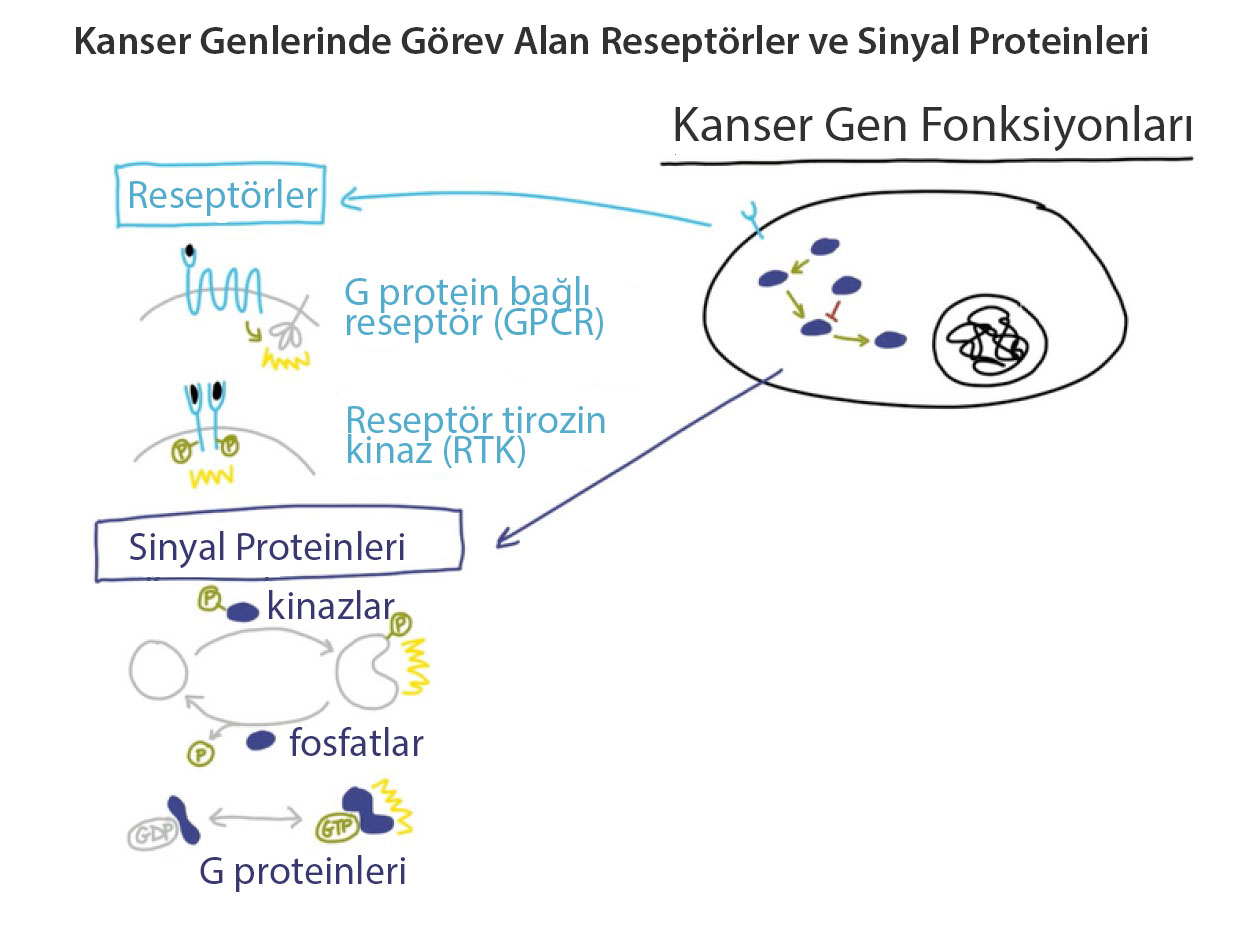
G-protein-coupled receptors (GPCRs) have a structure that crosses the cell membrane seven times and can bind to ligands outside the cell. They are called "G-protein" receptors because ligand binding activates a class of intracellular proteins known as "G-proteins." GPCR activation triggers various downstream signaling pathways inside the cell, regulating growth, proliferation and other functions.
Receptor Tyrosine Kinases (RTKs): A Key Role in Intracellular Phosphorylation and Signal Transmission

Another important receptor class located in the cell membrane, with only a single transmembrane (membrane-spanning) domain, consists of receptor tyrosine kinases (RTKs). When RTKs bind to ligands, they come together (dimerize), become activated and phosphorylate each other. Phosphorylation means adding a phosphate group to a protein. By allowing signals to spread within the cell, this process may trigger growth and metastasis in cancer cells.
Downstream Signaling Cascades: Spreading the Signal Within the Cell
Cellular signaling pathways proceed as cascades in which one protein activates another, amplifying the signal inside the cell. Phosphorylation and GTP binding are among the fundamental mechanisms of these cascades. Phosphorylation activates a protein by adding a phosphate group, while GTP binding activates G-proteins. Disruption of these processes can cause uncontrolled cell growth and cancer.
Transcription Factors and DNA Repair Factors: The Effects of Nuclear Proteins on Cancer
Intracellular signaling pathways usually end in the nucleus, where they activate transcription factors (TFs) that control gene expression. By activating particular genes, transcription factors regulate processes such as cell growth, survival and metastasis. Cells also contain nuclear proteins involved in DNA repair. DNA repair factors maintain genetic integrity by repairing DNA damage and provide an important line of defense against cancer development.
The Cell Cycle and Apoptosis: Maintaining Cellular Balance
Progression through the cell cycle and decisions about when a cell divides or dies are critical processes that directly affect cancer development. Proteins regulating the cell cycle and regulators of programmed cell death, known as apoptosis , maintain this balance by preventing unnecessary cell proliferation. Disruption of these processes in cancer cells causes uncontrolled proliferation and the formation of cancerous tissues.
Other Protein Types Encoded by Cancer Genes
Cancer-associated genes encode many different protein types, including metabolic enzymes, chromatin regulators and cytoskeletal proteins. These proteins influence intracellular signaling pathways and play roles in cancer development. Understanding the functions of genes frequently associated with cancer gives us deeper insight into cancer biology.
This article has summarized how genes mutated in cancer cells and the proteins they encode contribute to cancer development. Studying cancer-associated signaling pathways and cellular functions is an important step toward developing new cancer treatment strategies.
*
OUR INTRODUCTION TO CANCER GENETICS TOPICS
Was this article helpful?
Your feedback helps us improve our content.




Reader comments
Share your comment
Your name and comment are published only after administrator approval. Your email address is never shown to visitors.
Be the first to comment.