
It Will Change Everything! Google DeepMind AI Is Solving Protein Structures

Scientists say that, for determining proteins' 3-dimensional (3D) shapes, Google's deep learning programs are about to transform biology. New drug discovery is on the brink of a revolution.
Google artificial intelligence spin-off DeepMind has developed an AI network that has taken a huge step toward solving one of biology's greatest challenges: determining a protein's amino acid sequence-based 3D shape.
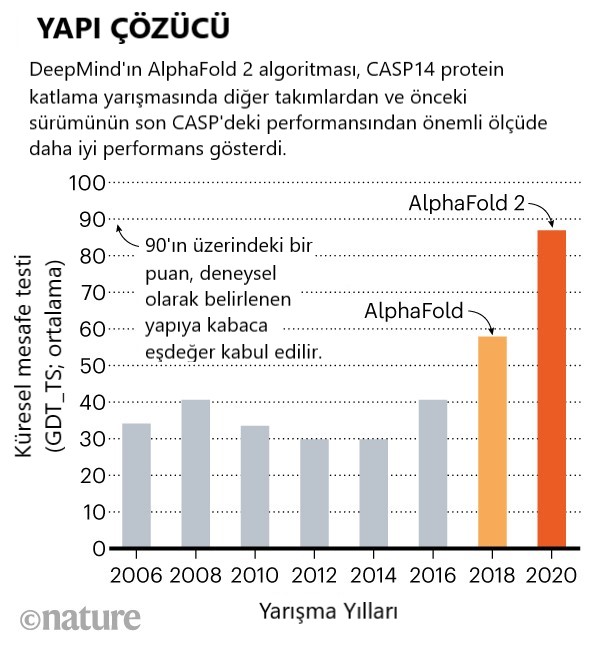
DeepMind's algorithm program, AlphaFold, outperformed 100 other teams in a biennial protein-structure prediction challenge called CASP, short for Critical Assessment of Structure Prediction. The results were announced on November 30 at the opening of this year's virtual conference evaluating the work.

Figure above: A protein's function defined by its 3D shape – DeepMind.
John Moult, co-founder of CASP, established in 1994 to develop computational methods for accurately predicting protein structures, and a computational biologist at the University of Maryland in College Park, says, “This is a very important achievement”.
The ability to predict protein structures accurately from amino acid sequences would be a major boon to life sciences and medicine. It would greatly accelerate understanding of cells' basic building blocks and enable faster, more advanced drug discovery.
AlphaFold arrived at the last CASP in 2018, the first year London-based DeepMind participated. But this year, its deep-learning network was far ahead of other teams, performing so remarkably well that scientists say it could herald a revolution in biology.

Andrei Lupas, an evolutionary biologist at the Max Planck Institute for Developmental Biology in Tübingen, Germany, who evaluates the different CASP teams' performance, says, “This is a game-changing development”. AlphaFold has already helped identify the structure of a protein that had troubled Lupas's laboratory for a decade, and he expects it to change the questions he addresses and how he works. Lupas says, “This will change medicine. It will change research. It will change bioengineering. It will change everything”.
In some cases, AlphaFold's structural predictions are indistinguishable from those determined by “gold-standard” experimental methods, such as X-ray crystallography and, in recent years, cryo-electron microscopy (cryo-EM). Scientists say AlphaFold may not eliminate the need for these laborious, expensive methods yet, but AI will make it possible to study living things in new ways.
The protein structure problem
Proteins are life's building blocks, responsible for most events within cells. How a protein works and what it does are determined by its 3D shape, and a protein's function is determined by its 3-dimensional structure. “Structure is function” is an axiom of molecular biology. Proteins tend to take shape unaided, guided only by the laws of physics.
For decades, laboratory experiments have been the main route to obtaining good protein structures. The first complete protein structures were determined in the early 1950s using a technique in which X-rays are fired at crystallized proteins and the diffracted light is translated into a protein's atomic coordinates. X-ray crystallography has produced the lion's share of protein structures. But over the past decade, cryo-EM has become the tool of choice in many structural biology laboratories.
Scientists have long wondered how a protein's constituent parts, a sequence of different amino acids, map out the many twists and folds of its final shape. Researchers say early efforts in the 1980s and 1990s to use computers to predict protein structures fared poorly. Grand claims about methods in published papers tended to fall apart when other scientists applied them to other proteins.
Moult launched CASP to bring greater rigor to these efforts. The event challenges teams to predict structures of proteins that have been solved experimentally but not disclosed. Moult believes it has had the effect of greatly improving the field by calling time on overblown claims. “You find out what really looks promising, what works, and what you should move away from”, he says.
DeepMind's 2018 performance at CASP13 surprised scientists in a field long dominated by small academic groups. But computational biologist Jinbo Xu at the University of Illinois Chicago says its approach was broadly similar to other teams using AI.
The first iteration of AlphaFold used structural and genetic data to predict distances between amino acid pairs in a protein, using deep learning, an AI method, for this purpose. DeepMind's John Jumper, who leads the project, says AlphaFold then used this information in a second step that did not require AI to find a “consensus” model of what the protein should look like.
The team tried to improve the approach by building on it, but ultimately failed. Jumper says they therefore changed it and developed an AI network incorporating additional information about the physical and geometric constraints that determine how a protein folds. They also set it a harder task: instead of predicting relationships between amino acids, the network predicts the final structure of a target protein sequence. Jumper calls it “quite a complicated system”.
Astonishing accuracy
CASP takes place over several months. Target proteins or protein sections called domains, approximately 100 in total, are released regularly, and teams have a few weeks to submit structural predictions. An independent team of scientists then evaluates the predictions using metrics measuring how closely a predicted protein resembles the experimentally determined structure. Assessors do not know who made each prediction.
Lupas says AlphaFold's predictions arrived under the name “group 427”, but the astonishing accuracy of many entries made them stand out. “I had guessed it was AlphaFold. Most people had guessed,” he adds.
Some predictions were better than others, but nearly two-thirds were comparable in quality with experimental structures. Moult says that, in some cases, it is unclear whether disagreement between AlphaFold's prediction and the experimental result is a prediction error or an artifact of the experiment.
AlphaFold's predictions matched experimental structures determined by a technique called nuclear magnetic resonance poorly, but Moult says this may depend on how raw data are transformed into a model. The network also tries to model individual structures in protein complexes or groups, where interactions with other proteins distort their shapes.
Moult says teams generally predicted structures more accurately this year than at the last CASP, but most of the progress can be attributed to AlphaFold. On protein targets considered moderately difficult, other teams' best performances generally scored 75 out of 100, whereas AlphaFold scored approximately 90 on the same targets.
Moult says approximately half the teams mentioned deep learning in their approach summaries, suggesting AI is having a broad impact in this field. Most were academic teams, but Microsoft and Chinese technology firm Tencent also entered CASP14.
Mohammed AlQuraishi, a computational biologist at Columbia University in New York City and a CASP participant, was eager to examine details of AlpaFold's performance in the competition and learn more about how the system worked when DeepMind presented its approach on December 1. AlQuarishi's strong intuition is that AlphaFold will be transformative.
“I think it is fair to say this is revolutionary for protein structure prediction. I suspect many will leave the field because the main problem has arguably been solved. This is a first-order breakthrough and certainly one of the most significant scientific results of my lifetime”, he says.
Faster structures
An AlphaFold prediction helped determine the structure of a bacterial protein Lupas's laboratory had been trying to crack for years. His team had already collected raw X-ray diffraction data, but turning these Rorschach-like patterns into a structure required some knowledge of the protein's shape. Tricks for obtaining that information had failed, as had other prediction tools. Lupas says, “the model from group 427 gave us our structure in half an hour after we had spent a decade trying everything”.
DeepMind co-founder and CEO Demis Hassabis says the company plans to make AlphaFold useful for other scientists (enough detail about the first version had previously been published for others to replicate its approach). AlphaFold can take days to produce a predicted structure, including estimates of the reliability of different protein regions. Seeing drug discovery and protein design as potential applications, Hassabis adds, “We are only beginning to understand what biologists would want.”
In early 2020, the company released predictions for a small number of SARS-CoV-2 protein structures not yet determined experimentally. In June, molecular neurobiologist Stephen Brohawn's team at the University of California, Berkeley, reported that DeepMind's prediction for a protein called Orf3a closely resembled the structure later determined using cryo-EM. “What they were able to do was very impressive”, he adds.
What will the AlphaFold 2 algorithm's real-world impact be?
Some applications, such as evolutionary analysis of proteins, are poised to flourish because the current flood of genomic data can now be reliably translated into structures. Lupas says, “This will enable the next generation of microbiologists to ask more advanced questions”. “It will require more thinking and less pipetting”.
Janet Thornton, a structural biologist and former CASP assessor at the European Molecular Biology Laboratory – European Bioinformatics Institute in Hinxton, England, says, “This is a problem I did not think would be solved in my lifetime”. She hopes the approach could illuminate the functions of thousands of unresolved proteins in the human genome and help interpret disease-causing gene changes.
AlphaFold's performance also marks a turning point for DeepMind. The company is best known for using AI to master games such as Go, but its long-term goal is to develop programs capable of achieving broad, human-like intelligence. Hassabis says tackling major scientific challenges such as protein-structure prediction is one of the most important applications of its AI. “I think it is the most meaningful thing we have done in terms of real-world impact.”
In conclusion, many new-generation drugs are proteins, and at the molecular level, producing the right proteins for genetic targets currently takes scientists decades. With algorithm programs such as Google's deep-learning-based AlphaFold 2, decades may become months. The future holds great excitement in biotechnology.
*
Sources
Was this article helpful?
Your feedback helps us improve our content.




Reader comments
Share your comment
Your name and comment are published only after administrator approval. Your email address is never shown to visitors.
Be the first to comment.