
Love in the Laboratory – Scientists Fall in Love Too!

Science is generally portrayed as a place that leaves no room for emotion, where only hard facts survive, and the scientist as an unfeeling person who makes decisions using reason alone. In honor of Valentine's Day week, however, we decided to discuss science's softer side. A shared passion for science can bring people together not only professionally but also romantically, and the scientific world is full of examples!

Our first couple is Professor Padmanee Sharma, recipient of the William B. Coley Award at the University of Texas MD Anderson Cancer Center, and winner of the 2018 Nobel Prize in Medicine for immunotherapy research Professor James P. Allison. They met during a business trip to New York, and their relationship truly developed while they worked together in the clinic and laboratory to bring an idea proposed by Pam to life. They say their love motivates them to find more effective treatments and advance in their field.
- Related topic: The discovery of immunotherapy in cancer and Coley's toxins

Another couple is Professor Arlene Sharpe and Professor Gordon J. Freeman of Harvard Medical School. They met in German class while still undergraduate students at Harvard University and grew closer during summer school while researching virus-host interactions. Their complementary areas of expertise allowed them to provide both support and companionship to each other. However, they decided to focus on what being a family requires without bringing too much work home, while working hard for science in the laboratory. Their understanding of each other's desire to work late and even on weekends also makes them good “team players.”
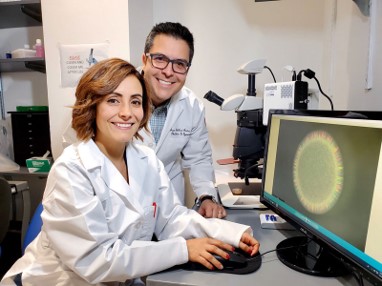
Our final couple is assistant professors Diane K. Morales and Juan R. Cubilos-Ruiz of Weill Cornall Medical College in New York. Working in different fields allows them to see their work from another perspective when exchanging ideas. Alongside the importance of shared goals and working together toward them, they emphasize passion and patience as common elements of success in both science and romantic relationships. The couple knows they must make time for themselves as well as devote working hours to science. They say traveling and enjoying art and music are among their favorite activities together. Their favorite trip so far was, moreover, their visit to Cappadociajust before starting their faculty positions! Finally, we wanted to share with you an impressive video in which Assoc. Prof. Dr. Oytun Erbaş, a specialist in Experimental Medicine, Neuroscience, and Drug Discovery, explains LOVE:
Sources
Love in the Lab: Valentine’s Day with Scientific Couples.
cancerresearch.org 13 Feb 2020
Was this article helpful?
Your feedback helps us improve our content.




Reader comments
Share your comment
Your name and comment are published only after administrator approval. Your email address is never shown to visitors.
Be the first to comment.