
Nivolumab and Ipilimumab Change Outcomes in MSI-H or dMMR Metastatic Colorectal Cancer

In this article
Metastatic colorectal cancer (mCRC) often has poor outcomes even with standard chemotherapy or targeted treatments, particularly in subtypes with characteristics such as microsatellite instability-high (MSI-H) or deficient DNA repair (dMMR).
MSI-H (microsatellite instability-high) means that repetitive sequences in genetic material (microsatellites) show more changes than normal because of defects in DNA repair mechanisms. dMMR (deficient DNA repair) means that the system responsible for repairing DNA damage does not function properly. Both conditions are commonly associated with cancer development.
Among metastatic colorectal cancers, approximately 5-15% have microsatellite instability-high (MSI-H) or deficient DNA repair (dMMR) characteristics. This proportion may be somewhat higher in early-stage colorectal cancer, while these features are less common at the metastatic stage. These biomarkers are often associated with inherited conditions such as Lynch syndrome or epigenetic changes in sporadic cancers. MSI-H or dMMR tumors have particular clinical importance because they are more sensitive to immunotherapy. However, single-agent immunotherapy approaches may be insufficient in metastatic disease.
With results published on 27 November 2024 in NEJM, the new phase 3 CheckMate 8HW trial showed that dual immunotherapy with nivolumab and ipilimumab provided significant clinical benefits over standard chemotherapy in this patient group.
Study Methods: Combination Immunotherapy, Monotherapy, or Chemotherapy?
The CheckMate 8HW study was designed as an open-label phase 3 clinical trial and assigned previously untreated patients with metastatic colorectal cancer to three groups:
- Nivolumab + ipilimumab combination
- Nivolumab alone
- Chemotherapy (with or without targeted therapy)
Patients underwent biomarker testing to confirm MSI-H or dMMR status and were then randomized to these groups in a 2:2:1 ratio. The study had two primary endpoints:
- The superiority of combination immunotherapy over chemotherapy in progression-free survival as the outcome being assessed.
- Progression-free survival with combination immunotherapy compared with nivolumab monotherapy.
Findings: Breakthrough Results in Immunotherapy
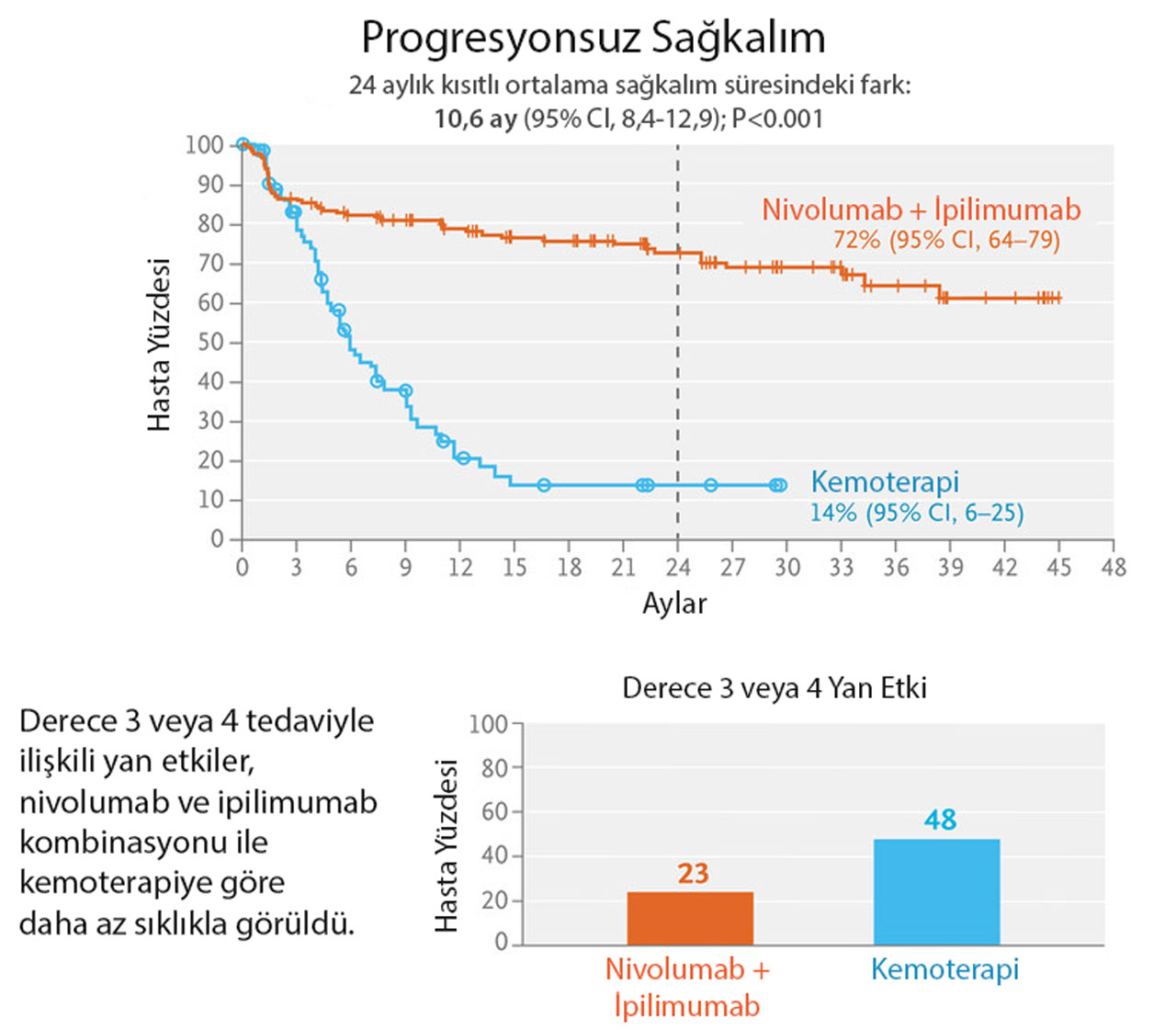
A total of 303 patients were enrolled, and MSI-H or dMMR status was confirmed by central testing in 255. After a median follow-up of 31.5 months, the results showed a significant advantage for combination immunotherapy over chemotherapy.
-
Progression-Free Survival:
-
In patients receiving combination treatment, the 24-month progression-free survival rate was 72% (95% CI, 64-79), compared with only 14% (95% CI, 6-25) in the chemotherapy group. This difference was highly statistically significant (P<0.001).
-
-
Median Overall Survival:
-
Median survival with combination treatment was recorded as 10.6 months (95% CI, 8.4-12.9) longer than with chemotherapy.
-
-
Side-Effect Profile:
-
Serious treatment-related side effects occurred in 23% of the combination immunotherapy group, compared with 48% of the chemotherapy group. These results suggest that immunotherapy is not only more effective but also better tolerated.
-
Conclusions and Clinical Implications
CheckMate 8HW demonstrates that nivolumab plus ipilimumab provides a marked progression-free survival benefit and fewer side effects than chemotherapy in patients with MSI-H or dMMR metastatic colorectal cancer. These findings provide strong evidence for adopting immunotherapy as first-line treatment in this group.
Future Prospects
The findings highlight the importance of immunotherapy in managing MSI-H or dMMR metastatic colorectal cancer and pave the way for broader use of immune checkpoint inhibitors in these patients. However, further studies are needed to address treatment costs, access, and long-term outcomes.
Sources
Was this article helpful?
Your feedback helps us improve our content.




Reader comments
Share your comment
Your name and comment are published only after administrator approval. Your email address is never shown to visitors.
Be the first to comment.