
Nubeqa (Darolutamide) and Doxel (Docetaxel) Treatment Regimen for Prostate Cancer

In this article
Prostate cancer is among the most common solid tumors in men. Metastatic hormone-sensitive prostate cancer (mHSPC), once managed with androgen deprivation therapy (ADT) alone, has undergone a major transformation through early combination treatment in recent years. Adding docetaxel and/or newer androgen receptor inhibitors to ADT significantly extends survival. Darolutamide + Docetaxel is a strongly evidence-based example of this strategy. ARASENS Phase 3 demonstrated that adding darolutamide to ADT + docetaxel, compared with placebo, reduced mortality risk by 32.5% and significantly improved overall survival. These findings led to FDA/EMA approval and inclusion in NCCN 2025 with a category 1 recommendation.
Darolutamideis a second-generation androgen receptor inhibitor (oral); low central nervous system penetration generally limits neurocognitive side effects. Docetaxel is a taxane chemotherapy disrupting microtubule dynamics and stopping mitosis (I.V.). The combination is given with ADT in mHSPC patients.
Dual action:
- Darolutamide: Blocks AR signaling, interrupting tumor growth instructions.
- Docetaxel: Stabilizes the mitotic spindle, stopping division and triggering apoptosis.
These complementary mechanisms suppress androgen-dependent and androgen-independent clones early, delaying resistance.
Treatment Goals
- Improve overall survival (OS)
- Extend radiographic progression-free survival (rPFS)
- Outperform ADT + docetaxel alone
- Maintain long-term hormonal control and quality of life
Approved Indication
FDA (2022) & EMA: First-line metastatic hormone-sensitive prostate cancer with ADT + docetaxel.
NCCN 2025: For mHSPC, a category 1 recommendation; particularly favored in high-volume/symptomatic disease.
ARASENS (Phase 3, n=1306) — What Was Done and Found?
- Design: International, double-blind, placebo-controlled, 1:1 randomized trial.
- Who received it? Newly diagnosed metastatic hormone-sensitive male patients; most had metastatic disease from the outset. ECOG 0–1 predominated.
- Regimen: All patients received ADT + docetaxel (75 mg/m², every 3 weeks × 6 cycles), plus darolutamide 600 mg twice daily or placebo as study treatment.
- Primary endpoint: Overall survival (OS). Result: Mortality risk was 32.5% lower in the darolutamide arm (HR 0.68). 4-year OS: 62.7% vs 50.4%.
- Secondary endpoints: rPFS, time to castration-resistant disease, time to pain progression, and time to first symptomatic skeletal event—all favored darolutamide.
- Subgroups: OS benefit in high-volume, high-risk, and low-risk patients was generally maintained.
- Feasibility: Completion rates for 6 docetaxel cycles were similar; safety was consistent with ADT+docetaxel.
The patient perspective: ‘Adding an extra pill (darolutamide) to standard ADT + docetaxel extended life while side effects remained broadly similar. The most common serious side effect is low blood counts, mainly during docetaxel treatment.’
Dosing and Administration Schedule
Initial Phase
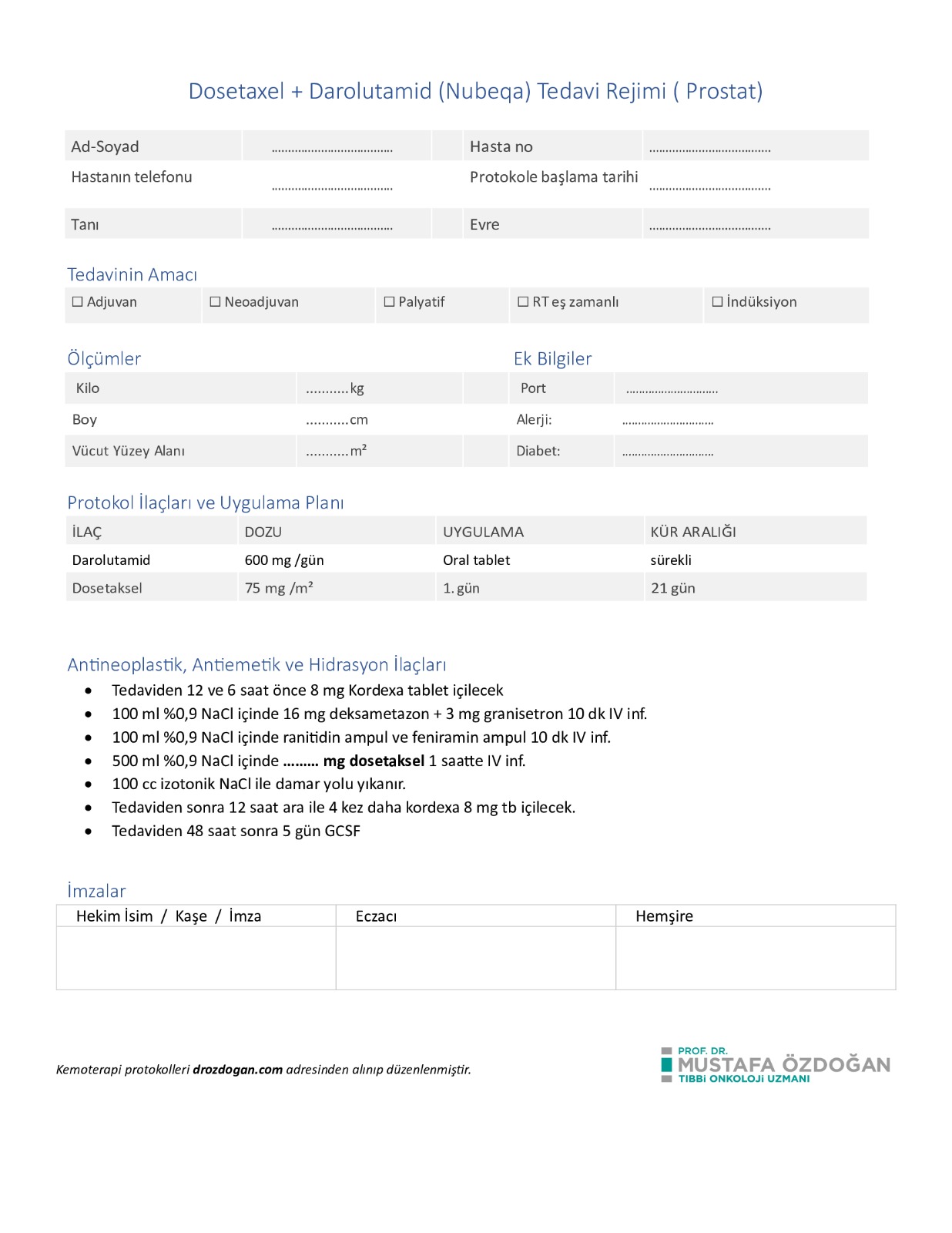
| Drug | Dose | Administration |
|---|---|---|
| Darolutamide | 600 mg × 2/day (oral, with food) | Concurrent with ADT initiation |
| Docetaxel | 75 mg/m² I.V. | Every 3 weeks × 6 cycles (with ADT + darolutamide) |
Maintenance Phase
After docetaxel cycles, darolutamide 600 mg × 2/day with ADT continues until progression of disease.
SGK Reimbursement Status
Darolutamide (600 mg tablet): SGK reimburses treatment of adult men with nonmetastatic Castration-Resistant Prostate Cancer (nmCRPC), ECOG performance status 0-1, and high metastatic risk (PSA doubling time ≤ 6 months, N0-1, PSA above 2 ng/dl, castrate testosterone levels (<50 ng/dl), and no prior cytotoxic chemotherapy).
Indicated with docetaxel and androgen deprivation therapy in adult men with metastatic Hormone-Sensitive Prostate Cancer (mHSPC) and high-volume disease (visceral metastases or ≥ 4 bone metastases, with at least 1 outside the vertebrae and pelvis). Docetaxel should begin within the first 6 weeks after the initial darolutamide dose.
Nubequa 300 mg tablets: 47.153.56 TL.
Docetaxel: For cancer treatment,a health board report showing the treatment regimen allows specialist physicians to prescribe it.
Administration Precautions
- Darolutamide must be taken with food; missed doses may be made up within the same day.
- Before docetaxel, dexamethasone premedication is given for edema/hypersensitivity.
- Complete blood count requires close monitoring because of hematological toxicity risk; consider G-CSF prophylaxis if needed.
- Monitor liver function, glucose, and blood pressure regularly.
Pretreatment Checks and Monitoring
- PSA, testosterone; complete blood count; creatinine; AST/ALT; alkaline phosphatase
- ECG and cardiac risk assessment (for taxane-related risks)
- PSA and appropriate imaging every 3 months (CT/MRI ± bone scintigraphy)
Patient Selection Criteria
Ideal candidates are men with mHSPC, ECOG 0–1, chemotherapy fitness, and particularly high-volume metastatic disease. In low-volume cases, ADT + an AR inhibitor is also a suitable alternative.
Drug Interactions
- Darolutamide: CYP3A4/P-gp substrate → interactions possible with strong inhibitors/inducers.
- Docetaxel: Metabolized by CYP3A4 → strong inhibitors may increase toxicity (azole antifungals, etc.).
- Live vaccines should be postponed during active treatment.
Side Effects and Management
| Adverse effect (ARASENS data) | Frequency / Severity | Practical management |
|---|---|---|
| Neutropenia | Any grade: ~39%; Grade 3–4: 33.7% (placebo 34.2%) | Monitor blood counts closely; urgent assessment with fever; if needed, G-CSF; dose delay/reduction. |
| Febrile neutropenia | Grade 3–4: 7.8% (placebo 7.4%) | Urgent antibiotics; consider primary prophylaxis (G-CSF) in high-risk patients. |
| Fatigue/Asthenia | ~33% (similar) | Sleep and nutrition routines, gentle exercise, assess concomitant anemia; interrupt if needed. |
| Alopecia | ~40% (similar) | Hair-loss counseling; scalp cooling may be considered at some centers. |
| Anemia | ~28%; Grade 3–4: 4.8% | Assess iron/B12/folate; transfuse when indicated. |
| Hypertension | Grade 3–4: 6.4% (placebo 3.2%) | Monitor blood pressure, adjust antihypertensives, exclude secondary causes. |
| Elevated liver enzymes (AST/ALT) | Grade 3–4: ~2–3% | Monitor LFTs; temporarily withhold darolutamide at Grade ≥3, restarting at a reduced dose after improvement. |
| Rash | Any grade: ~16.6% (placebo 13.5%) | Topical steroids/antihistamines; short-term systemic steroids if widespread/severe. |
| Pneumonia | Grade 3–4: ~3% | Clinical assessment and imaging; appropriate antibiotics; a chemotherapy break may be needed. |
Notes: Grade 3–4 serious adverse events occurred in 66.1% of the darolutamide arm versus 63.5% with placebo. Study-drug permanent discontinuation due to adverse effects was 13.5% vs 10.6%; docetaxel discontinuation was 8.0% vs 10.3%. Adverse effects peak particularly during the period overlapping docetaxeland then decrease.
Dose Modifications
- Darolutamide: Grade 3–4 toxicity → temporarily withhold; restart at 300 mg × 2/day after improvement and escalate if tolerated.
- Docetaxel: Severe neutropenia/neuropathy → reduce to 75% of dose or discontinue; consider G-CSF prophylaxis after febrile neutropenia.
Darolutamide + Docetaxel in Other Cancers
Darolutamide is an AR inhibitor specific to prostate cancer ; efficacy has not been demonstrated in other tumors. Docetaxel is used alone and in combinations for many tumors; however, darolutamide + docetaxel is currently approved only in prostate cancer (particularly mHSPC).
References
- Smith MR, et al. N Engl J Med 2022;386:1132–1142. (ARASENS primary publication)
- Hussain M, et al. J Clin Oncol 2023; subgroup analyses (volume/risk)
- NCCN Prostate Cancer, Version 2.2025
- EMA/FDA Product Information: Darolutamide (Nubeqa®), Docetaxel (Taxotere®)
Was this article helpful?
Your feedback helps us improve our content.


Reader comments
Share your comment
Your name and comment are published only after administrator approval. Your email address is never shown to visitors.
Be the first to comment.