
Prof. Ali Ertürk's Transparent Mouse Technique: A Revolution in Cancer Drug Testing

In this article
Progress in cancer biotechnology requires continual testing of drugs and treatment methods. Obtaining reliable results and identifying genuinely effective treatments, however, is often complex and difficult. Improving this process could bring faster, more effective results against cancer. A new technology enters the picture here: transparent mice.
How Does Transparent Mouse Technology Work?
In 2018, at the Helmholtz Munich research center, Prof. Ali Ertürk discovered how to make a mouse transparent. His team has now improved the technology using chemicals to highlight particular tissues, making it possible to scan tissues in unprecedented detail .
The method can identify small tumors that were previously undetectable. This is important for demonstrating that cancer drugs can eliminate tumors in mice before being tested in humans. The research could bring revolutionary advances to medical research.
A New Era in Drug Testing
This scanning method could completely change cancer drug testing. Drug effectiveness is usually tested first in mice, and the new method could make these tests more efficient.
Prof. Ertürk says the method can detect tiny tumors that MRI (magnetic resonance imaging) and PET scans cannot reveal. This is important for showing that cancer drugs can destroy tumors in mice before they are tested in humans.
Making Mice Transparent and Testing Drug Effectiveness
Laboratory mice are normally exposed to cancer, and conventional scans monitor tumor progression. They are then given the cancer drug being tested and scanned again to see whether treatment made a difference.
Prof. Ertürk's scanning method can only be used on dead mice. After exposure to cancer, the mice are made transparent and examined with the new technique. Making just a few mice transparent should suffice to test a drug's effectiveness.
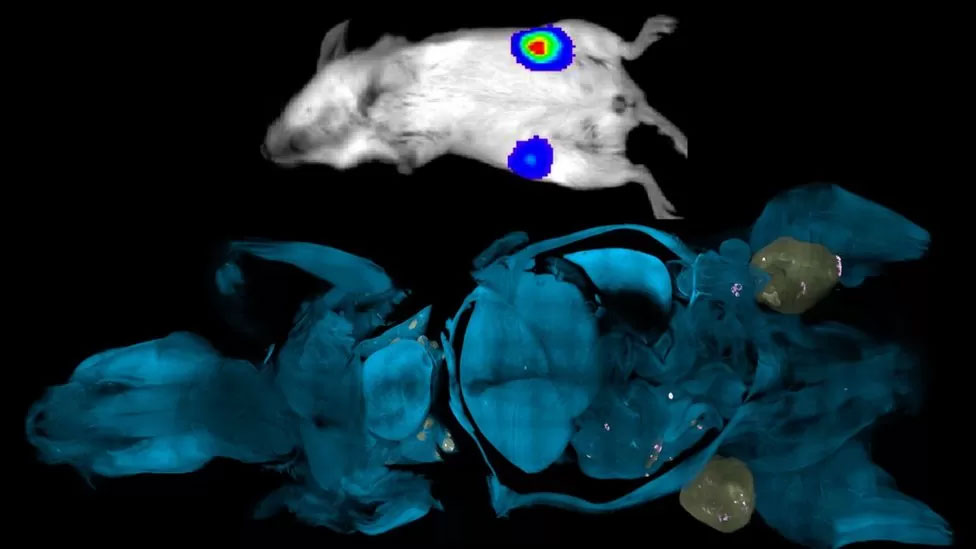
Ertürk's scanning method (below) shows tumor tissue in greater detail. A conventional scan (above, in white) shows only the largest tumor concentrations.
Our Previous Articles About Prof. Ali Ertürk:
Study Details
According to a paper published in Nature Biotechnology on July 10, 2023, Prof. Ali Ertürk and his team developed a technique called "wildDISCO". This chemical method allows standard IgG antibodies to penetrate an entire mouse body. It can map the molecular structure and distribution of cells throughout the body, helping us understand systems that extend everywhere, particularly the nervous system.
WildDISCO relies on cholesterol extraction (removing fat molecules from tissue) to allow standard antibodies to penetrate the entire mouse body. Antibodies can then consistently penetrate different tissue layers, muscles and bones. The technique provides whole-body maps of cell types and protein distribution.
The study could improve understanding of systems that extend throughout the body, particularly the nervous system. This forms a complex network connecting organs, yet its exact distribution and cell types remain incompletely understood. WildDISCO could help answer these questions.
The technique also allows other systems in the mouse body, such as the lymphatic system , to be mapped. The lymphatic system regulates fluid circulation and is an important part of immunity. By showing the distribution of its cells and proteins, WildDISCO helps us understand how these systems work together.
Finally, the technique can identify rare cell types and structures in the mouse body. Researchers can use it, for example, to identify rare immune-cell clusters (tertiary lymphoid structures) in mice with cancer. These structures may enhance immune responses in cancerous tissues and could be treatment targets.
Technology and Cancer: Future Possibilities
This scanning technology could improve our understanding of how diseases such as cancer develop. Observing the effects of drugs and treatments throughout the body could give researchers a broader perspective.
Another advantage is that these 3-dimensional images are stored online. Researchers can use this library for their own experiments or to examine different parts of the animal. Prof. Ertürk believes the technology could reduce laboratory animal use tenfold.
The technology is not limited to mice and could be used in any animal. It could even make human tissues and organs transparent.
Conclusion
Transparent mouse technology and the new scanning method are exciting scientific innovations. They may improve understanding of disease development and treatment effects. Advancing technology could help identify new ways to detect, treat and prevent cancer, representing a major step in the fight against it.
Who Is Ali Ertürk? His Education
Ertürk grew up in Turkey and completed his undergraduate degree in Molecular Biology and Genetics at Bilkent University in Ankara. During his degree, he undertook two summer internships in US neurobiology laboratories, at Yale School of Medicine and Harvard Medical School. Before that, he had never spent time in a research laboratory, left Turkey or been on a plane. "It was a very big deal for me," he says. For his doctoral research in neuroscience, he went to the Max Planck Institute of Neurobiology, working on imaging technologies and tissue clearing. He took photographs, bringing together the real world and the microscopic one. "What I love is taking photographs, especially at night." He enjoys audiobooks and buys 70-80 books a year.
Ertürk's mentor and Helmholtz Munich CEO Matthias Tschöp said they set out to transform biomedicine by combining "next-generation engineering" and AI (artificial intelligence) technologies. "With his expertise in systems biomedicine, high-resolution imaging and artificial intelligence, Ali Ertürk embodies the hybrid scientist we need today to address the growing health threats facing us as a society," he says. Beyond his scientific achievements, "Ali has an infectiously creative mind." He is a synthetic thinker with impressive talents as an accomplished artist and photographer.
Sources
Was this article helpful?
Your feedback helps us improve our content.




Reader comments
Share your comment
Your name and comment are published only after administrator approval. Your email address is never shown to visitors.
Be the first to comment.