
Second-Line Treatment of Small Cell Lung Cancer: Impressive Results with Tarlatamab

In this article
One of Medicine's Most Treatment-Resistant Diseases
Small cell lung cancer (SCLC) accounts for approximately 15% of all lung cancers, but follows a highly aggressive course. At diagnosis, more than 70% of patients have extensive-stage disease, and the 5-year overall survival rate is below 10%. First-line treatment generally includes platinum-based chemotherapy combined with PD-L1 inhibitor immunotherapy, such as atezolizumab or durvalumab. Unfortunately, although initial response rates are high, responses are short-lived, and the disease progresses within the first year in most patients.
Second-line options are limited. Topotecan has been the main chemotherapy agent in this setting for many years. However, its effectiveness is limited (median overall survival of 8–9 months), and hematologic toxicity is substantial. Lurbinectedin and drugs such as amrubicin have been approved in some countries, but have not provided a clear survival advantage in randomized phase 3 trials. Consequently, patients with SCLC progressing after platinum therapy have needed a new, more effective option for years.
Tarlatamab: A Promising Next-Generation Immunotherapy Agent
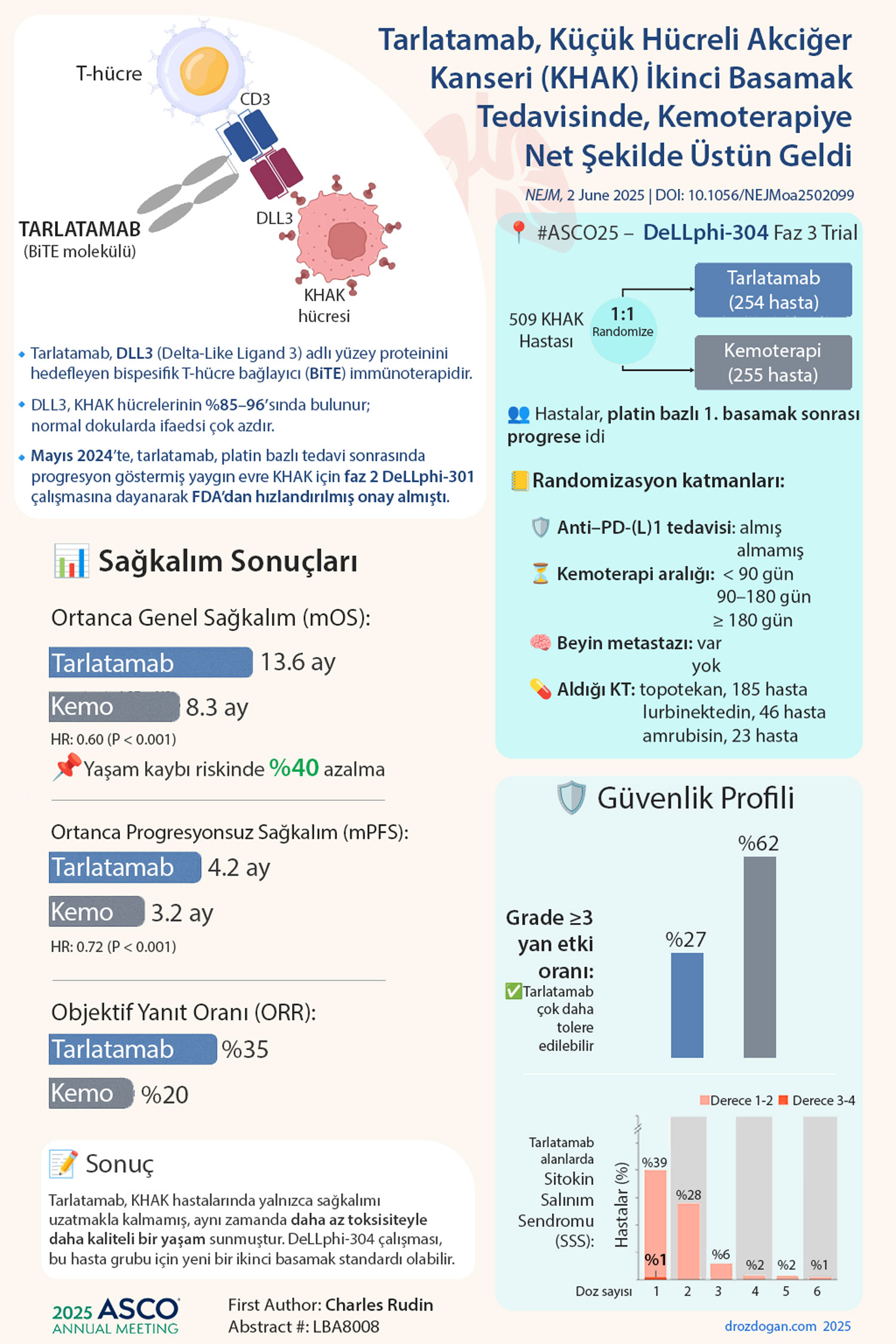
Tarlatamabtargets a surface protein called DLL3 (delta-like ligand 3), which is overexpressed in 85–96% of SCLC cells, and is an immunotherapy developed in the bispecific T-cell engager (BiTE) format. It simultaneously directs CD3+ T cells toward this target, enabling the immune system to kill tumor cells. In 2024, the FDA granted it accelerated approval for advanced SCLC progressing after platinum-based treatment. This approval was based on the phase 2 DeLLphi-301 study, in which tarlatamab produced an objective response rate of 40% and median survival of 15.2 months in patients who had received two or more treatment lines.
What Does the Study Presented at ASCO 2025 Add?
Presented at ASCO 2025 and simultaneously published in NEJM , the DeLLphi-304 studydirectly compared tarlatamab with the current standard chemotherapy options (topotecan, lurbinectedin, and amrubicin) in SCLC progressing after platinum therapy. It was the first phase 3 randomized multinational trial of this comparison.
The primary aim was to demonstrate tarlatamab's effect on overall survival . Other multidimensional outcomes included progression-free survival, objective response, treatment-related toxicity, and patient-reported quality of life.
The results demonstrated an advantage that was not only statistically significant, but also clinically striking . In this context, DeLLphi-304 represents more than the success of a single molecule: it is a development that could open a new era in SCLC treatment .
DeLLphi-304: Study Design
The phase 3 DeLLphi-304 study, presented at the 2025 ASCO meeting, compared tarlatamab with chemotherapy such as topotecan/lurbinectedin/amrubicin in patients with SCLC progressing after platinum-based therapy. 509 patients were randomized to two arms.
- Primary endpoint: Overall survival (OS)
- Secondary endpoints: Progression-free survival (PFS), patient-reported symptoms (dyspnea, cough, pain)
Striking Findings
- Median Overall Survival (OS):
- Tarlatamab: 13.6 months
- Chemotherapy: 8.3 months
- HR: 0.60 (P<0.001)
- Median Progression-Free Survival (PFS):
- Tarlatamab: 4.2 months
- Chemotherapy: 3.2 months
- HR: 0.72 (P<0.001)
- Objective Response Rate (ORR): 35% vs 20%
- Duration of Response (DOR): 6.9 months vs 5.5 months
- Patient-Reported Improvement: A significant 9.14-point reduction in the dyspnea score (P<0.001)
Toxicity Profile: An Important Advantage
- Rate of grade ≥3 adverse reactions: Tarlatamab 27% vs chemotherapy 62%
- Cytokine release syndrome: Generally low grade (1% Grade 3), manageable with supportive care.
- ICANS (Neurotoxicity): 6% of patients, mostly low grade and manageable.
Clinical Interpretation and Future Perspectives
DeLLphi-304 is the first phase 3 trial to show that tarlatamab is significantly superior to chemotherapy in the second-line setting. These findings are consistent with earlier phase 2 studies such as DeLLphi-301 and support evaluating tarlatamab earlier in treatment.
Conclusion
Tarlatamab may be more than a new option for patients with progressing SCLC: it could become a new standard. Longer survival, good tolerability, and substantial improvement in patients' symptoms distinguish this immunotherapy.
Sources
Was this article helpful?
Your feedback helps us improve our content.


Reader comments
Share your comment
Your name and comment are published only after administrator approval. Your email address is never shown to visitors.
Be the first to comment.