
The OPTIMA Study: Who Can Skip Chemotherapy in Breast Cancer with the Prosigna Gene Test?

In this article
Who Can Skip Chemotherapy in ER+ / HER2- Breast Cancer with High Clinical Risk?
What did the study test?
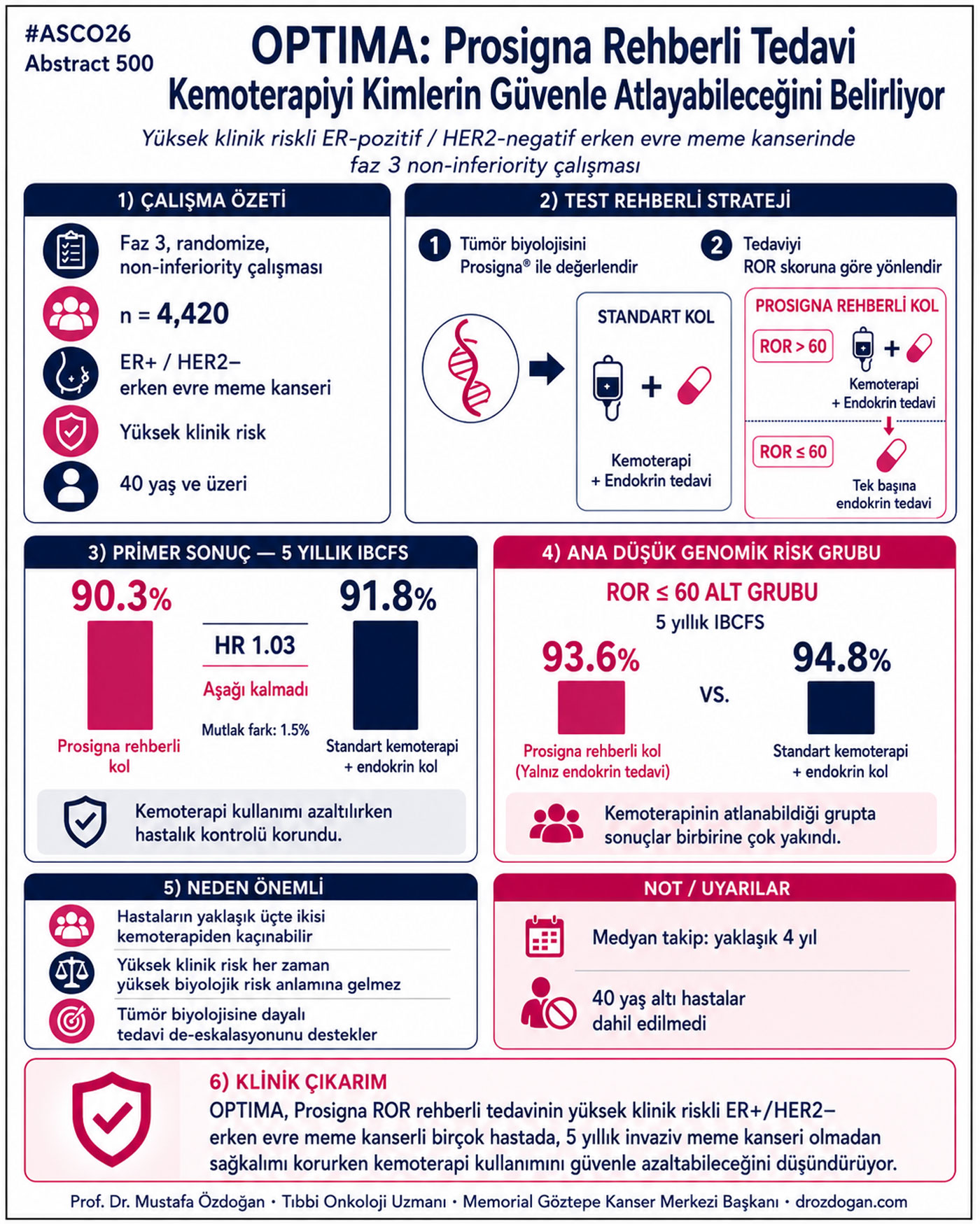
OPTIMA assessed patients aged 40 and older with surgically treated ER+/HER2- early breast cancer who were considered clinical candidates for chemotherapy. In the control arm, patients received standard chemotherapy followed by endocrine therapy. The test-directed arm used the Prosigna ROR score : chemotherapy was given if the ROR score was above 60; at 60 or below, chemotherapy was omitted and endocrine therapy was given.
It is a study design seeking to show that a new approach is not worse than standard treatment to a clinically unacceptable extent. Here, the aim is to understand whether disease control can be preserved while reducing chemotherapy.
Main results
| Outcome | Prosigna-directed treatment | Standard chemotherapy + endocrine therapy | Interpretation |
|---|---|---|---|
| 5-year invasive breast cancer-free survival | %90,3 | %91,8 | Difference 1,5%; within the non-inferiority margin. |
| HR | 1,03; 90% CI 0,85–1,25 | The test-directed approach was found to be non-inferior. | |
| ROR ≤60 subgroup | %93,6 | %94,8 | The most critical group: outcomes were very similar among patients who omitted chemotherapy. |
| Potential to avoid chemotherapy | Approximately two-thirds | None | Genomic risk may be low even when clinical risk is high. |
Clinical significance
This study shows that high clinical risk does not always mean high biological risk. The tumor may be large or lymph nodes may be involved, but if the gene expression profile is low risk, the expected absolute benefit from chemotherapy may be very limited.
OPTIMA’s most important contribution is testing this question in a higher-risk population already considered clinical candidates for chemotherapy rather than a lower-risk one. The study provides important evidence that test-directed decisions may also be safe in premenopausal, ovarian function-suppressed, and node-positive patients.
Points requiring attention
Follow-up is not yet very long; median follow-up is approximately 4 years. A substantial proportion of patients have less than 5 years of follow-up. Premenopausal women younger than 40 were also not included. These results should therefore not be directly generalized to very young patients in particular.
Drozdogan Academic Commentary
OPTIMA strongly reminds us that chemotherapy decisions in ER+/HER2- early breast cancer should be based on tumor biology alongside clinical risk.
This study offers important de-escalation evidence by supporting the idea of safely reducing chemotherapy in patients with high clinical risk but low Prosigna ROR scores.
The most critical message is this: good treatment in breast cancer does not always mean more treatment; it means giving the right patient the treatment from which they will truly benefit.
Conclusion
OPTIMA showed that chemotherapy decisions directed by the Prosigna ROR score were non-inferior to the standard chemotherapy approach in ER+/HER2- early breast cancer with high clinical risk. This is an important ASCO 2026 result for reducing chemotherapy and tailoring treatment to tumor biology, especially in patients with ROR scores of 60 or below.
- ASCO 2026 Abstract 500. OPTIMA phase III randomized non-inferiority trial.
- OncLive. IBCFS With Prosigna-Guided Adjuvant Therapy Is Noninferior to Chemoendocrine Therapy in ER+/HER2− Early Breast Cancer. 2026.
- OncoDaily. OPTIMA: Prosigna-Guided Chemotherapy Avoidance Shows Non-Inferior Outcomes. 2026.
- drozdogan.com. ASCO 2026’da Gözden Kaçırılmaması Gereken 4 Sessiz Devrim.
Was this article helpful?
Your feedback helps us improve our content.


Reader comments
Share your comment
Your name and comment are published only after administrator approval. Your email address is never shown to visitors.
Be the first to comment.