What Does HER2-Low Mean in a Pathology Report? What Do Scores 1+ or 2+ (FISH Negative) Mean?
In this article
What Does HER2-Low Mean in a Pathology Report? What Do Scores 1+ or 2+ (FISH Negative) Mean?
If your pathology report lists HER2 as “score 1+” or “score 2+, FISH negative,” your tumor counts as HER2-negative in the classic system, while current medical language calls this group HER2-low. It does not mean your cancer is HER2-positive, and classic anti-HER2 drugs such as trastuzumab are not given for that reason. What makes it important is this: in advanced (metastatic) disease, under specific conditions, the antibody-drug conjugate trastuzumab deruxtecan (T-DXd, Enhertu) gave longer progression-free survival than chemotherapy. In early-stage disease, a HER2-low result does not change treatment today. HER2-low is not a separate type of cancer; it is the name of a measurement result. We cover T-DXd separately in our Enhertu article (Turkish).
- What does it mean? HER2 immunohistochemistry (IHC) is 1+ or 2+, and the ISH/FISH test shows the HER2 gene is not amplified. The tumor cells carry a small amount of HER2 protein; roughly 45-60% of breast cancers fall into this group.
- What is it not? It is not HER2-positive, and it is not a separate biological subtype: it occurs in both hormone receptor-positive and triple-negative tumors. Classic anti-HER2 treatments such as trastuzumab or pertuzumab are not used for this group.
- Effect on treatment: Only in unresectable or metastatic disease. In DESTINY-Breast04, T-DXd after chemotherapy raised median overall survival from 16.8 to 22.9 months (HR 0.69). In DESTINY-Breast06, in hormone receptor-positive disease after endocrine therapy, T-DXd raised median progression-free survival from 8.1 to 13.2 months (HR 0.62).
- Caution: Separating 0, 1+ and 2+ is a visual, interpretation-sensitive assessment and can change over time or between biopsies. The decision is not made on one score; the tumor board weighs stage, hormone receptor status and prior treatments.
How Is the HER2 Score Obtained? IHC and FISH
HER2 is a protein on the surface of some breast cancer cells that passes on growth signals. The pathology lab answers two separate questions. First: how much HER2 protein stains on the cell membrane? This is measured by immunohistochemistry (IHC) and written as 0, 0+, 1+, 2+ or 3+. Second: is the HER2 gene truly amplified? In situ hybridization (ISH) methods such as FISH answer this. ISH is added only when the IHC result is 2+ (equivocal).
So the phrase “score 2+, FISH negative” carries two pieces of information: the protein stained at an equivocal level, but there is no gene amplification. A score of 3+ is HER2-positive on its own. Figure 1 summarizes which category each score corresponds to.
Figure 1 · The HER2 score ladder
The IHC score and the ISH result decide which category you fall into
What Does the Wording in Your Report Mean?
| What the report says | Meaning | Current category |
|---|---|---|
| HER2 IHC: 0 (no staining) | No membrane staining seen | HER2-negative (zero); outside the T-DXd approvals |
| HER2 IHC: 0+ (or “0 with faint membrane staining”) | Very faint staining in ≤10% of cells | HER2-ultralow: only in hormone receptor-positive metastatic disease after endocrine therapy (DESTINY-Breast06) |
| HER2 IHC: 1+ | Faint, incomplete staining (>10%) | HER2-low |
| HER2 IHC: 2+ (equivocal); FISH/ISH negative | Moderate protein level, no gene amplification | HER2-low |
| HER2 IHC: 2+; FISH/ISH positive | HER2 gene is amplified | HER2-positive (not HER2-low) |
| HER2 IHC: 3+ | Intense, complete membrane staining | HER2-positive |
Many reports simply say “HER2 negative,” and the split between 0, 0+ and 1+ is not visible. The 2023 ASCO/CAP update did not yet recommend reporting “HER2-low” and “HER2-ultralow” as separate result categories, but it stated that distinguishing 0 from 1+ now has clinical relevance. The current CAP reporting template also provides for reporting 0, 0+ and 1+ separately, with an optional explanatory comment. If your score is not in the report, you can ask the pathology lab or your doctor for the IHC score.
Why Did HER2-Low Suddenly Become Important?
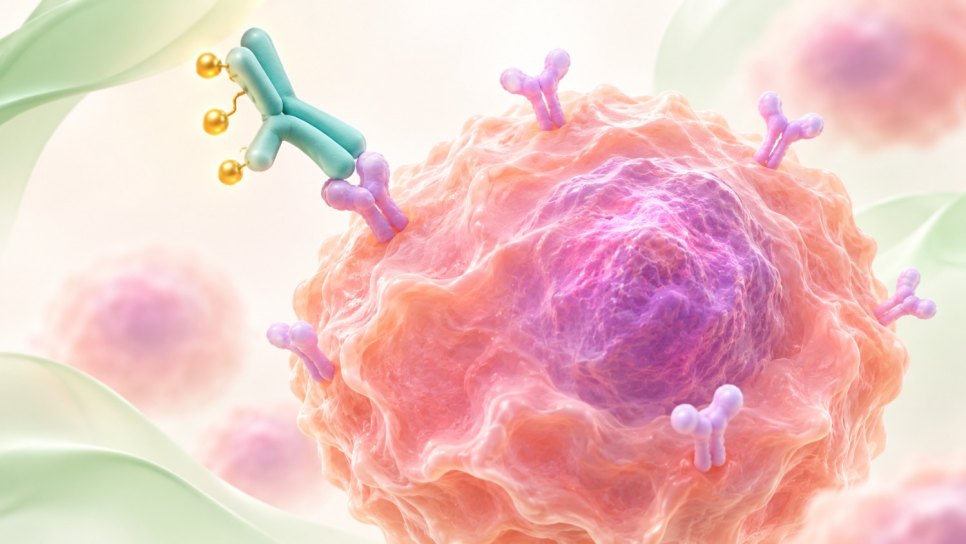
For a long time, a HER2-negative result meant no benefit was expected from anti-HER2 drugs. Studies such as NSABP B-47 had shown that adding trastuzumab brought no benefit in IHC 1+ or 2+/FISH-negative tumors. The change came with T-DXd. This drug is an antibody-drug conjugate in which an antibody that recognizes HER2 carries a potent chemotherapy payload into the cell; it was shown to work even when the target carries only a little HER2.
DESTINY-Breast04 showed this in a randomized phase 3 trial and led to US approval on August 5, 2022 for HER2-low metastatic breast cancer. DESTINY-Breast06 moved T-DXd to a step before chemotherapy, in hormone receptor-positive disease; it was approved in the US on January 27, 2025 and by the European Commission in April 2025.
| Feature | DESTINY-Breast04 | DESTINY-Breast06 |
|---|---|---|
| Patient group | HER2-low metastatic breast cancer (hormone receptor-positive or negative); had received chemotherapy in the metastatic setting or relapsed during or within 6 months of adjuvant chemotherapy | Hormone receptor-positive, HER2-low or HER2-ultralow metastatic disease; progressed on endocrine therapy and had not yet received chemotherapy in the metastatic setting |
| Number of patients | 557 (373 T-DXd, 184 chemotherapy) | 866 (713 HER2-low, 153 HER2-ultralow) |
| Comparator | Physician’s choice chemotherapy (eribulin, capecitabine, gemcitabine, nab-paclitaxel or paclitaxel) | Physician’s choice chemotherapy (capecitabine, paclitaxel or nab-paclitaxel) |
| Median progression-free survival (T-DXd / chemotherapy) | All patients: 9.9 / 5.1 months (HR 0.50; 95% CI 0.40-0.63). Hormone receptor-positive: 10.1 / 5.4 months (HR 0.51; 95% CI 0.40-0.64) | HER2-low: 13.2 / 8.1 months (HR 0.62; 95% CI 0.51-0.74). HER2-ultralow: 13.2 / 8.3 months (HR 0.78; 95% CI 0.50-1.21; prespecified exploratory analysis) |
| Median overall survival (T-DXd / chemotherapy) | At 32 months of follow-up, all patients: 22.9 / 16.8 months (HR 0.69; 95% CI 0.55-0.86). Hormone receptor-positive: 23.9 / 17.6 months (HR 0.69; 95% CI 0.55-0.87) | Immature at first analysis; in HER2-low HR 0.83 (95% CI 0.66-1.05), not significant |
| Approval | US: August 5, 2022 | US: January 27, 2025; European Union: April 2025 |
The trials enrolled different patient groups (DESTINY-Breast04 after chemotherapy, DESTINY-Breast06 before chemotherapy); the numbers cannot be substituted for one another. In each row, the first value is the T-DXd arm and the second is the chemotherapy arm.
Figure 2 · Median times: T-DXd and chemotherapy
In months. Taken from two separate trials and not comparable with each other; the bars compare only the two arms of the same trial.
Safety: What Is the Cost of T-DXd?
The most important side effect of T-DXd, which needs close monitoring, is interstitial lung disease (ILD) or pneumonitis. In the long-term analysis of DESTINY-Breast04, adjudicated ILD/pneumonitis was reported in 12.1% of patients; in DESTINY-Breast06, 3 of 436 patients treated with T-DXd had a loss of life caused by ILD. New cough, shortness of breath or fever should be reported to the treatment team without delay.
Other side effects and the monitoring plan are detailed in the drug’s prescribing information; make the decision together with your doctor, weighing benefit and risk for you.
What Does This Mean, and What Does It Not Mean?
- Measurement variability: Disagreement between pathologists is greatest at the 0/0+/1+ and 1+/2+ boundaries. Technical factors such as fixation time, section thickness, antibody and staining platform affect faint staining; staining may fade in archived blocks.
- Change within the tumor and over time: HER2 expression can vary in different parts of a tumor and between biopsies. In 547 women whose primary tumor was matched with the relapse, HER2 status was discordant in 39%; 15% of HER2-negative primaries became HER2-low at relapse, and 14% of HER2-low primaries became HER2-negative. Part of this difference may be technical.
- Not a separate disease: HER2-low does not define a biological subtype; it spans hormone receptor-positive and triple-negative tumors together. Independent prognostic value in early-stage disease has not been proven.
- The threshold debate: DESTINY-Breast04 enrolled only 1+ and 2+/ISH-negative patients; CAP notes that this did not prove a new predictive threshold between 0 and 1+. The ultralow definition rests only on the hormone receptor-positive patients of DESTINY-Breast06.
- Licensing and reimbursement: Enhertu is licensed in Türkiye, and its product information lists HER2-low metastatic breast cancer (our Enhertu article, Turkish). It is reported not to be covered by SGK; for the current situation, ask your treatment team and follow SGK announcements (access to FDA-approved drugs in Türkiye, SGK reimbursement conditions; both Turkish).
- If your report has no score: Ask the pathology lab in writing for the IHC score (0, 0+, 1+, 2+, 3+) and, if done, the FISH result; the word “negative” alone does not show whether you are HER2-low.
- Old block and new biopsy: If a decision is needed in metastatic disease, the tumor board can re-evaluate old blocks or request a new biopsy.
- Tumor board: The treatment decision is made through the joint evaluation of the medical oncologist, pathologist, surgeon and radiation oncologist.
- Clinical trials: New antibody-drug trials continue for HER2-low disease; you can talk to your doctor about taking part (what is a clinical trial?, Turkish).
Questions You Can Ask Your Doctor
- What is the HER2 IHC score in my report (0, 0+, 1+, 2+)? If it is 2+, what is the FISH result?
- What stage is my disease, and does my HER2-low result change my treatment choice now?
- Is my hormone receptor positive or negative, and how does that affect the T-DXd option?
- If the disease progresses, is a new biopsy needed to measure HER2 again?
- If T-DXd is considered, how are lung side effects monitored and how is access to the drug arranged?
Common Misconceptions
- “HER2-low means HER2-positive.” No. HER2-low is HER2-negative in the classic sense; anti-HER2 treatments such as trastuzumab or pertuzumab are not given to this group for that reason.
- “HER2-low is a new type of cancer.” No. It is not a separate biological subtype but the name of a measurement result; it appears in both hormone receptor-positive and triple-negative tumors.
- “If my score is 1+, I will get Enhertu.” No. Approvals depend on specific conditions, on metastatic or unresectable disease and on prior treatments; the decision is made by the tumor board.
- “If my report does not say HER2-low, I do not have it.” No. Many labs write only “HER2 negative”; the IHC score may not be stated in the report. Asking for the score is enough.
Frequently Asked Questions
- What does HER2-low mean in a pathology report?
- It means a HER2 IHC score of 1+ or 2+ with a negative ISH/FISH test (no gene amplification). The tumor is not HER2-positive, but it can matter in metastatic disease for drugs such as T-DXd.
- Is score 2+ with a negative FISH HER2-positive?
- No. A score of 2+ is considered equivocal; if FISH is negative, the HER2 gene is not amplified and the tumor is HER2-negative (HER2-low). If FISH is positive, it is HER2-positive.
- Is trastuzumab (Herceptin) given for HER2-low?
- No. Studies showed that adding trastuzumab brings no benefit in HER2-low tumors. T-DXd, a newer-generation antibody-drug conjugate, is used in metastatic disease under specific conditions.
- Does HER2-low change my treatment and outlook?
- In metastatic or unresectable disease it can bring the T-DXd option into the discussion. In early-stage disease it does not change treatment today, and its independent prognostic value has not been proven.
- Can HER2-low status change over time?
- Yes. When primary tumors were compared with relapses, HER2 status differed in about 39% of cases; part of this may be technical. For that reason, a repeat biopsy may be recommended when the disease progresses.
Glossary
- HER2
- A protein on the surface of some breast cancer cells that passes on growth signals; its gene is ERBB2.
- Immunohistochemistry (IHC)
- A test that shows, by staining, how much HER2 protein sits on the cell membrane and scores it from 0 to 3+.
- ISH / FISH
- A test that counts copies of the HER2 gene; FISH is one ISH method. It is added when IHC is 2+.
- HER2-low
- A tumor with IHC 1+ or IHC 2+ and a negative ISH; it is not HER2-positive.
- HER2-ultralow
- A tumor with IHC 0 and very faint membrane staining in ≤10% of cells; the term used in DESTINY-Breast06.
- Antibody-drug conjugate (ADC)
- A type of drug in which an antibody carries a potent chemotherapy payload to the target cell.
- Trastuzumab deruxtecan (T-DXd)
- An ADC in which a topoisomerase I inhibitor payload is attached to the antibody that recognizes HER2; brand name Enhertu.
- Hormone receptor (HR)
- The presence of estrogen and/or progesterone receptors in the tumor; it guides treatment choice.
- Metastatic breast cancer
- Breast cancer that has spread to other organs or cannot be removed by surgery.
- Progression-free survival (PFS)
- The time after treatment during which the disease does not progress; the median is the time reached by half of patients.
- Interstitial lung disease (ILD)
- Inflammation and stiffening of lung tissue; a side effect of T-DXd that is closely monitored.
DROZDOGAN Academy Commentary
HER2-low is not a new disease; it is a classification that rests on measurement sensitivity but truly affects drug decisions.
⚡ Why it matters
About half of the patients once labeled HER2-negative may now be candidates, in metastatic disease, for a treatment with demonstrated benefit. That is why writing the IHC score clearly in the pathology report can directly affect the treatment path.
✅ Strengths
A consistent progression-free survival advantage over chemotherapy in two randomized phase 3 trials; an overall survival benefit and long follow-up in DESTINY-Breast04; FDA and EU approvals; reporting guidance from ASCO/CAP and CAP.
⚠️ Limits
Inter-reader variability at the 0/0+/1+/2+ distinction; HER2 status changing over time; overall survival still immature in DESTINY-Breast06; the exploratory nature of the ultralow data; ILD risk; the reimbursement barrier in Türkiye.
🩺 In practice
The IHC score and, if done, the FISH result should be clearly readable in the report. In metastatic disease, if the decision hinges on T-DXd, a repeat biopsy and a second pathology opinion can be considered. In early-stage disease we do not present HER2-low as a finding that changes treatment.
❓ Open questions
Why should the line between 0 and 1+ be so decisive? Is there a real biological difference between ultralow and “zero” patients? What will be the role of T-DXd in early-stage HER2-low disease? Will more sensitive measurement methods change the classification?
Bottom line: HER2-low does not change the fact that the tumor is HER2-negative in the classic sense, but it is a valid door to T-DXd in metastatic disease. Knowing your score and getting it in writing is the first step toward learning whether that door opens for you.
- This article was prepared in November 2026.
- Result figures come from the Nature Medicine (2025) long-term analysis and FDA approval summaries for DESTINY-Breast04, from the NEJM (2024) publication and ESMO/FDA summaries for DESTINY-Breast06, and reporting information from the 2023 ASCO/CAP update and the CAP reporting template. The long-term ILD rate in DESTINY-Breast04 (12.1%) and the number of ILD-related losses of life in DESTINY-Breast06 were compiled from secondary news and analysis sources; the primary-versus-relapse HER2 discordance (547 women) comes from a conference report. These sources were not reviewed line by line.
- Licensing and reimbursement information for Türkiye rests on the Enhertu article on our site; it was not separately verified with official sources (TİTCK, SGK) and may change. Illustrations are simplified. The Academy commentary is our own.
- This article is not medical advice; make your health decisions together with your doctor.
Sources
- Wolff AC, Somerfield MR, Dowsett M, et al. Human Epidermal Growth Factor Receptor 2 Testing in Breast Cancer: ASCO-College of American Pathologists Guideline Update. J Clin Oncol. 2023;41(22):3867-3872. doi:10.1200/JCO.22.02864. pubmed.ncbi.nlm.nih.gov
- Modi S, Jacot W, Iwata H, et al. Trastuzumab deruxtecan in HER2-low metastatic breast cancer: long-term survival analysis of the randomized, phase 3 DESTINY-Breast04 trial. Nat Med. 2025;31(12):4205-4213. doi:10.1038/s41591-025-03981-4. pmc.ncbi.nlm.nih.gov
- Trastuzumab Deruxtecan after Endocrine Therapy in Metastatic Breast Cancer (DESTINY-Breast06). N Engl J Med. 2024. Full-text copy. repository.cam.ac.uk
- ESMO. Trastuzumab Deruxtecan Prolongs PFS After Endocrine-Based Therapy in Patients with HR-positive, HER2-low or HER2-ultralow Metastatic Breast Cancer. 17 October 2024. esmo.org
- ONS Voice. FDA Approves Fam-Trastuzumab Deruxtecan-nxki for HER2-Low Breast Cancer. August 2022. ons.org
- OncLive. FDA Approves Trastuzumab Deruxtecan for Pretreated HER2-Low and -Ultralow Metastatic Breast Cancer. January 2025. onclive.com
- OncLive. T-DXd Wins EU Approval for HR+, HER2-Low or -Ultralow Metastatic Breast Cancer After Endocrine Therapy. 4 April 2025. onclive.com
- College of American Pathologists. Template for Reporting Results of Biomarker Testing of Specimens From Patients With Carcinoma of the Breast (Breast.Bmk 1.6.2.0). 2026. cap.org
- Liang K, Jia Z, et al. HER2-low and HER2-ultralow breast cancer in the antibody-drug conjugate era: diagnostic challenges and reporting workflow. Diagn Pathol. 2026;21:79. pmc.ncbi.nlm.nih.gov
- Medicom Medical Publishers. Evolution of HER2-low status from primary tumor to relapse (Miglietta et al.), conference report. conferences.medicom-publishers.com
- HER2-Low Breast Cancer: Current Knowledge and Future Directions. PubMed Central. pmc.ncbi.nlm.nih.gov
- OAE Publishing. HER2-low metastatic breast cancer: molecular insights and therapeutic strategies. 2023. oaepublish.com
- ApexOnco. ASCO 2024: Enhertu nears its "ultralow" dream. June 2024. oncologypipeline.com
- PatSnap Insights. DESTINY-Breast04 safety profile of T-DXd (long-term data). patsnap.com
- ClinicalTrials.gov. DESTINY-Breast04 protocol (NCT03734029). clinicaltrials.gov
Was this article helpful?
Your feedback helps us improve our content.