Is AI Speeding Up Its Own Development? The METR Report and the Changing Role of Humans in Science
In this article
Is AI Speeding Up Its Own Development? The METR Report and the Changing Role of Humans in Science
For a long time there was a comforting assumption in artificial intelligence: "as problems get harder, progress slows down on its own." An evaluation by the independent organization METR (Model Evaluation & Threat Research), carried out inside Anthropic between August and October 2026 and published on 5 November 2026, weakens that assumption. According to the report, the rate at which Anthropic's models gain capability has risen to about 1.9 times its pre-October 2025 pace, and METR attributes most of that acceleration to AI's own contribution to research. In this article I explain what the report says and what it does not say, the timelines that follow from these data, and what I think is the real issue: the bottleneck in producing science is moving, and the human role is shifting from producing to selecting and verifying. I covered AI's place in medical publishing in my article on JAMA's AI rules (in Turkish).
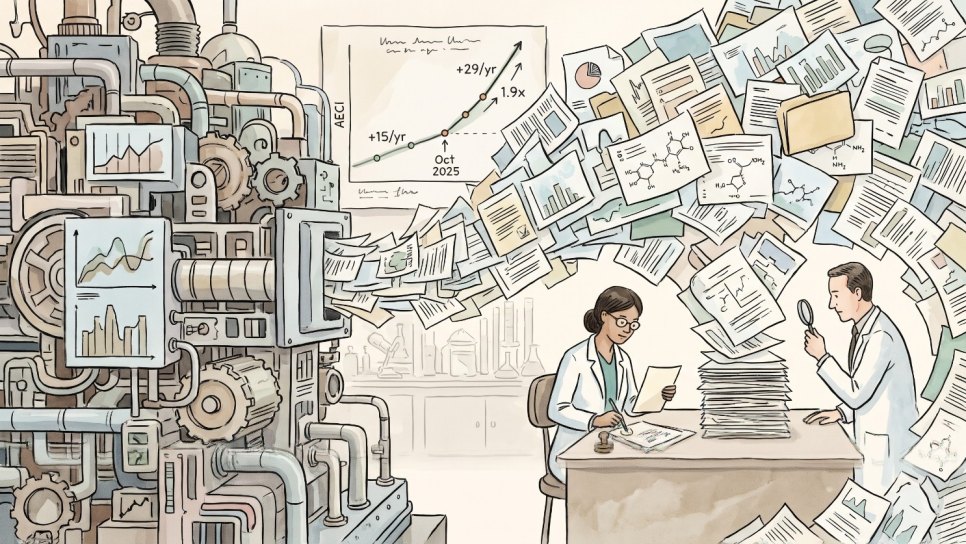
- What did the report find? The combined capability index of Anthropic's models (AECI) has been rising about 1.9 times faster since October 2025 (95% CI 1.5-2.8): from roughly 15 to 29 points per year. METR subjectively attributes about 80% of this acceleration to AI itself.
- What did it not find? AI cannot yet make fully independent contributions to the most critical parts of model development. No convincing bottleneck was found for the next 12 months either; however, METR has low confidence in this assessment.
- Limits: Most of the most informative evidence was redacted at the company's request for confidentiality. How test scores translate into real-world capability is unclear. Acceleration is smaller in other companies' models (1.4 times).
- What it means for us: The direction matters, not an exact date. As access to information gets easier, choosing the right question, testing results critically and applying them responsibly are becoming the decisive skills. In medicine, clinical validation remains a separate and slow bottleneck.
Why does this topic matter?
AI is now entering every area of medicine, from diagnosis and treatment selection to drug development and scientific publishing (the AACR 2026 report and AI, AI that predicts immunotherapy response; both in Turkish). How fast these tools develop directly affects how physicians, researchers and institutions plan the next few years.
Until now, most of the speed was explained by more computing power and more data. What the METR report adds is that progress is now partly fed by AI's own contribution to research. In other words, a better model means faster research, which means a better model. Whether this loop is real, and how strong it is, will shape how science is done well beyond the technology world.
What does the METR report say?
The METR report estimates that the rate at which Anthropic's models gain capability rose to about 1.9 times its earlier pace after October 2025, and that most of this acceleration comes from AI's contribution to research. AI is not yet running research fully independently; its contribution is largely supportive.
METR assessed the acceleration from several sources: a capability index combining the company's internal and external tests (AECI), internal measurements of pretraining, reinforcement learning and computing power, interviews with about 15 employees, productivity gains reported by employees themselves, and data such as lines of code and usage spending. The most striking finding in the chart is that the annual rise in the capability index went from about 15 points to 29: in the last year alone, roughly two years' worth of earlier progress took place. METR is confident that this acceleration cannot be explained by the increase in computing power used for training.
Annual rise in the capability index
Anthropic models, AECI (combined score of internal and external tests); points per year.
In one year, roughly two years' worth of earlier progress. The acceleration is not explained by the increase in computing power used for training. How the index scores translate into real-world capabilities is uncertain.
How robust is the estimate?
METR states openly that the result is sensitive to analysis choices. When assumptions about test difficulty, the way the trend is calculated and the choice of tests change, the acceleration estimate varies between 1.1 and 2.9 times. The acceleration calculated for other companies' frontier models is lower, about 1.4 times. In addition, because the most advanced internal model scored above 50% on all 15 tests used, measurement with the current tests is becoming harder.
How robust is the acceleration estimate?
Ratio of the rate of gain after October 2025 to the rate before; 1 = no acceleration.
Test difficulty, the way the trend is calculated and the choice of tests all change the result. Because the most advanced internal model scored above 50% on all 15 tests, measurement is becoming harder.
The interviews paint a similar picture. Of the 11 interviews that were classified, 5 said progress had accelerated by more than 2 times, 4 were borderline or uncertain, and 2 said no. Employees' self-reported productivity gains reached up to 12 times for the most capable internal model; however, METR describes this as "very loose evidence." METR's 2025 developer study had already shown clearly that self-reported productivity can be misleading.
Researchers' views
The 11 Anthropic employees METR interviewed; answers to "has progress accelerated by more than 2 times?", number of people.
Employees' self-reported productivity gains reached up to 12 times for the most capable internal model; METR describes this as "very loose evidence." AI cannot yet make fully independent contributions to the most important parts of model training, but there are "signs of life."
What the report does not say
- AI is not running research on its own. According to METR, AI cannot yet make fully independent contributions to the most important parts of model development; its contribution is largely supportive.
- An important part of the evidence is not visible. The company used its right to redact information it considered competitively sensitive. METR itself states that the public has to rely largely on its judgment and that the report could not provide transparency of the evidence.
- A test score is not the real world. How gains on tests translate into real-world capability is unclear. The report also notes that focusing on well-defined, verifiable tasks may overstate the acceleration.
- A single company. The assessment was carried out only at Anthropic; acceleration appears smaller in other companies' models.
These limits do not reduce the report's value, but they call for careful reading. As I often see in health news, a striking chart and solid evidence are not the same thing (seemingly solid studies, evidence-based medicine; both in Turkish).
Why did the "problems get harder, so progress slows" assumption weaken?
Jonathan Mann, the author who interprets the report, writes that he once hoped rising difficulty would hold acceleration back, but no longer thinks so. In his reading, progress really is getting harder, but not at the expected rate. Rising investment and the contribution to research of models that become more capable with each generation more than make up for the slowdown that would normally occur. The METR report likewise says it sees no clear sign of diminishing returns over the next 12 months, and that this carries the risk of a compounding acceleration.
Figure 1 · Brake and accelerator
Harder problems and faster research
Timelines: a direction, not a certainty
Based on this picture, Jonathan Mann moves his median estimate for transformative-level AI (TAI) to mid-2029, about a year earlier than his estimate a year ago. He puts the probability of reaching this level much earlier, next year, through a sudden breakthrough at roughly one in six. With that probability included, the median shifts to mid-2028. However, taking delaying factors into account, such as regulation, chip supply disruptions or the need for a new approach, he keeps his overall median at mid-2029.
According to the author's calculation, reaching this level requires METR's "time horizon" measure (the length of tasks AI can complete independently) to double 6 to 12 times. If each doubling initially takes about 4 months and this shortens over time, that corresponds to a window of 2 to 4 years. This is shorter than the strategic planning cycle of most institutions and the length of a doctoral thesis.
Figure 2 · The 2-to-4-year window
A rough calculation and delaying factors
Two things should be kept in mind when reading these estimates. First, the estimate is the interpretation of a single author, based on public data and impressions from within the industry; it is not a certainty. Second, in METR's first study in 2025 the doubling time of the time horizon was about 7 months; the 4-month figure reflects a newer and faster trend, and there is no guarantee that this trend will continue. Even so, there appears to be no strong reason for the direction to change.
The bottleneck is moving
The scarce resource in producing science is changing. AI can scan the whole existing literature, generate hypotheses, and run thousands of analyses and experiments in parallel. By contrast, the human researcher's attention is still limited. In Jonathan Mann's words, the most productive research ideas are being used up faster than new ones are produced; the low-hanging fruit is running out, and gains increasingly have to come from more marginal sources. But machine intelligence's capacity to scan and try is large enough to offset this marginality.
The practical meaning is this: the human role in research is shifting from producing to selecting and verifying. Which question is worth asking? Which result is reliable? Which finding should be carried into the real world? These decisions are becoming the most important human element that determines the pace of progress. Most of history's great discoveries also began, in fact, with asking the right question (Aziz Sancar and DNA repair, the 2026 Nobel Prize in Medicine; both in Turkish).
Figure 3 · Division of labor in research
From producing to selecting and verifying
What does this mean for medicine and oncology?
This picture is starting to show up in medicine too. AI is beginning to recognize several diseases from a single blood sample, catch findings missed on images, and extract treatment targets from large genomic datasets (many diseases from one blood sample, AI in colonoscopy, proteo-genomic map; all in Turkish). Work that took the Human Genome Project 13 years can now be done in days; reading the activity of thousands of genes from a single blood sample and turning it into a treatment decision now depends largely on computing power (the Human Genome Project, the whole-blood transcriptome atlas, the actionable transcriptome; all in Turkish). AI also makes it possible to extract new biological information from routine images (brown fat on PET-CT, in Turkish). As hypothesis generation and data analysis speed up, an oncologist's or researcher's real contribution will be asking the right question and critically testing the findings that emerge.
In medicine, however, there is one more bottleneck that AI research does not have: clinical validation. To show that a drug truly helps patients live longer and better, you need volunteer patients, a stepwise process starting with first-in-human studies, years of follow-up and rigorous safety assessment (what is a phase 1 study?, in Turkish). AI can generate a hypothesis in a day, but it cannot measure overall survival in a day. It is worth remembering that many plausible-looking hypotheses have failed to be confirmed in large clinical trials (an outcomes trial with a negative result, what is a clinical trial?; both in Turkish). For this reason, in medicine the acceleration will depend less on the laboratory than on clinical trial design, patient selection and correct interpretation of the data.
The relationship between patient and physician is changing too. My patients now come to appointments with questions they prepared using AI; this is not a threat but, if well managed, an opportunity (when a patient comes with AI, in Turkish). Attempts to have AI go as far as writing prescriptions bring questions of responsibility and safety to the fore (the AI prescription pilot in Utah, in Turkish).
Reasons for caution
- Test scores are not the real world. A model that does well on tests may not show the same success in complex and uncertain real-world tasks.
- Self-reported productivity can mislead. In METR's randomized study in 2025, developers thought they were faster when they were actually slower.
- Part of the evidence is confidential. Even though the assessment is independent, the most informative data are not public.
- External factors. Regulation, chip supply, energy and the need for a new approach could stretch the timeline.
- The risk of exaggeration is high in fast-moving fields. In science, examples of hype and promotion getting ahead of the evidence are not rare (hype and reality in science, in Turkish).
Questions we should ask ourselves
- Has my institution or team planned how AI will change research and clinical workloads over the next 2-4 years?
- By what method do I verify a result produced with AI?
- Am I passing on information to my students and assistants, or teaching them to ask the right question and think critically?
- Are rules ready to protect patient data and patient safety?
- Who decides to carry a finding into the clinic, and on what evidence?
- "AI is now improving itself." Not exactly. According to METR, its contribution is largely supportive; it is not fully independent in the most critical work.
- "Transformative AI is certainly coming in 2029." No. This is a single author's probabilistic median estimate; it could come earlier or later.
- "The measured acceleration applies to the whole AI sector." The assessment was carried out at a single company; acceleration appears smaller in other companies' models.
- "AI will leave no need for physicians and researchers." The role will change: selecting, verifying and taking responsibility will come to the fore more than producing.
- "AI will speed up everything in medicine at the same rate." Clinical validation requires patients, time and safety; this bottleneck does not disappear by itself.
Frequently Asked Questions
- What does the METR report say?
- According to the independent assessment METR published in November 2026, the rate at which Anthropic's models gain capability rose to about 1.9 times its earlier pace after October 2025 (95% CI 1.5-2.8). METR attributes most of this acceleration to AI's contribution to research, but notes that AI is not yet running research fully independently.
- When is transformative AI expected?
- In Jonathan Mann's interpretation based on the METR report, the median estimate is mid-2029, about a year earlier than his estimate a year ago. When the chance of a sudden breakthrough is included, mid-2028 comes to the fore. These estimates are probabilities, not certainties, and could change with factors such as regulation or chip supply.
- How is AI changing scientific research?
- AI is quickly taking over tasks such as scanning literature, generating hypotheses, analyzing data and running experiments. As a result, the human role is shifting from producing to selecting and verifying: choosing the right question, testing results critically and carrying findings into the real world responsibly come to the fore.
- How will this acceleration affect medicine?
- Acceleration is expected in diagnosis, imaging, genomic analysis and drug discovery. However, showing that a treatment truly benefits patients requires clinical trials, years of follow-up and safety assessment. This bottleneck will keep its importance no matter how fast AI accelerates.
Glossary
- METR
- A research organization that independently evaluates the capabilities and risks of AI models.
- AECI
- A capability index combining Anthropic's internal and external tests; an adaptation of the Epoch Capabilities Index.
- R&D automation
- The performance of part of research and development work by AI.
- Time horizon
- The length of tasks, measured in the time a human would need, that an AI model can complete independently at a given success rate.
- Doubling time
- The time it takes for a measure to double.
- TAI
- Transformative-level AI; a level of capability that could fundamentally change the economy and science.
- Bottleneck
- The scarcest resource that limits the speed of a process.
- Diminishing returns
- A gain that keeps shrinking for the same effort.
- Confidence interval
- The range of estimates within which the true value lies with a given probability.
- Clinical validation
- Showing through clinical studies that a diagnosis or treatment provides real benefit to patients.
DROZDOGAN Academy Commentary
This report points to a direction more than it gives a date. AI's development is accelerating partly through its own contribution, and this acceleration does not look likely to slow down by itself in the near term. The real question should not be "when" but "what will we focus on."
⚡ Why it matters
In a world where access to information becomes nearly unlimited and cheap, competitive advantage will lie not in having information but in choosing the right question, testing results critically and applying them responsibly.
✅ Strengths
An independent assessment with access to internal company data; several sources of evidence; uncertainties and limits stated openly; a numerical estimate given with a confidence interval.
⚠️ Limits
An important part of the evidence is redacted; a single company; how test scores translate to the real world is unclear; the timelines are a single author's interpretation.
🩺 In practice
In my team and with my students, I try to put asking the right question, questioning the source and testing the result ahead of memorizing information. I consider it essential to pass every finding produced by AI through the filter of evidence-based medicine before it reaches the patient.
❓ Open questions
Will the acceleration be seen at other companies and in other fields of science? To what extent will the rise in test scores carry over to the real world? How will clinical validation processes adapt to this pace? Who will oversee the safe and fair use of this power, and how?
Conclusion: In a world with systems more capable than the smartest human, the advantage will lie not in access to information but in choosing the right question, testing results critically and applying them responsibly. Those who do not build these competencies today, at the institutional and individual level, will only watch the consequences of progress rather than its pace.
- This article was prepared in November 2026.
- Information about the report is based on METR's publication of 5 November 2026. Some parts of the report were redacted at the company's request; METR states this openly in the report.
- The timelines are based on Jonathan Mann's personal blog post; they are not an official estimate of any institution. The "2-to-4-year window" is a rough calculation made with this author's assumptions.
- The charts and diagrams in the article are simplified. The Academy commentary is my own.
Sources
- METR. Independent assessment of AI R&D acceleration at Anthropic in October 2026 (5 November 2026). metr.org
- METR. Benchmarks provide one piece of evidence for acceleration (X, November 2026). x.com
- Mann J. My read on METR's AI R&D report. Abstraction (November 2026). abstraction.substack.com
- LessWrong. METR: Independent assessment of AI R&D acceleration at Anthropic (discussion). lesswrong.com
Was this article helpful?
Your feedback helps us improve our content.