
What Is B-SYNC CAR-T? An Experimental Brain-Activated Glioma Approach Tested in Mice
In this article
What Is B-SYNC CAR-T? An Experimental Brain-Activated Glioma Approach Tested in Mice
In a study published in Science Translational Medicine on October 28, 2026, UCSF researchers introduced “B-SYNC” CAR-T cells, engineered to switch on only when they reach the brain. In models of diffuse midline glioma (DMG), one of the most serious childhood brain tumors, the tumor was cleared in every mouse tested across two human DMG models when the cells were delivered directly into the brain’s fluid spaces. These results come from mouse models, though; there is no proven treatment for children yet. We could not access the full text of the study while writing this article; the information rests on UCSF’s announcement and conference abstracts. This article does not interpret anyone’s report or treatment: decisions about your own child’s or relative’s treatment and follow-up are made by the pediatric oncology team that looks after them.
- What is B-SYNC? CAR-T cells carrying a synthetic “switch” (synNotch). When the sensor detects brevican, a protein found throughout the brain, the cell produces a CAR that targets tumor cells carrying EphA2 or IL13Rα2.
- What was shown? In mouse models: some intravenously delivered cells crossed into the brain and the CAR was expressed only there; when delivered into the brain’s fluid space (ICV), the tumor was cleared in every mouse across two human DMG models, and a second dose of tumor cells given about seven weeks later was rejected.
- What was not shown? There are no human efficacy or safety data. The reports give no quantitative toxicity data, mouse numbers or statistics.
- Level of evidence: Laboratory cells and mouse models only. A human trial is planned for “as early as April 2027”; that is an estimate.
What is B-SYNC CAR-T?
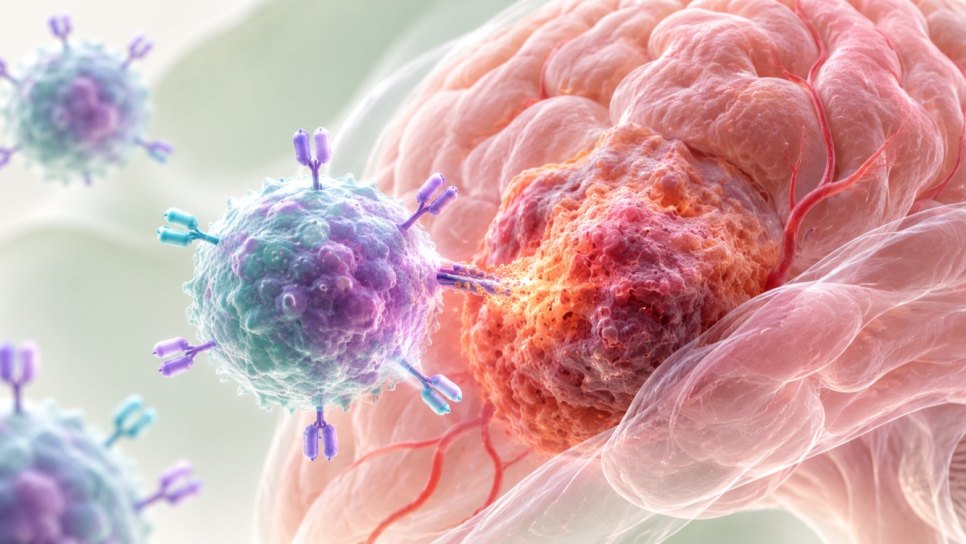
CAR-T is a cell therapy in which a patient’s own T cells are reprogrammed in the laboratory to recognize a target. B-SYNC is a two-step version: first a sensor on the cell surface (synNotch) detects brevican, a protein found throughout the brain, and then the cell produces the CAR that homes in on tumor targets. The CAR is therefore designed to stay off outside the brain and switch on inside it.
| Topic | Detail |
|---|---|
| Disease | Diffuse midline glioma (DMG): a childhood brain tumor that spreads into healthy tissue and also involves the brainstem |
| Sensor | A synNotch receptor that detects brevican, which is found throughout the brain |
| CAR targets | EphA2 and IL13Rα2, found on most DMG and glioblastoma cells (according to UCSF’s announcement) |
| Cell source | In the planned human trial, each patient’s own T cells |
| Route of delivery | Intravenous (IV) and into the brain’s fluid space (ICV); ICV requires a shunt running from the ventricles to a reservoir under the scalp |
Source: Lakshmanachetty et al., Science Translational Medicine, 2026 (DOI 10.1126/scitranslmed.aed9994); details are taken from UCSF’s press release and conference abstracts. We could not read the paper itself.
Figure 1 · B-SYNC’s two-step switch
The CAR is produced only when the brain signal is received
Why a design that switches on “only in the brain”?
B-SYNC’s predecessor E-SYNC was introduced in 2021 for glioblastoma and used a mutant protein called EGFRvIII as its sensor. Only about 20% of patients have tumors that carry EGFRvIII, and tumor cells can lose the protein during treatment. In B-SYNC the sensor instead binds brevican, which is found throughout the brain. The design thus aims to switch the CAR on in cells that reach the brain without depending on a tumor-specific marker.
| E-SYNC (2021) | B-SYNC (2026) | |
|---|---|---|
| Disease | Glioblastoma | Diffuse midline glioma (DMG) |
| Marker the sensor detects | EGFRvIII (in about 20% of patients) | Brevican (found throughout the brain) |
| Limitation | The tumor can lose EGFRvIII | Brevican is generally present in brain tissue; the consequences of this in humans have not been tested |
The UCSF researchers think that restricting CAR activity to the brain may have reduced T cell exhaustion before the cells reached the tumor. This is a hypothesis; the cause has not been confirmed.
What was shown in mice?
According to UCSF, some of the B-SYNC cells delivered intravenously crossed into the brain and homed in on the tumor, while the CAR was not expressed in blood or spleen. When the cells were delivered directly into the brain’s fluid space (ICV), the tumor was cleared in every mouse tested across two human DMG models; ordinary, constitutively active CAR-T cells could not control the cancer in the same model.
| Experiment | What was reported? |
|---|---|
| Intravenous (IV) | Some of the cells crossed into the brain and homed in on the tumor; no CAR expression was seen in blood or spleen |
| Brain fluid space (ICV) | The tumor was cleared in every mouse tested across two human DMG models |
| Constitutively active CAR-T | Could not control the cancer in the same model |
| Second tumor cells | When DMG cells were given again about seven weeks later, every mouse treated with B-SYNC rejected the new tumor |
| Persistence | The cells were reportedly still functional after more than 70 days (the researcher’s statement) |
| Earlier conference abstract (2024) | With a single IV dose, the tumor was completely cleared in 4 of 7 mice and survival was prolonged; it has not been confirmed that this is the same data as in the published paper |
No source gives mouse numbers, dose, survival curves or statistics. The “every mouse” statement rests on an observation whose details in the published paper we could not read.
Safety: what is known and unknown
The researchers say that earlier CAR-T approaches struggled to succeed in DMG without “unacceptable side-effects,” and that restricting the CAR to the brain is aimed at overcoming this. But UCSF’s announcement and the news reports contain no quantitative safety data.
A separate conference abstract (Neuro-Pediatrics, 2026) reported marked nervous system toxicity, even at low doses, in tumor-bearing and tumor-free mice after a B-SYNC version targeting B7-H3 and IL13Rα2 was delivered into the brain’s fluid space; the authors attribute this to B7-H3 also being present in normal brain tissue. Another version caused no such toxicity in a model with an intact immune system. We could not confirm whether the construct in that abstract is the same as the B-SYNC in the published paper. The safety question therefore remains open.
The human trial plan
A clinical trial is being prepared at UCSF Health and could begin as early as April 2027. It has not started; we could not confirm details on registration, approval or eligibility criteria.
| Topic | Reported |
|---|---|
| Timing | As early as April 2027 (an estimate) |
| Led by | First trial led by Marie Jaeger-Krause and Sabine Mueller |
| Cell source | Each patient’s own T cells will be converted into B-SYNC |
| Delivery | IV and ICV, to be tested in different combinations; for ICV, a shunt and a reservoir under the scalp allow repeated doses |
Figure 2 · Steps of evidence
Where does B-SYNC stand today?
Limits of this study
- All efficacy data rest on cell culture and mouse models; efficacy and safety in humans are unknown.
- Mouse numbers, doses, survival curves and statistics are absent from the news reports; we could not read the paper itself.
- Tumor clearance was reported with cells delivered directly into the brain’s fluid space; the effect of intravenous delivery is described more narrowly.
- Why brain-restricted activation produced a stronger response is not known; the researchers offer only a possibility.
- Because brevican is generally present in brain tissue, its effect on healthy brain tissue has not been tested in humans.
- A conference abstract from the same team reported nervous system toxicity with a version aimed at different targets; its relationship to the paper has not been confirmed.
- Only DMG models were studied; there are no results for other brain tumors.
- The human trial is a plan; its start date is an estimate.
Common misunderstandings
- “If the tumor was cleared in mice, it will be cleared in children too.” No. Mouse models do not fully reflect human disease; efficacy and safety in children are not yet known.
- “This treatment is approved or already in use.” No. The human trial is planned for April 2027 at the earliest and has not started.
- “Because it switches on only in the brain, it has no side effects.” No. The reports contain no quantitative safety data; a separate conference abstract reports toxicity in mouse brain with a different version.
- “It applies to every brain tumor.” No. The study examined DMG models only.
What does this news mean for you?
- This study does not change your child’s treatment plan; it is a laboratory study with no human data yet.
- If you are interested in clinical trials, ask the pediatric oncology team that follows your child about eligibility criteria and the current status.
- When you hear news of a new cell therapy, ask how many patients it was tried in and whether the data came from mice or from humans.
For this article we did not check whether such CAR-T cell therapies or clinical trial opportunities for DMG exist at centers in Turkey, nor the licensing and reimbursement conditions; we made no assumptions on these matters. For information about your own situation, consult the pediatric oncology team that follows your child.
DROZDOGAN Academy Assessment
This study reports that a smart design restricting CAR-T activity to the brain produced strong results in mouse models of a serious childhood brain tumor. Its clinical meaning depends on safety and efficacy being shown in a human trial.
⚡ Why it matters
In DMG, standard CAR-T approaches have remained limited. Activating the cell only in the brain is a design principle aimed both at limiting off-target effects and at reducing T cell exhaustion. Not depending on a tumor-specific marker also aims to overcome the limit of its predecessor E-SYNC.
✅ Strengths
The reported results look consistent across two human DMG models; ordinary CAR-T was used as a comparison, and the cells’ rejection of re-administered tumor cells suggests that persistence was also tested. The absence of CAR expression in blood and spleen after intravenous delivery fits the design’s expected behavior.
⚠️ Weaknesses
Mouse numbers, statistics and safety data are absent from the sources this article rests on; we could not read the paper itself. That cells delivered into the brain’s fluid space gave a clearer result than the intravenous route means the approach requires a shunt. That another version from the same team reportedly caused toxicity in mouse brain keeps the safety question open.
🩺 Practical meaning for patient and clinician
There is no practical change today. In future, the main questions are safety in humans, the dose, how the ICV and IV routes will be combined, and whether the mouse results will be repeated in children.
❓ Open questions
Is the effect on brain tissue safe in humans? Will the mouse results be repeated in children? Which delivery route or combination is better? Does brain-restricted activation really reduce T cell exhaustion? None of these questions is answered by this study.
Bottom line: B-SYNC is an experimental cell therapy approach reporting promising results in DMG mouse models; it is not a proven treatment in children. No diagnostic or treatment decision should be made on the basis of this finding; discuss everything about your child with the physicians who follow them.
Frequently asked questions
- What is B-SYNC CAR-T?
- An experimental two-step CAR-T cell therapy designed to produce a CAR that recognizes EphA2 and IL13Rα2 once it detects brevican, a protein found throughout the brain.
- Has it been tried in children?
- No. The results come from cell culture and mouse models. A human trial is planned for April 2027 at the earliest; that is an estimate.
- Why is it delivered into the brain’s fluid space?
- According to the reports, when delivered into the brain’s fluid space (ICV), the tumor was cleared in every mouse across two human DMG models. ICV requires a shunt running from the ventricles to a reservoir under the scalp, which allows repeated doses.
- Is it safe?
- Not known. The reports contain no quantitative safety data; a separate conference abstract reported toxicity in mouse brain with a version aimed at different targets, and its relationship to the paper could not be confirmed.
- Does it apply to other brain tumors?
- Not known. The study examined DMG models; this study reports no results for other tumors such as glioblastoma.
Glossary
- CAR-T
- A cell therapy in which a patient’s T cells are equipped with an artificial receptor (CAR) that recognizes a target.
- synNotch
- A synthetic receptor that, on detecting an external signal, switches on a specified gene inside the cell.
- Brevican
- A protein found throughout brain tissue.
- EphA2 and IL13Rα2
- Surface proteins found on many DMG and glioblastoma cells, targeted by the CAR.
- DMG
- Diffuse midline glioma; a brain tumor seen in children that arises in midline structures such as the brainstem.
- ICV
- Intracerebroventricular: delivery of a drug directly into the brain’s fluid spaces.
- E-SYNC
- The predecessor system introduced in 2021 for glioblastoma, whose sensor relied on EGFRvIII.
- T cell exhaustion
- Loss of T cell function after prolonged stimulation.
Verified: UCSF’s press release was read through its reproduction on three news sites (News-Medical, Technology Networks, RegMedNet) and through two conference abstracts from 2024 (SNO) and 2026 (Neuro-Pediatrics); the publication date and DOI are consistent across these sources. Only stated: Mouse numbers, doses, survival curves, statistics and safety data could not be read; the Science Translational Medicine page, UCSF’s own page and the PubMed record could not be accessed. The difference in target molecules between the conference abstracts (EphA2/IL13Rα2 versus B7-H3/IL13Rα2) could not be compared with the construct in the paper. Not verified and therefore not written: efficacy and safety in humans; the approval and registration status of the trial; how many mice were used; availability in Turkey; overlap with articles on drozdogan.com (not checked). The assessments and opinions belong to this article. This article is not medical advice; no diagnosis should be made or treatment decision taken on its basis.
Who is this article for? Families, relatives and health professionals interested in childhood brain tumors and cell therapies. Decisions about your own child’s situation can only be made by the physicians who follow them.
Sources
- Lakshmanachetty S, Simic MS, Watchmaker PB, et al. Brain-sensing synNotch–CAR T cells enable precise targeting and clearance of diffuse midline glioma in multiple preclinical models. Science Translational Medicine, 2026;18(873):eaed9994. DOI 10.1126/scitranslmed.aed9994. doi.org (full text not accessible)
- UCSF press release (reproduction): News-Medical, October 28, 2026
- UCSF press release (reproduction): Technology Networks, October 29, 2026
- Conference abstract (2024): Neuro-Oncology, Supplement 4, DIPG-15
- Conference abstract (2026): Neuro-Pediatrics, DOI 10.1093/neuped/wuag026.073
Was this article helpful?
Your feedback helps us improve our content.



