Cribriform and Tubular Breast Cancer: How They Differ From Classic Ductal Carcinoma and Their Course

In this article
If Your Pathology Report Says “Tubular” or “Cribriform”: Two Rare Types With a Generally Favorable Course
Tubular and cribriform carcinoma are two rare, low-grade subtypes of breast cancer with a distinctive look under the microscope. In large series these tumors recurred less often and followed a more favorable course than classic invasive ductal carcinoma; however, that does not mean “zero risk” or “no treatment needed.” This article summarizes the survival data and shows where the evidence is strong and where it is debated for surgery, radiotherapy, endocrine therapy, chemotherapy, and gene testing. For background, see our articles on breast cancer stages and treatment, in situ and invasive carcinoma, and terms used in pathology reports (in Turkish). Key source: Colleoni et al., Ann Oncol 2012 (doi:10.1093/annonc/mdr461).
- What was found: In cribriform carcinoma, 5-year disease-free survival was 97.9% versus 87.4% for classic ductal (HR 0.48); about 10 more of every 100 patients remained recurrence-free at 5 years.
- Basis: There are no randomized trials. The data come from retrospective series, registry databases (SEER, NCDB), and a subgroup analysis of the BIG 1-98 trial.
- Caution: The advantage is not the same on every measure: 13-year overall survival did not differ significantly from matched ductal cancer, and late recurrences occur. The findings apply only to “pure” types (more than 90%).
- In practice: Chemotherapy is often unnecessary, but decisions on radiotherapy and endocrine therapy are not one-size-fits-all and are made by a multidisciplinary team based on pathology, stage, and the individual.
Why does this matter?
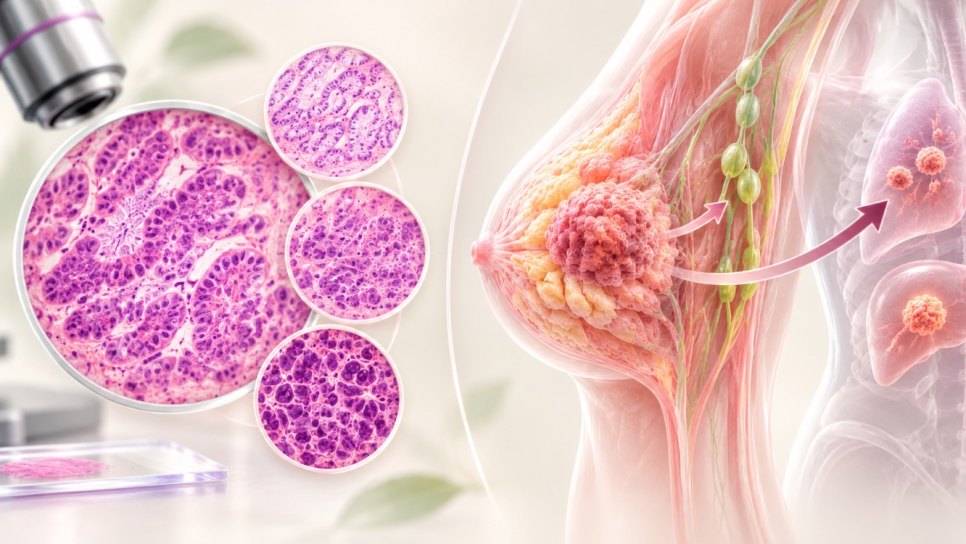
Most breast cancers are classified as “invasive ductal carcinoma of no special type” (classic ductal carcinoma); about a quarter are “special types” with a characteristic microscopic appearance. Tubular carcinoma consists of well-formed, angular small tubes (glands); invasive cribriform carcinoma consists of islands of cells with sieve-like holes between them. In the World Health Organization (WHO) classification, a tumor is called a “pure” type if more than 90% shows this pattern, and a mixed type if less.
Both are rare. Tubular carcinoma makes up about 1–4% of invasive breast cancers; reported frequencies for cribriform carcinoma range from under 1% to 3.5%. They are usually estrogen receptor (ER)- and progesterone receptor (PR)-positive, HER2-negative, low-grade (grade 1), luminal A–like tumors with little lymph node involvement. Because they are small, they may sometimes be found without a palpable lump; diagnosis is made by biopsy, but calling a tumor “pure” requires examining the whole tumor.
The real question is about treatment: because these tumors behave so favorably, people ask whether they need the full treatment given to classic ductal cancer or something lighter. Because they are rare, there are no randomized trials; the evidence is observational and hard to interpret.
No. It has long been known that special types behave differently from classic ductal carcinoma; what has changed is that large series now put numbers on it and question its effect on treatment decisions:
How do tubular and cribriform breast cancer differ from classic ductal carcinoma?
Tubular and cribriform carcinoma are rare breast cancer types with a distinctive microscopic appearance, usually low grade, hormone receptor-positive, and HER2-negative. In their pure forms, lymph node involvement is less common and recurrence rates are generally lower than in classic invasive ductal carcinoma. Late recurrences can still occur; treatment is not one-size-fits-all and is planned for each person.
What do they look like under the microscope and in the pathology report?
The table summarizes three patterns often seen in reports. Proportions vary from series to series; the statements show general trends.
| Feature | Tubular | Cribriform | Classic invasive ductal (no special type) |
|---|---|---|---|
| Microscopic appearance | Small, angular tubes with open lumens | Islands of cells with regular holes between them, like a “sieve” | Irregular cords, clusters, and sheets; highly variable |
| Threshold for “pure” type | More than 90% of the tumor | More than 90% of the tumor | No threshold |
| Grade | Mostly grade 1 | Mostly grade 1 | Grade 1–3 |
| Receptors | Mostly ER+/PR+, HER2− | Mostly ER+/PR+, HER2− | Varies by subtype |
| Lymph node involvement | Less common | Less common | More common |
| Frequency | About 1–4% of invasive breast cancers | Even rarer; under 1% to 3.5% depending on the source | About 75% |
Figure 1 · Three looks, three patterns
Schematic drawing; not to scale
How different is the course from classic ductal carcinoma?
Recurrence and disease-free survival
Among 7,372 patients with luminal invasive breast cancer operated on at the European Institute of Oncology in Milan between 1997 and 2005 (median follow-up 5.8 years), there were 250 cribriform and 83 tubular carcinomas. Five-year disease-free survival was 97.9% for cribriform, 98.7% for the pooled tubular-cribriform group, and 87.4% for classic ductal. The absolute difference is about 10 points: about 10 more of every 100 patients stayed recurrence-free at 5 years. “Disease-free survival” is the time without recurrence, a second cancer, or loss of life.
Colleoni 2012: 5-year disease-free survival
Percent. Colored bars show cribriform and tubular-cribriform groups; the gray bar shows classic ductal carcinoma.
Cribriform: HR 0.48, p = 0.015; pooled group: HR 0.45, p = 0.005. Median follow-up 5.8 years. Higher is better. Retrospective, single center, luminal tumors only.
What happened in every 100 patients at 5 years?
Colleoni 2012; values rounded to whole numbers.
Cribriform carcinoma
Classic ductal carcinoma
Actual values: 97.9% and 87.4%; the remainder is calculated to complete 100.
BIG 1-98: postmenopausal women on endocrine therapy
In the monotherapy cohort of BIG 1-98 (4,922 women; 4,091 with central pathology review), the tubular/cribriform group included 83 women. With a median follow-up of 8.1 years, 5-year breast cancer-free interval was 97.5% and distant recurrence-free interval 98.8% in this group, versus 88.9% and 90.9% in the ductal group.
BIG 1-98: recurrence-free interval at 5 years
Percent. Colored bars show tubular/cribriform (n = 83); gray bars show ductal (n = 3,257).
Groups from the same trial; all women received tamoxifen or letrozole for 5 years. Median follow-up 8.1 years. Higher is better. Subgroup analysis with few events.
Does the reassurance fade with long follow-up?
In a Canadian series (Poirier 2018), 13-year overall survival for tubular carcinoma was 89.0%, versus 85.8% for ductal carcinomas matched on age, size, node status, grade, and other features; the difference was not significant (p = 0.13). So the claim that “tubular is clearly better than classic ductal on every measure” does not hold. In the same series, 13-year survival was 95.8% for node-negative tubular patients and 90.0% for those with 1–3 positive nodes (p = 0.01).
Poirier 2018: 13-year overall survival
Percent. The gray bar shows matched classic ductal carcinoma.
Groups from the same series. All tubular versus matched ductal is not significant (p = 0.13); node-negative versus node-positive is significant (p = 0.01). Overall survival is also affected by age and other illnesses. Higher is better.
In the meta-analysis of tubular carcinoma (Metovic 2021), pooled disease-free interval was 96.4% at 5 years and 91.8% at 10 years. Among 54 patients with pure tubular carcinoma followed at Istanbul Faculty of Medicine between 2003 and 2020, 5-year overall survival was 97.9% and 10-year 93.6%.
Long follow-up: year 5 and year 10
Percent. Two different sources; lighter bar year 5, darker bar year 10.
Comparison across different studies is indirect; patient groups, endpoints, and follow-up differ. Higher is better. The Istanbul series is small (n = 54).
The curve starts very high but declines somewhat over time. Because late recurrence or a second breast cancer can occur, follow-up should not be limited to the first years.
How is treatment planned?
There is no separate treatment guideline for pure tubular and cribriform carcinoma based on randomized trials. In practice, the principles for early-stage hormone receptor-positive breast cancer are adapted; if pathology shows a mixed type or lymph node involvement, the tumor is usually handled like classic invasive ductal carcinoma.
Figure 2 · The path to a treatment decision
Simplified scheme; decisions are made with the team for each patient
Surgery and the axilla
Breast-conserving surgery or mastectomy is chosen based on tumor size and the individual; for the margin debate in breast-conserving surgery, see our article on the 2 mm surgical margin for DCIS. Because axillary lymph nodes are less often involved in tubular carcinoma, the extent of axillary surgery is debated: in the Istanbul series, 70.4% of patients had sentinel lymph node biopsy, 22.2% had axillary dissection, and 7.4% had no axillary surgery. For current approaches, see is removing axillary lymph nodes necessary, sentinel lymph node biopsy, and the relationship with axillary lymph nodes; for arm swelling after surgery, see lymphedema.
Radiotherapy
The need for radiotherapy is among the most debated issues. Three observational analyses reported different results:
| Study | Patients | Finding | Comment |
|---|---|---|---|
| SEER, 1992–2007 (2012) | Pure tubular carcinoma | Small absolute survival benefit of radiotherapy at age 65 or younger; can be omitted above 65 | The authors noted the benefit was small |
| SEER, Front Oncol 2018 | Age 65+, breast-conserving surgery, T1 N0 ER+ | Radiotherapy did not improve breast cancer-specific survival (p = 0.858) | Very few events |
| NCDB, 2004–2015 (2021) | pN0 M0, lumpectomy, after matching | 5-year overall survival 91.7% (radiotherapy) vs 84.5% (none); HR 0.58 | Overall survival measured; selection bias likely |
Because overall survival is affected by age and coexisting illnesses, these three results cannot be compared directly. There are data suggesting radiotherapy may be omitted, especially above age 65, but this approach has not been confirmed by a randomized trial; the decision should be made between the patient and the team.
Endocrine therapy
Because the tumors are ER-positive, endocrine therapy (tamoxifen or an aromatase inhibitor) is usually discussed; for options, see treatment options for hormone-positive breast cancer and letrozole. In the tubular/cribriform subgroup of BIG 1-98 (n = 83), breast cancer recurrence appeared higher with letrozole than with tamoxifen (HR 3.31; 95% CI 0.94–11.7; p = 0.06); the difference is not significant and the confidence interval is very wide. So letrozole’s advantage may not be as clear in these types, but this is an exploratory subgroup finding.
In another NCDB analysis (ER+, HER2−, pT1-2 N0, tubular/mucinous/cribriform; 2,482 matched pairs), adjuvant endocrine therapy was associated with better overall survival (HR 0.81; 95% CI 0.67–0.98; p = 0.03). Because the data are observational, this should not be taken as firm proof; the burden of long-term use, side effects, and sexual problems should also be weighed. For resistance to endocrine therapy later on, see resistance to hormonal therapy.
Chemotherapy
In an analysis of SEER data covering 6,486 tubular patients, chemotherapy was associated with worse breast cancer-specific survival (HR 3.20; p<0.001). This does not mean chemotherapy causes harm: a likely explanation is confounding, because chemotherapy was given to patients who looked riskier. Still, there is no evidence that these patients benefit from chemotherapy; the authors point to the risk of overtreatment. For which patients may skip chemotherapy, see patients who will not need chemotherapy after breast cancer surgery.
Gene expression tests
In a series examining the 21-gene Oncotype DX assay in special histologic subtypes (Tadros 2018), most patients had low scores, but depending on the subtype 12–25% had intermediate and 0.5–9% had high scores. So even when tumors look alike under the microscope, their biology is not always the same; whether the test is needed is discussed case by case. For details, see genomic recurrence score tests in lobular breast cancer and genomic testing: tumor biology or clinical risk?.
How should the results be read?
Strengths
- The Milan series, BIG 1-98, and registry databases point in the same direction: fewer recurrences in tubular/cribriform groups.
- Large samples (6,486 tubular patients in SEER) and long follow-up (13 years).
- The difference is clinically meaningful: about 10 more of every 100 patients stayed recurrence-free at 5 years.
- The findings fit the biology: low grade, ER+/HER2−, little lymph node involvement.
Points to keep in mind
- No randomized trials: All data are observational; treated and untreated patients may differ from each other.
- Variable definitions: The threshold for a “pure” type (90%) depends on the pathologist’s assessment; series may pool tubular and cribriform or include mixed types.
- Small subgroups: BIG 1-98 had 83 patients and the Istanbul series 54; few events mean wide confidence intervals.
- Selection bias: Patients given chemotherapy or radiotherapy may already be at higher risk, which can reverse the apparent results.
- Different endpoints: Disease-free survival, breast cancer-free interval, overall survival, and breast cancer-specific survival are not the same thing.
Practical tips for patients and families
If your diagnosis is tubular or cribriform carcinoma, these steps may help:
- Ask whether the tumor is pure or mixed, its grade, ER/PR/HER2 status, and the lymph node result in the pathology report.
- If the diagnosis was made by needle biopsy, remember that the final type becomes clear only after the whole surgical specimen is examined.
- For radiotherapy, endocrine therapy, and chemotherapy, ask “what is this decision based on, and what happens if I skip it?”
- If your family has many breast or ovarian cancers, discuss genetic counseling (BRCA carriers).
- Keep up follow-up (examination, mammography) for many years; ask your team about lifestyle (alcohol, exercise, prevention).
- If the decision is hard, consider a second opinion and ask about clinical trials.
- “Tubular or cribriform cancer is benign, so no follow-up is needed.” No. These are cancers; late recurrence and second cancers can occur, so follow-up should continue.
- “The course is good, so treatment can be skipped.” Not every treatment is unnecessary. Chemotherapy is often not needed, but radiotherapy and endocrine therapy are decided individually.
- “If the report says tubular features, it is pure tubular.” No. A pure type requires more than 90% of the tumor to show the pattern; if less, it counts as a mixed type.
- “These types always have better survival than classic ductal.” Not on every measure: in a matched analysis, 13-year overall survival did not differ significantly.
- We could not confirm a separate Turkish guideline or reimbursement rule for these two types; treatment is usually planned in a multidisciplinary breast tumor board using the principles for early-stage hormone receptor-positive breast cancer.
- Endocrine drugs such as tamoxifen and letrozole are widely used in Türkiye; for the license and reimbursement status of letrozole, see the article linked above, and for general rules see the guide to SGK cancer drug reimbursement conditions (SGK: the Turkish Social Security Institution).
- We could not confirm the reimbursement status of 21-gene expression tests (such as Oncotype DX) in Türkiye; whether a test is needed is decided by the pathology result and the treatment team.
- Data from Türkiye: among 54 patients with pure tubular carcinoma followed at Istanbul Faculty of Medicine between 2003 and 2020, 5-year overall survival was 97.9% and 10-year 93.6%.
Frequently asked questions
- Are tubular and cribriform breast cancers benign?
- No, both are cancers. However, they are low-grade tumors, usually hormone receptor-positive, with infrequent lymph node involvement, and recurrence rates are generally lower than in classic invasive ductal carcinoma. Because late recurrences can occur, follow-up should last a long time.
- Is chemotherapy needed for tubular or cribriform carcinoma?
- Often it is not. There is no evidence that pure types benefit from chemotherapy, and the risk of overtreatment is emphasized. The decision may change with a mixed type, lymph node involvement, or other high-risk features; it is made by the multidisciplinary team.
- Can radiotherapy be skipped?
- This is not settled. Some SEER analyses suggest radiotherapy may be omitted, especially above age 65, while an NCDB analysis reported a benefit in overall survival. Because the data are observational, the decision is made with the team based on age, tumor features, and patient preference.
- My report says “tubular features”; does that mean pure tubular carcinoma?
- No. A “pure” type requires more than 90% of the tumor to look tubular (or cribriform). If less, it is counted as a mixed type and is usually treated like classic invasive ductal carcinoma. The final type becomes clear after the whole surgical specimen is examined.
Glossary
- Tubular carcinoma
- A rare, low-grade invasive breast cancer type made of well-formed, angular small tubes with open lumens.
- Cribriform carcinoma
- A rare, usually low-grade breast cancer type made of islands of cells with sieve-like holes between them.
- Pure type
- A tumor in which more than 90% shows a single special pattern (tubular or cribriform).
- Invasive ductal carcinoma of no special type
- The classic type without a special pattern, making up most breast cancers.
- Luminal A–like
- A group of tumors that are ER- and PR-positive, HER2-negative, and slowly proliferating.
- Disease-free survival
- The time after treatment without recurrence, a second cancer, or loss of life.
- Sentinel lymph node biopsy
- Removal and examination of the first lymph node draining the tumor; in most patients it makes removing all axillary nodes unnecessary.
- 21-gene expression test
- A test that predicts recurrence risk from gene activity in the tumor (for example, Oncotype DX).
DROZDOGAN Academy Commentary
When a pathology report says “tubular” or “cribriform,” patients are often told it is reassuring news. That is true, but “favorable course” should not be read as “no follow-up and no treatment.”
⚡ Why it matters
Separating these types from classic ductal carcinoma is the first step toward avoiding unnecessary chemotherapy. The same distinction, however, carries the risk of false reassurance and inadequate follow-up.
✅ Strengths
Independent series (Milan, BIG 1-98, SEER, NCDB, Istanbul) point in the same direction, and the difference is meaningful in absolute terms too.
⚠️ Limitations
No randomized data; small subgroups; definitions can vary between pathologists; chemotherapy and radiotherapy results are affected by selection bias.
🩺 In practice
Once a pure type is confirmed on the report, we rarely bring up chemotherapy; we discuss radiotherapy and endocrine therapy one by one according to age, stage, and coexisting illnesses. We do not shorten follow-up. For the broader changes in breast cancer care in recent years, see our article based on the NEJM review.
❓ Open questions
In which pure tubular/cribriform patients can radiotherapy be omitted safely? Should the duration and type of endocrine therapy (tamoxifen or an aromatase inhibitor) differ in these types? In which patients do gene tests change the decision?
Bottom line: On average, tubular and cribriform breast cancers follow a more favorable course than classic ductal cancer; this justifies an approach with treatment intensity adjusted to the individual, not one without treatment or follow-up.
- This article was prepared in November 2026.
- It is based on the abstracts of the publications listed in the references; the full text of Munzone et al. was available, while for most of the others only abstracts could be read.
- The absolute difference (about 10 points), the rounded values for 100 patients, and the bar widths were calculated by us. Explaining the chemotherapy finding as confounding is our own interpretation.
- Frequency figures vary by source; the WHO 90% threshold is taken from the 5th edition (2019). Information about Türkiye (license, reimbursement, test access) should be confirmed before publication.
- Comparisons in the charts are between arms of the same study; only the “Long follow-up” chart places two different sources side by side. The schemes are derived from the text and contain no new data. The Academy commentary is our own.
- This article is not medical advice; consult your physician for diagnosis and treatment decisions.
References
- Colleoni M, Rotmensz N, Maisonneuve P, et al. Outcome of special types of luminal breast cancer. Ann Oncol 2012;23:1428-1436. doi:10.1093/annonc/mdr461
- Munzone E, Giobbie-Hurder A, Gusterson BA, et al. Outcomes of special histotypes of breast cancer after adjuvant endocrine therapy with letrozole or tamoxifen in the monotherapy cohort of the BIG 1-98 trial. Ann Oncol 2015;26:2442-2449. doi:10.1093/annonc/mdv391
- Poirier E, Desbiens C, Poirier B, et al. Characteristics and long-term survival of patients diagnosed with pure tubular carcinoma of the breast. J Surg Oncol 2018;117(6). doi:10.1002/jso.24944
- Metovic J, Bragoni A, Osella-Abate S, et al. Clinical relevance of tubular breast carcinoma: large retrospective study and meta-analysis. Front Oncol 2021;11:653388. doi:10.3389/fonc.2021.653388
- Zhao Y, Chai N, Li S, et al. Evaluation of the efficacy of chemotherapy for tubular carcinoma of the breast: a Surveillance, Epidemiology, and End Results cohort study. Cancer Med 2023;12:10326-10339. doi:10.1002/cam4.5763
- Tadros AB, Wen HY, Morrow M. Breast cancers of special histologic subtypes are biologically diverse. Ann Surg Oncol 2018. pmc.ncbi.nlm.nih.gov/articles/PMC6128764
- Association of endocrine therapy with overall survival in women with hormone receptor-positive, HER2-negative, node-negative breast cancer of favorable histology. Breast J 2020;26:2006-2010. researchconnect.buffalo.edu
- Prognostic impact of radiation therapy in tubular carcinoma of the breast. Radiother Oncol 2021;159:202-208. scholars.houstonmethodist.org
- Adjuvant radiation therapy and survival for pure tubular breast carcinoma: experience from the SEER database. 2012. PMID 22543207
- Omission of Postoperative Radiotherapy in Women Aged 65 Years or Older With Tubular Carcinoma of the Breast After Breast-Conserving Surgery. Front Oncol 2018;8:190. doi:10.3389/fonc.2018.00190
- Emiroglu S, Abuaisha AM, Tukenmez M, et al. Pure tubular breast carcinoma: clinicopathological characteristics and clinical outcomes. Eur J Breast Health 2023;19:115-120. doi:10.4274/ejbh.galenos.2023.2022-12-9
- WHO Classification of Tumours Editorial Board. Breast Tumours. WHO Classification of Tumours, 5th ed. IARC; 2019. tumourclassification.iarc.who.int
Was this article helpful?
Your feedback helps us improve our content.