
What Is Familial GİST (Gastroinstentinal Stromal Tumor)?

What is familial GİST?
Familial GİST (Gastroİnstentinal Stromal Tumor), which increases a person's GİST risk, is a hereditary syndrome. GİST is a type of tumor found in parts of the digestive system such as the esophagus, stomach, gallbladder, liver, small intestine, large intestine and rectum. The digestive system plays a central role in digesting food and liquids and removing waste. GİSTs originate from the interstitial cells of Cajal (ICC) in the wall of the digestive system.
GİSTs originate from mesenchymal cells and therefore differ from other digestive-system tumors. GİSTs belong to a group of cancers called soft-tissue sarcomas.
The illustration below shows in which organs gastrointestinal stromal tumors occur and in what proportions.
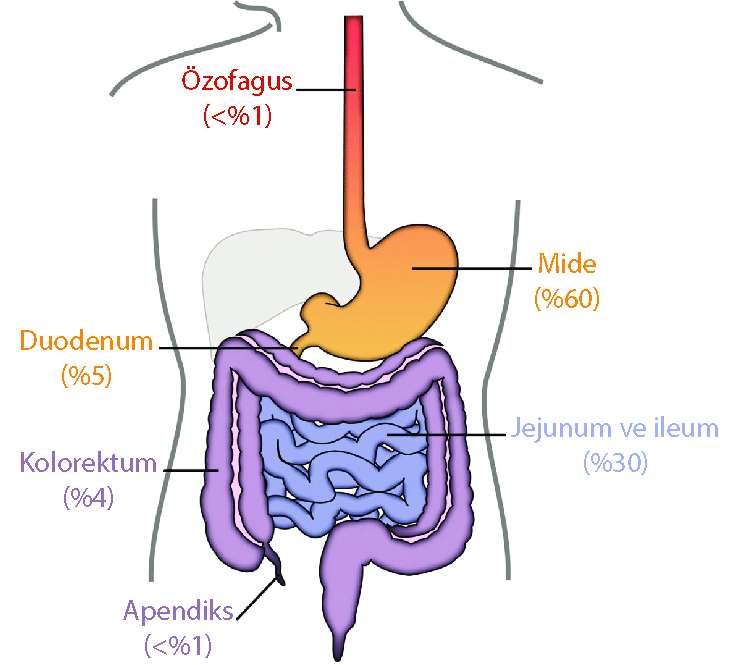
People with familial GİST may have several GİSTs at diagnosis. In familial GİST, tumors are seen most commonly in the stomach and small intestine. Tumors are usually diagnosed between ages 25 and 45. By comparison, nonhereditary GİST, also called sporadic GİST (arising by chance), generally occurs after age 50. All GİSTs have the potential to be cancerous and spread to other parts of the body. However, tumors caused by familial GİST spread to another part of the body less frequently than sporadic GİST.
When should familial GIST be considered?
- If someone in your family had GİST before age 50
- If someone in your family developed more than 1 GİST
- If two or more close relatives have been diagnosed with GİST
- Having a person with GİST in your family and another rare tumor type in a close relative
- Having a person with GİST in your family along with an NF1 gene mutation, multiple moles or rare skin problems
Once a GİST diagnosis is confirmed, if familial GİST is suspected, genetic testing may be recommended. For genetic testing, the patient's DNA can be collected through a saliva swab or blood test. A doctor or genetic counselor can review your personal and family health history to help determine whether you should consider such testing.
Genetic tests for familial GİST are still being developed. Studies may identify genes other than KIT or PDGFRA that cause the syndrome.
What are the symptoms of GİST?
As GİST grows, it may cause symptoms such as:
- Abdominal pain or discomfort
- An abdominal mass that you can feel with your hand
- Nausea and vomiting
- Blood in the stool or vomiting blood
- Fatigue due to anemia (a decrease in the number of red blood cells)
People with familial GİST often have additional symptoms, including:
- Occasional abdominal pain and problems with constipation and diarrhea, which in some people may be mistaken for irritable bowel syndrome
- Dark patches of skin on the body, known as skin hyperpigmentation, that usually become visible in childhood or adolescence. These are found more on the hands and feet than in the armpits or groin.
- Urticaria pigmentosa (a skin condition causing raised brownish patches that sting or itch). This condition may also increase the risk of skin infection in some people.
- Skin moles
- Difficulty swallowing, known as dysphagia
What causes familial GİST?
Familial GİST is passed from generation to generation in a family. The most commonly affected genes and the syndromes they cause are:
- Germline (hereditary) KIT and PDGFR gene mutations - primary familial GİST syndrome
- Neurofibromin (NF1) - Neurofibromatosis 1
- Succinate dehydrogenase (SDH) - Carney-Stratakis dyad / SDH-deficient GİST
Researchers continue to look for specific genes that may be associated with the development of familial GİST and may be used to help decide on the patient's treatment plan.
Overview of immunohistochemical staining and genetic analysis in gastrointestinal stromal tumors (GIST):
The blue dashed border indicates CD117 / DOG1 + GISTs. The orange sharp border indicates GISTs with KIT / PDGFRA mutations. The black dashed lines divide GISTs into somatic and germline mutations as groups.

How is familial GİST passed to subsequent generations?
Normally, each cell has 2 copies of a gene, one inherited from the mother and one from the father. Familial GİST, known to disrupt gene function, shows autosomal dominant inheritance, and a mutation in just one copy of a gene is sufficient for it to occur. This means that a parent with the gene mutation can pass a copy of either their normal gene or their mutated gene to their child. Therefore, a child with a parent who has the mutation has a 50% chance of inheriting it. The brother, sister or parent of a person with the mutation also has a 50% chance of having the same mutation. However, if the parents test negative for the mutation (no mutation is found in the test results), the risk to siblings is substantially reduced, although their risk may still be higher than average.
Some options are available for people who carry a hereditary cancer syndrome and want to have children. Preimplantation genetic diagnosis (PGT) is a medical procedure performed with in vitro fertilization (IVF) that can enable people to have children without passing on a specific gene mutation. The woman's eggs are removed and fertilized in a laboratory. When the embryos reach a certain size (approximately 8 cells), 1 cell is removed and tested for the hereditary condition in question. The parents can then choose to transfer embryos without the mutation into the woman's uterus. PGT has been used for more than twenty years to prevent various hereditary cancer predisposition syndromes. However, it is a complex procedure requiring consideration of financial, physical and emotional factors before starting PGT.
How common is familial GİST?
GİST is diagnosed in approximately 4,000 to 6,000 people in the United States each year. Familial GİST, however, is rare. There are an estimated 50 to 100 families worldwide with more than one family member who has developed GİST. As researchers continue to learn more about GİST and familial GİST, this number may increase.
How is familial GİST diagnosed?
When GİST symptoms appear, your doctor will ask about your medical history, perform a physical examination and recommend imaging tests to confirm GİST. These tests may include barium X-rays, computed tomography (BT) scans, magnetic resonance imaging (eMaR) scans and positron emission tomography (PET-BT) scans as possible methods.
If a mass is found, your doctor will recommend a biopsy as a procedure. This involves removing a small piece of tissue so it can be examined under a microscope. The method chosen for biopsy may vary according to the tumor's location. Tissue samples can be taken for examination during endoscopy (insertion of a thin tube with a camera into the body to view the digestive tract). Sometimes GİST is found unexpectedly during testing or surgery for an unrelated health condition.
What are the estimated cancer risks associated with familial GİST?
Familial GİST is associated with an increased risk of developing one or more GİSTs. A mutation in the KIT gene is particularly associated with a high risk of developing GİST over a person's lifetime. However, GİST can develop in everyone with a known mutation. It is not known whether people with primary familial GİST have an increased risk of other tumor types.
What are the screening options before tumors develop in people with familial GİST?
There is currently no standard screening for people with a known genetic mutation who have not developed a tumor. Your doctor will work with you to determine the best individual screening plan. Screening options may change over time as new technologies are developed and more is learned about familial GİST. You can talk to your doctor about appropriate screening tests. In general, different screening types, such as tomography scans, MRI scans or endoscopy, are ways doctors can monitor people for GİST.
What are the ways to treat tumors associated with familial GIST?
Treatment options and recommendations depend on various factors, such as tumor location, whether the disease has spread and, if so, where it has spread and whether it affects those organs. There is some evidence that familial GİST spreads more slowly than sporadic GİST, which may influence treatment decisions. Given the rare nature of the disease, it is important for patients to talk with doctors who have particular expertise in this area of medicine.
The two main types of treatment used are surgery and targeted therapy (smart drugs). Surgery removes the tumor and surrounding tissues. Targeted therapies (smart drugs) target the tumor's specific genes, proteins or tissue environment that contribute to its growth or survival. Given alone or with surgery, targeted therapies block tumor cell growth and spread while reducing harm to normal cells. The first drug used to target the KIT and PDGFRA genes is İmatinib. Other drugs, such as Sunitinib, Regorafenib and Avapritnib, may also be used.
When planning treatment for gastrointestinal stromal tumors, the stage of the disease and risk factors are the main considerations. In the first infographic below, we summarize the treatment algorithms for "early / locally advanced stage" GISTs. Since Avapritinib has not been approved for early-stage GIST, the treatment approach for this stage has not changed.

*
In the second infographic, we summarize the "pre-avapritinib" treatment algorithms for "advanced / metastatic stage" GISTs.

*
In the third infographic, we summarize the "post-avapritinib and possible future" treatment algorithms for "advanced / metastatic stage" GISTs.

Questions to ask the healthcare team
If you are concerned about your risk of developing cancer, talk to your healthcare team. It may be helpful to bring someone to your appointments to take notes. You can ask your healthcare team the following questions:
- What is my risk of developing GİST?
- What is my risk of developing other types of cancer?
- What can I do to reduce my cancer risk?
- What are my options for cancer screening?
If you are concerned about your family history and think your family may have familial GİST, you can ask the following questions:
- Does my family history increase my GİST risk?
- Should I see a genetic counselor or another genetics specialist?
- Should I consider genetic testing?
- Do I have screening options if I suspect familial GİST?
Was this article helpful?
Your feedback helps us improve our content.




Reader comments
Share your comment
Your name and comment are published only after administrator approval. Your email address is never shown to visitors.
Be the first to comment.