
What is large cell carcinoma? What you should know

There are two types of lung cancer: small cell lung cancer and non-small cell lung cancer. Large cell lung cancer is a type of non-small cell lung cancer.
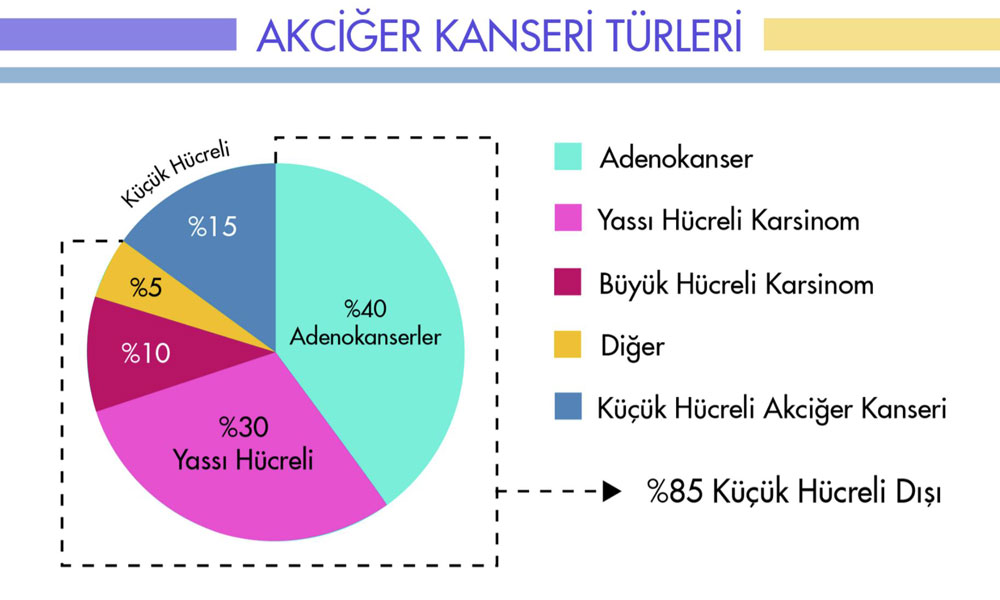
Non-small cell lung cancer accounts for 80-85% of lung cancers.
- Related topic: Lung Cancer Symptoms, Stages and Treatment
What is large cell carcinoma?
Large cell carcinoma is thought to be a cancer type that can begin in various lung cancer subtypes. As the name suggests, these cancer cells look larger than typical cancer cells under a microscope.
Other types of non-small cell lung cancer are squamous cell carcinoma and adenocarcinoma. Less common types include;
- Carcinoid tumors
- Salivary gland carcinoma
- Pleomorphic
- Unclassified carcinoma
Symptoms of large cell carcinoma
Some of the most common symptoms of large cell carcinoma and other lung cancers include;
- A persistent cough
- Coughing up blood or rust-colored sputum
- Hoarseness
- Chest pain that worsens with deep breathing or coughing
- Loss of appetite
- Shortness of breath
- Fatigue
- Unexplained weight loss
- Wheezing
- Persistent or recurrent infections such as bronchitis or pneumonia
Different symptoms may occur depending on where the cancer has spread;
- Cancer spreading to the liver can cause jaundice
- Cancer in the bones can cause bone pain, such as pain in the back or hip
- Cancer spreading to the brain can cause changes in the nervous system, such as headaches or sinusitis
- Cancer spreading to the lymphatic system can cause swollen lymph nodes
Stages of large cell carcinoma
Large cell carcinoma and other non-small cell lung cancers are staged using the TNM staging system, also known as the Tumor Node Metastasis system.
Tumor
According to Cancer Research UK, the “T” in TNM represents the measurement and size of the primary tumor.
| Stage | Meaning |
| T1 |
The cancer is within the boundaries of the lung. T1a means the cancer measures 1 centimeter (cm). T1b means the cancer measures between 1 – 2 cm. T1c means the cancer measures between 2 – 3 cm. |
| T2 |
At this point, the cancer measures between 3 – 5 cm and may involve the airway and lung wall. All or part of the lung may also show collapse / atelectasis. T2a means the cancer measures between 2 – 4 cm. T2b means the cancer measures between 4 – 5 cm. |
| T3 | This stage means the cancer measures between 5 – 7 cm or there is more than one tumor. It may have spread to the chest wall, the outer wall of the chest cavity, a nerve near the lung or the outer surface of the heart. |
| T4 |
At this point, the cancer is larger than 7 cm. It may also be present in more than one lobe of the lung. It may have spread to other body parts, such as the heart, esophagus, spinal bone and other parts of the lung. |
Node
The “N” in TNM, for “Node,” represents whether cancer has spread to the lymph nodes.
| Stage | Meaning |
| N1 | This stage means cancer cells are in lymph nodes within the lung or near it. |
| N2 | This stage means the cancer has spread to lymph nodes in the center of the chest or where the windpipe branches toward the lungs |
| N3 |
This stage means the cancer has spread to lymph nodes located;
|
Metastasis
Finally, the “M” in TNM stands for metastasis and shows how far the cancer has spread through the body.
- Related topic: What are the symptoms of lung cancer metastasis?
| Stage | Meaning |
| M0 | This stage means the cancer has not spread. |
| M1 |
Cancer has spread to other parts of the body, which doctors describe further using the following labels;
|
In addition, according to the US National Cancer Institute, a final staging system should be used.
| Stage | Meaning |
| Stage 0 | This stage means cancerous cells are present, but have not spread to nearby tissue. We call this “carcinoma in situ (CIS).” This also means the cells are not cancerous but could become cancer. |
| Stages 1 - 3 | These stages mean cancer is present. The higher the grade, the larger the cancer and the more it has spread. |
| Stage 5 | At this stage, cancer has spread to other parts of the body. |
Causes of large cell carcinoma
The American Lung Association estimates that almost 90% of lung cancers are caused by smoking in its assessment.
- Related topic: Quitting smoking allows healthy lung cells to multiply
It lists other triggers as;
- Exposure to radon
- Exposure to carcinogens such as asbestos
- Outdoor air pollution
Recommendations therefore emphasize making every effort to stop or avoid smoking.
- Related topic: How do the lungs recover after quitting smoking?
Treatment options for large cell carcinoma
Depending on the stage of large cell carcinoma and how far it has spread, your doctor may recommend various treatments.
Lung cancer treatment options include;
Surgery
In the early stages of large cell carcinoma, surgery alone may be used. Your doctor will remove all or part of the cancer, depending on its size and location.
There are four types of surgery for large cell carcinoma;
- Partial resection: Removal of the tumor and some surrounding normal tissue.
- Lobectomy: Removal of part of the lung or an entire lobe.
- Pneumonectomy: Removal of the entire lung.
- Sleeve surgery: Removal of part of the bronchi.
If surgery cannot remove all the cancer, additional treatment may be needed. If the risk of recurrence is high, chemotherapy or radiotherapy may also be needed after surgery.
Chemotherapy
Chemotherapy uses anticancer drugs to kill cancer cells in the body and is a systemic treatment for large cell carcinoma.
Targeted therapy
Targeted therapy uses drugs that target cancer cells without affecting normal cells. We call this precision or personalized medicine. To assist this approach, doctors may recommend a biopsy to obtain a cancer-tissue sample. Specialists can then understand the precise genetic makeup of the cancer cells, combine the best treatments to attack them and even stop them multiplying.
Radiation therapy
Radiation therapy kills cancer cells using high-energy particles such as X – rays. For airway tumors, an endoscope may be used to deliver radiation directly to the tumor.
Immunotherapy
This treatment helps the body’s natural immune system fight cancer cells. Doctors achieve this by stimulating natural defenses so the immune system can find and attack cancer cells.
Additional treatment options
An interventional radiologist may use various needles to apply the following methods to destroy cancerous tissue:
- Radiofrequency ablation, microwave ablation
- Cryotherapy to freeze and destroy cancerous tissue
Outlook
The outlook varies according to the cancer stage at diagnosis.
Current 5-year survival rates may not be definitive because they do not account for any new advances in cancer treatment. However, US Cancer Statistics reports that the 5-year survival rates for non-small cell lung cancer from 2010 to 2016 were as follows;
| Stage at diagnosis | 5-year relative survival rate |
| Localized: The cancer has not spread outside the lung | 63.1% |
| Regional: The cancer has spread outside the lung to nearby areas and lymph nodes. | 35.4% |
| Distant: The cancer has spread to other body parts, such as the liver, bones, brain or the other lung. | 6.9% |
| Overall rate | 24.9% |
- Related topic: Stage 4 lung cancer survival statistics
Diagnosis
During diagnosis, the doctor will ask about the person’s medical history and perform a physical examination.
Individuals may also undergo the following scans to investigate signs of large cell carcinoma;
- X-ray
- CT scan (Computed Tomography)
- MRI scan (Magnetic Resonance Imaging)
- PET scan (Positron Emission Tomography)
- Bone scan
A pathologist also diagnoses large cell carcinoma lung cancer by examining a lung cancer sample under a microscope. The following methods are used;
- Sputum cytology: Examination of a mucus sample coughed up from the lungs.
- Thoracentesis: An interventional radiologist will take some fluid from around the lung and examine the cells.
- Needle biopsy: An interventional radiologist will use a hollow needle to obtain a small sample of lung cells.
When should you see a doctor?
It is important to note that symptoms of large cell lung carcinoma and other lung cancers are more likely to be caused by conditions other than cancer.
However, it is vital to see a specialist as soon as symptoms are first noticed. This may allow detection at an early stage, when treatments may be more effective.
Some questions a person may wish to ask their doctor include;
- What type of cancer is it?
- How far has the cancer spread?
- What stage is the cancer, and what does that mean?
- What treatments are recommended?
- Do particular activities make symptoms worse?
- What do the long-term effects of cancer and treatment involve?
- What lifestyle changes are needed?
Summary
Large cell carcinoma is a type of non-small cell lung cancer. Symptoms may include a persistent cough, coughing up blood and shortness of breath.
Anyone experiencing common lung cancer symptoms should see a specialist. If large cell lung carcinoma is diagnosed, it is vital to begin treatment as early as possible.
Sources
Was this article helpful?
Your feedback helps us improve our content.




Reader comments
Share your comment
Your name and comment are published only after administrator approval. Your email address is never shown to visitors.
Be the first to comment.