
What Is Waldenström Macroglobulinemia? Where Does Its Name Come From?

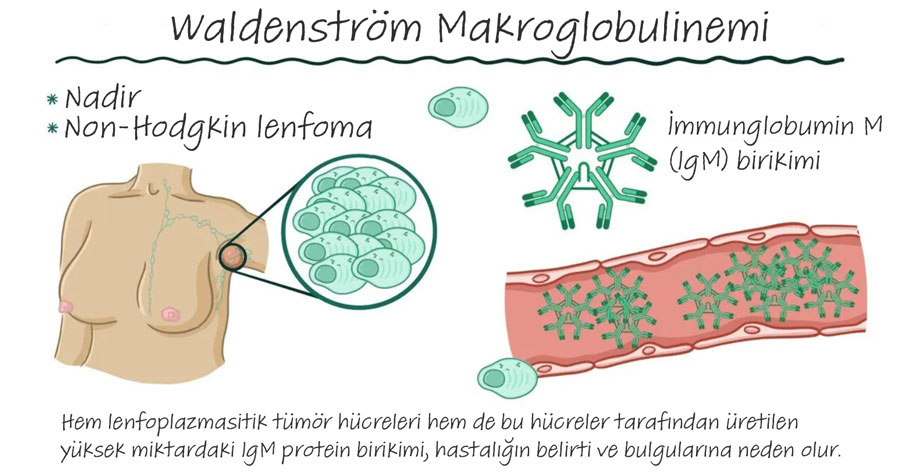
Waldenstrom macroglobulinemia (WM) is a type of non-Hodgkin lymphoma (NHL). The cancer cells produce large amounts of an abnormal protein called macroglobulin. Another name for WM is lymphoplasmacytic lymphoma.
In more medical terms, Waldenström macroglobulinemia is a lymphoma characterized by the accumulation of clonal lymphoplasmacytic cells in the bone marrow that produce monoclonal immunoglobulin M (IgM).
The clinical signs and symptoms of Waldenström macroglobulinemia are caused by both tumor cell infiltration and the physicochemical and immunological properties of the monoclonal IgM protein pentamer produced by the malignant cells.
MYD88 somatic mutation genetic testing is used to distinguish Waldenström macroglobulinemia from other conditions.
Prognosis (disease course) can be estimated using the International Prognostic Scoring System, developed in 2009 using 5 covariates (age, hemoglobin level, platelet count, beta-2-microglobulin level and IgM concentration). Treatment options for Waldernström macroglobulinemia include anti-CD20 monoclonal antibody-based combinations and BTK inhibitors.
Where Does the Name Waldenström Come From?
The person after whom Waldenström macroglobulinemia is named, Dr. Jan Gosta Waldenström, was born in Stockholm in 1906 and completed his medical education at Uppsala University in Sweden.
After studying organic chemistry in Germany for 4 years, Dr. Waldenström returned to Uppsala University and studied diseases associated with an increased erythrocyte sedimentation rate (sedimentation test).
In 1944, Dr. Waldenström described two patients with oronasal (mouth and nose) bleeding, lymphadenopathy (enlarged lymph nodes), anemia, increased sedimentation, thrombocytopenia, hypoalbuminemia, low serum fibrogen levels and lymphoid infiltration in the bone marrow. The patients had postoperative bleeding, lobar pneumonia and retinal (eye) bleeding. They also did not have the destructive bone lesions and bone pain expected in multiple myeloma. In addition, their bone marrow was infiltrated by lymphocytes rather than plasma cells.
Both patients had poor-quality blood and bone marrow smears, and Dr. Waldenström thought hyperproteinemia was the cause. He observed high serum viscosity in both patients and evidence of a cryoglobulin in one of them.
Dr. Waldenström also observed abnormally high amounts of a homogeneous globulin with a high sedimentation factor and an estimated molecular weight greater than 1,000,000. He theorized that this was a giant globulin molecule rather than an aggregation of smaller molecules. This previously undescribed condition was named Waldenström macroglobulinemia.
Another major contribution Dr. Waldenström made to medicine was the distinction between monoclonal and polyclonal gammopathies, which he presented in the Harvey lecture series in 1961. After a long and productive career as a physician and clinical researcher, Dr. Waldenström died in 1996.
Sources
2. Dimopoulos MA, Kastritis E. How I treat Waldenstrom macroglobulinemia. Blood. 2019
3. Kastritis E, Leblond V, Dimopoulos MA, et al. Waldenstrom’s macroglobulinaemia: ESMO Clinical Practice Guidelines for diagnosis, treatment and follow-up. Ann Oncol. 2018
4. Morel P, Duhamel A, Gobbi P, et al. International prognostic scoring system for Waldenström macroglobulinemia. Blood. 2009
5. Kyle RA, Anderson KC. A tribute to Jan Gosta Waldenström. Blood. 1997
Was this article helpful?
Your feedback helps us improve our content.




Reader comments
Share your comment
Your name and comment are published only after administrator approval. Your email address is never shown to visitors.
Be the first to comment.