
World Cancer Statistics 2020 – One in Every 5 People Faces Cancer

In this article
The International Agency for Research on Cancer (IARC), an agency of the World Health Organization (WHO), published its latest estimates of the global cancer burden on 15 December 2020. Part of the IARC Global Cancer Observatory, the GLOBOCAN 2020 database is accessible online and provides incidence and mortality estimates for 36 specific cancer types and all cancer types combined in 185 countries for 2020. In light of these data, the global cancer burden was reported to have risen to 19.3 million new cases and 10.0 million deaths in 2020.

Worldwide, one in every 5 people develops cancer during their lifetime. Cancer causes the death of 1 in every 8 men and 1 in every 11 women. Worldwide, the total number of cancer patients alive within 5 years after a cancer diagnosis (5-year prevalence) is estimated to be 50.6 million in total.
The Most Common Cancers in 2020 – Summary Cancer Statistics
The Most Common Cancers
The 10 most common cancer types account for more than 60% of newly diagnosed cancer cases and more than 70% of cancer deaths.
- The most common cancer worldwide is female breast cancer (11.7% of new cases),
- followed in order by lung cancer (11.4%),
- colorectal cancer (10.0%),
- prostate cancer (7.3%) and
- stomach cancer (5.6%).
Cancers Causing the Most Deaths
- Lung cancer is the leading cause of cancer deaths (18% of all cancer deaths),
- followed in order by colorectal cancer (9.4%),
- liver cancer (8.3%),
- stomach cancer (7.7%) and
- female breast cancer (6.9).

In Men;
Lung cancer is the most frequently diagnosed cancer and the main cause of cancer deaths. In the ranking of incidence (the number of new cancer cases per 100 thousand people), lung cancer is followed by prostate cancer and colorectal cancer. In terms of mortality rates, lung cancer is followed by liver cancer and colorectal cancer.
In Women;
Breast cancer is the most frequently diagnosed cancer and the main cause of cancer deaths. In the incidence ranking, breast cancer is followed by colorectal cancer and lung cancer. In mortality rates, breast cancer is followed by lung cancer and colorectal cancer.

The Projected Cancer Burden in 2040
Approximately 28.4 million new cancer cases are projected worldwide in 2040, corresponding to a 47% increase over the approximately 19.3 million cases in 2020.
- Related Topic: Turkey Cancer Statistics 2020 (Detailed)
Cancer Will Be a Bigger Problem in the Future for Countries with Low and Medium Development
The 4-tier Human Development Index (HDI) is an indicator of the degree of national social and economic change. Countries classified as having low or medium HDI will see the greatest relative increase in cancer incidence by 2040 (increases of 95% and 64%, respectively, over 2020). Moreover, the prevalence of cancer risk factors found in countries with high and very high HDI tends to rise in most countries in the low and medium HDI categories. Examples of these risk factors include smoking, unhealthy diets, excess body weight and physical inactivity.
Freddie Bray, Head of the Cancer Surveillance Section at the International Agency for Research on Cancer (IARC), says, “Ongoing changes in the structure of society, the environment we live in and the ability of health systems to deliver effective cancer control interventions will shape the profile and scale of cancer incidence, mortality and prevalence in the coming years.”
Breast Cancer Has Now Overtaken Lung Cancer as the Most Commonly Diagnosed Cancer Worldwide
Approximately 2.3 million new breast cancer cases were reported in 2020, showing that 1 in every 8 cancers diagnosed was breast cancer. Also in 2020, breast cancer caused 685,000 deaths and ranked 5th among cancers causing death worldwide. In women, breast cancer accounts for 1 in every 4 cancer cases and 1 in every 6 cancer deaths. It also ranks first in many countries in terms of mortality (death rate) and incidence (new case rate).
Marked changes in lifestyles, sociocultural contexts and urban living substantially affect the prevalence of breast cancer risk factors in many countries in the low and medium HDI categories. Examples include postponing childbirth and having fewer children, as well as excess weight and physical inactivity. Breast cancer incidence rates are converging worldwide. In countries in the low HDI category, breast cancer mortality and survival rates are low because it is detected at a late stage.
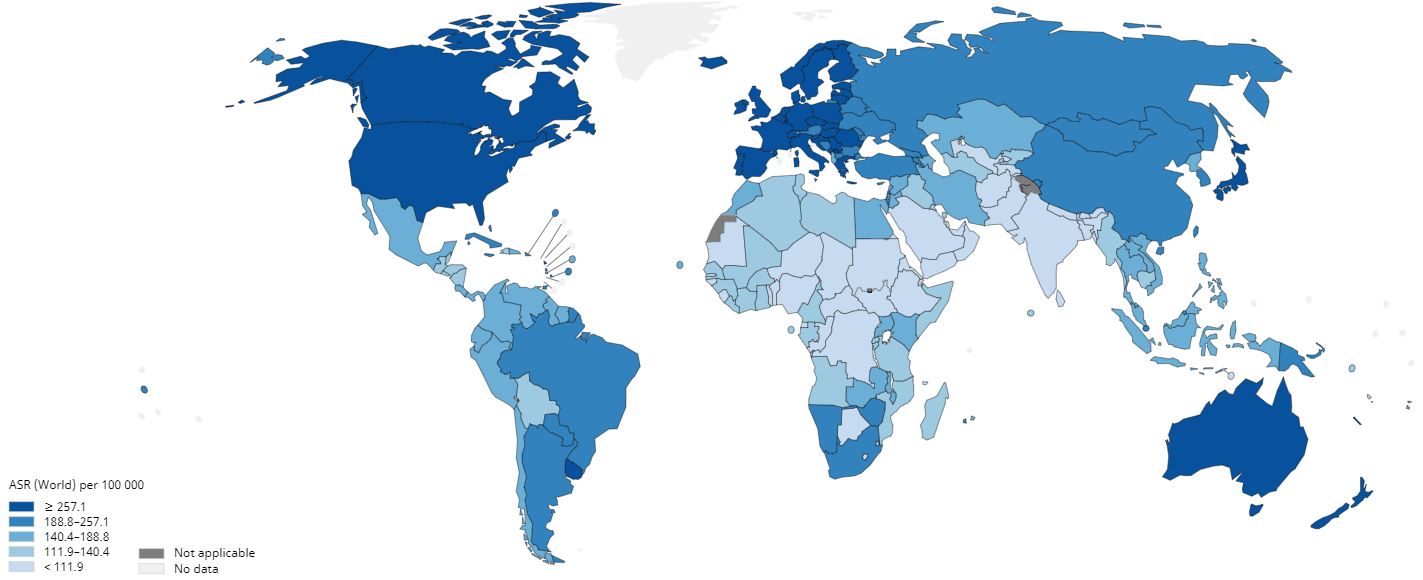
A comparison of cancer incidence (the annual number of new cancer cases per 100 thousand people) by country is shown below. Darker shading indicates a higher frequency of cancer.
New Features of the Global Cancer Observatory
Through its Cancer Today subsite, the Global Cancer Observatory website provides a range of data visualization tools to explore GLOBOCAN 2020 database estimates of incidence, mortality and prevalence by sex and age group for 36 specific cancer types and all cancer sites in 185 countries or territories worldwide in 2020. The revamped Cancer Tomorrow subsite also provides data visualization tools to estimate future incidence and mortality for a particular region or country up to 2040. The baseline estimates assume that 2020 rates will remain unchanged and apply them to national population projections that account for future population growth and ageing. Cancer Tomorrow has a new feature that lets the user specify changes in incidence and mortality trends from 2020 onward and thus how cancer rates will develop in the future.
After noting the great need for evidence-based and resource-stratified guidelines to support the progressive implementation of early breast cancer diagnosis and treatment worldwide, IARC Director Dr. Elisabete Weiderpass says that the World Health Organization and IARC are currently working together on a new global breast cancer initiative in 2021, focusing on improving early diagnosis and comprehensive treatment to improve population-level outcomes.
Dr. Weiderpass concludes, “The updated global cancer figures for 2020 highlight the different cancer patterns seen today as well as the expected increase in the cancer burden in the coming years. There is an urgent need to address this disease as both a public health problem and an economic problem. Cancer prevention plays an important role here. Effective interventions exist for cancer prevention and early diagnosis, and they must be incorporated into cancer planning to control the projected increase in this devastating disease.”
- Related Topic: Cancer Prevention
Sources
Was this article helpful?
Your feedback helps us improve our content.




Reader comments
Share your comment
Your name and comment are published only after administrator approval. Your email address is never shown to visitors.
Be the first to comment.