
2017 United States cancer statistics and their implications

Are cancer rates rising uncontrollably? Is cancer really the plague of our age? Although cancer remains a leading cause of death, its incidence appears to have fallen significantly in recent years in some developed countries that have adopted healthy-living measures. According to the 2017 United States Cancer Statistics report, mortality from all cancers fell over the past 25 years by % 25.

Cancer-related mortality in the United States peaked in 1991 and has declined annually by % 1-2 since then.
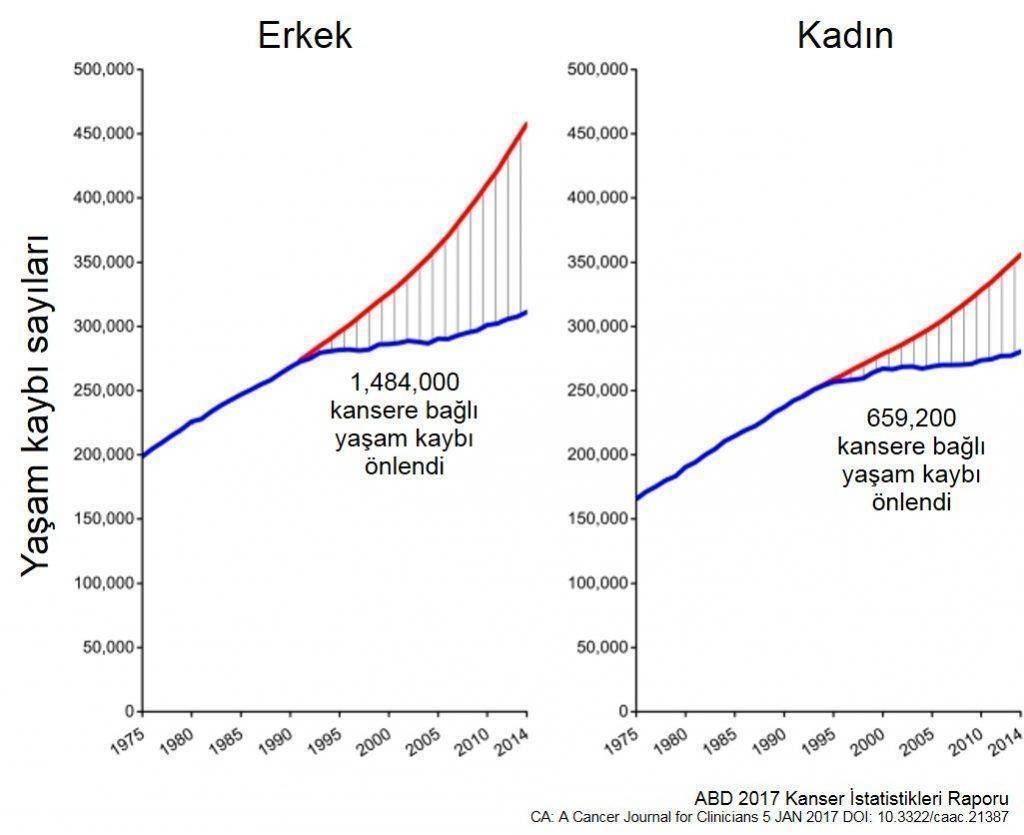
This decline, resulting from reduced smoking alongside advances in prevention, such as hepatitis and HPV vaccines; early detection, such as mammography and colonoscopy screening; and treatment, has prevented approximately 2 million deaths in the United States alone.
Smoking was clearly established as a cause of many cancers, particularly lung cancer, in the 1960s. Since then, tobacco control efforts have been pursued at varying intensities worldwide. The diagram below illustrates how cancer incidence rises dramatically years after exposure to an environmental carcinogen such as smoking.

As the diagram shows, exposure to a carcinogen reveals its true impact decades later. We believe a similar danger exists for obesity and will cast a shadow over our fight against cancer in coming years.
Returning to what the 2017 United States cancer statistics tell us:
The research estimates that in 2017, new cancer diagnoses across the United States will number 1.688.780, meaning more than 4600 new diagnoses daily. In our country, the annual number of new cases is approximately 160 thousand.
In women, the cancers most likely to cause death are lung cancer, followed by breast and colorectal cancers.
For men, the most common causes of cancer death are again lung, colorectal and prostate cancers.

These four cancers—lung, breast, colorectal and prostate—account for % 46 of all cancer deaths, with lung cancer accounting for more than a quarter (% 26).
Lung cancer statistics
Interestingly, the decline in lung cancer incidence is almost twice as large in men as in women. This may reflect women’s more recent uptake of heavy smoking and their tendency to quit more slowly.

In 2017, breast cancer is expected to account for approximately % 30 of new cancer diagnoses in women.
Changes in colorectal cancer incidence are also very similar in men and women, declining between 2004 and 2013 by % 3 annually. Rapid declines are thought to result from increased colorectal cancer screening and simultaneous removal of any precancerous polyps. Indeed, among adults aged 50 and older, colonoscopy use in 2000 was % 21, rising in 2015 to % 60. By contrast, colorectal cancer incidence among younger people has increased annually by approximately % 2. Increasing obesity is thought to be one reason for rising colorectal cancer rates in young people.
Liver cancer continues to increase
Liver cancer is increasing annually in women by % 3 and in men by % 4. Despite an effective hepatitis B vaccine, the lack of a hepatitis C vaccine, no decline in alcohol consumption and obesityappear to explain rising liver cancer incidence.
Cancer figures differ between men and women
Overall cancer incidence is approximately % 20 higher in men than women, and cancer mortality is % 40 higher in men. One reason is that more fatal cancers, such as esophageal, laryngeal, bladder cancer and melanoma, occur more often in men.
Pancreatic cancer survival remains poor
The 5-year survival rate for pancreatic cancer is approximately %8, with no visible improvement in recent years. This poor survival largely reflects at least % 50 of pancreatic cancer patients being diagnosed at an advanced stage. The pancreas’s location and the cancer’s biology also pose different treatment challenges.
Cancer rates in children and adolescents also appear to have stabilized in recent years. Survival for all cancers in both groups exceeded between 2006 and 2012 the level of % 80, but survival varies greatly according to cancer type and age at diagnosis.
We must prioritize cancer prevention
One area where we truly fall short worldwide is cancer prevention. When attention focuses on early-detection screening programs and treatment, cancer prevention measures can be overlooked. We can emphasize motivating people toward healthy eating, exercise, smoking cessation and vaccination.
When current cancer statistics for our country are published, we will share our interpretation with you.
Sources
Cancer Statistics, 2017.
CA Cancer J Clin. 2017 Jan 5. doi: 10.3322/caac.21387
Was this article helpful?
Your feedback helps us improve our content.




Reader comments
Share your comment
Your name and comment are published only after administrator approval. Your email address is never shown to visitors.
Be the first to comment.