
5 Notable Cancer Studies of 2021

In this article
In 2021, scientists learned many things, from how some animals naturally become resistant to cancer to how tumor cells use extracellular DNA to develop rapid drug resistance. Let us look together at the basic science studies that contributed this valuable knowledge.
Dogs That Smell Cancer

Image: Florin, a trained cancer detection dog, sniffs a urine sample.
Using dogs’ keen sense of smell to diagnose cancer has long been an idea. Scientists have even tried to build machines based on it, but none were as sensitive as dogs, humans’ best friends. Rather than competing with evolution, researchers decided to leave the job to the experts. In a proof-of-concept study, they used dogs to train a machine-learning algorithm to detect prostate cancer, the second most common cancer in men (for details of the study, see our article "Dogs That Detect Prostate Cancer").
According to Prof. Marc Aubreville, a specialist in image understanding and medical applications of artificial intelligence at Techische Hochshule Ingolstadt in Germany who was not involved in the study, the dogs did not reach the sensitivity and specificity achieved by others because the study included a small number of samples from 50 men, only 12 of whom had positive biopsies. Nevertheless, it was a promising step. Aubreville said of the study: “What they have done is genuinely interdisciplinary and quite cool. I think the approach makes sense… but I would really like to see more samples and better evidence that it actually works with machine learning.”
A New Understanding of Metastasis May Lead to Better Treatments

The migration of cancer cells from their tissue of origin to other organs and tissues, called metastasis, continues to cause 90% of cancer-related deaths.
In 2013, cancer biologist Adrienne Boire at Memorial Sloan Kattering encountered a patient who would determine the course of her career. There were fundamental questions Boire could not answer: How and why had the patient’s cancer spread to the spinal fluid? How exactly had the process described as “cancer cell metastasis” allowed them to colonize and multiply in new tissues?
Through this patient, Boire and other scientists learned that metastasis is a complex process that can begin much earlier, rather than being a late stage of cancer. They also found that cancer cells can sometimes remain dormant for years before awakening. These findings opened new ways to monitor and treat metastatic cancers. Boire says researchers will develop ways to reduce metastasis altogether.
Cancer Cells May Behave Like Parasites to Survive
Tumor cells are known for their striking heterogeneity (mixed structure): each cell may differ slightly from its neighbor/sibling, presenting a major challenge in cancer treatment. In some cases, the loss of certain genes or proteins can drive cells to adopt new ways of life. University of Minnesota researchers found that cancer cells lacking a DNA repair protein complex called the Ku complex became parasitic and attacked neighboring tumor cells to access their cytoplasmic material.
Beyond this, cancer cells behaving like parasites were sometimes found to enter other cells and remain intact inside before leaving. University of Minnesota molecular biologist Nurten Saydam, who was involved in the study, says this may allow cancer cells to adapt to genetic stresses in the microenvironment of cancer cells and ultimately metastasize. “Parasites enter the cell. They hide there and then, when everything is over, emerge and can grow much better.”
Video: A colorectal cancer cell deficient in Ku70 (the green cell indicated by a yellow arrow) exits one cell and then enters two other cells in sequence.
Cancer May Be Driven by DNA Outside Chromosomes
In 2012, Paul Mischel was surprised when glioblastoma (GBM) patients’ tumors evolved in ways that defied genetics. Despite aggressive treatment with drugs targeting a growth-promoting oncogene, the tumors developed resistance in two patients. Mischel and his team discovered that the DNA providing this resistance was not in the patients’ chromosomes but in extrachromosomal DNA (ecDNA) found in the nucleus of each cell.
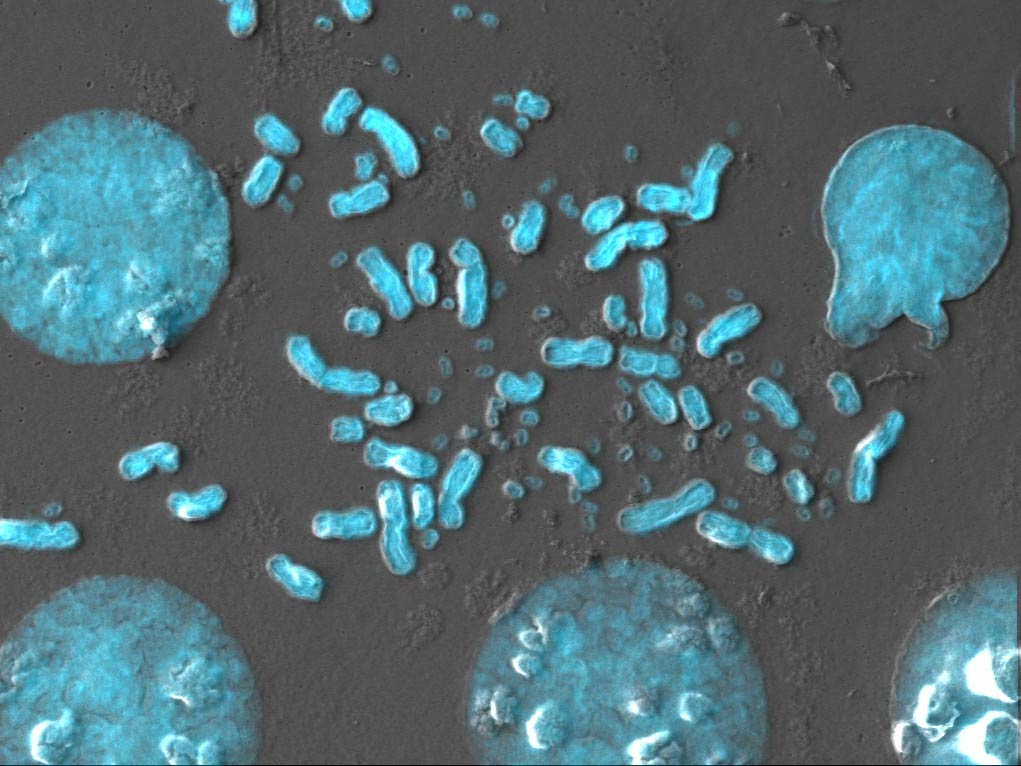
Image: Extrachromosomal DNA in a scanning electron microscope image of disrupted colon cancer cells. (Large dots are intact nuclei from other cells) (Image by Kristen Turner of Boundless Bio)
This previously overlooked ecDNA has since been found to promote very high levels of oncogene transcription (proliferation of cancer-triggering genes) and even create entirely new gene-regulatory interactions, all of which combine to make cancers more resistant.
This new discovery also led Mischel and his team to establish a company called Boundless Bio and created new treatment opportunities to identify and develop ways to treat ecDNA-based cancers.
Mischel says, “It is exciting to see the growing interest of talented researchers aiming to decipher fundamental aspects of ecDNA biology.” He adds, “We look forward to the development of new tools, new collaborations, and new treatments for patients.”
Blind Mole Rats Use Junk DNA to Fight Cancer

Image: A blind mole rat (University of Rochester)
Blind mole rats are unusual not only in appearance but also genetically. These eyeless rodents live exceptionally long lives and are naturally resistant to cancer thanks to increased production of the inflammatory cytokine interferon beta (INF-β), which triggers the death of precancerous cells. Researchers recently traced this unique cancer-fighting ability to DNA sequences in mole-rat genomes that can copy themselves and move by settling in a new location. These “jumping genes” are found across the tree of life, including humans, but are generally silenced through methylation.
However, researchers discovered that in rapidly proliferating mole-rat cells, retrotransposon RNAs and INF-β were more abundant while levels of DNA-methylating enzymes were lower, and they could artificially reproduce this in human cells.
Cancer biologist Stephen Baylin of Johns Hopkins School of Medicine, who was not involved in the study, said, "This report describes an important new mechanistic understanding of how inflammatory signals can be triggered in cancer cells to kill them directly or make them vulnerable to cancer-killing treatments. Its significance is truly profound.”
Sources
2. Metastasis infographic: murphyscienceart.com
3. Video: Saydam O. and Saydam N. Deficiency of Ku Induces Host Cell Exploitation in Human Cancer Cells. Front Cell Dev Biol, 29 March 2021.
Was this article helpful?
Your feedback helps us improve our content.




Reader comments
Share your comment
Your name and comment are published only after administrator approval. Your email address is never shown to visitors.
Be the first to comment.