Early-Warning Blood Marker Candidate for Ovarian Cancer Precursors

In this article
Early-Warning Blood Marker Candidate for Ovarian Cancer Precursors
In a study published in Nature Medicine on 10 November 2026, an RNA signal called "Tu-Stroma" was investigated in blood as a way to detect STIC (serous tubal intraepithelial carcinoma) lesions, which are considered precursors of high-grade serous ovarian cancer. The researchers report a sensitivity of 92.3% and a specificity of 98.2% in a separate validation group. This is exciting for early detection, but the samples came from people whose diagnoses were already known. There is not yet any evidence from real-life screening or of a reduction in loss of life. This page summarizes what was reported, why these figures are not enough on their own, and how the results should be read.
- What was studied? Whether the Tu-Stroma RNA signal in blood can detect STIC lesions, the accepted precursor of high-grade serous ovarian cancer.
- What was reported? In a separate validation group, sensitivity was 92.3% and specificity 98.2%. The signal was also high in early-stage high-grade serous ovarian cancer.
- What limits the study? It used previously collected blood samples from people with confirmed diagnoses; it was not a prospective study. Group sizes were not given in the announcements.
- What is unknown? How it performs in real-life screening of healthy women, how many years before disease the signal rises, and what to do for people who test positive.
- Clinical meaning: The test is not ready for clinical use; prospective studies are planned.
What is STIC and why does it matter?
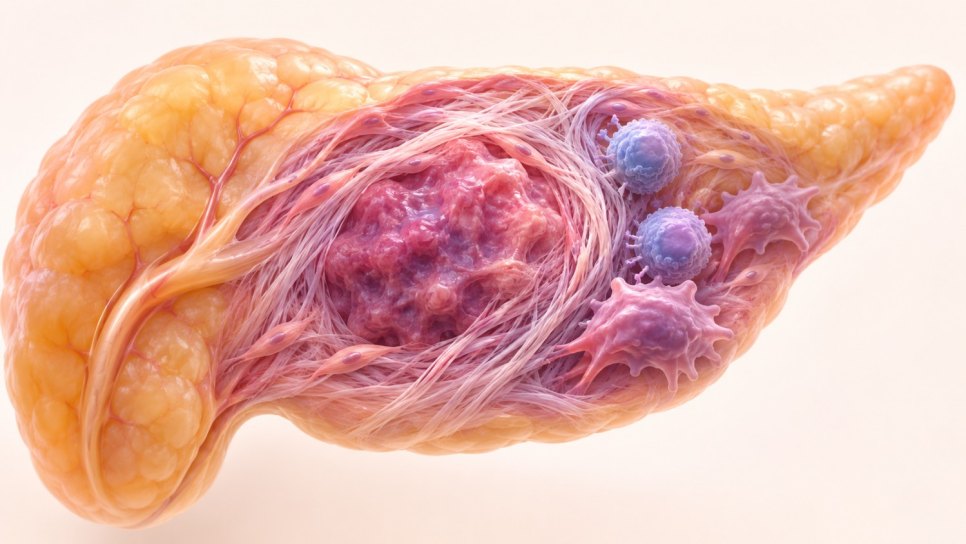
STIC is a microscopic lesion in the lining of the fallopian tube, near its end. Many high-grade serous ovarian cancers are thought to begin in this lesion or in the fallopian tube. Because STIC is microscopic, imaging cannot reliably detect it; today it is mostly found incidentally in tissue removed during risk-reducing surgery in BRCA1/2 carriers.
The work is reported to have been led by Dr. Rajan Gogna and Dr. Esha Madan of Hoag in Newport Beach, USA, and is described as an eight-year, international, multi-institution study. The announcements do not give the total sample size or the countries involved; the funding is described only as partly from "philanthropic partners".
What is the Tu-Stroma marker?
Tu-Stroma is described in the announcements as an RNA molecule. The researchers looked for a signal that could track, in blood, the stage before cancer appears; in Dr. Gogna's words, "ovarian cancer does not begin the day we discover a tumor."
The level of the signal in blood was reported to be high in women with STIC and in early-stage high-grade serous ovarian cancer. The test was developed with samples from several countries and confirmed in a separate group. The summary sent to us says the marker was measured in extracellular vesicles in serum; this detail does not appear in the press announcements.
The researchers suggest the signal could point to cancer development years before conventional methods can detect a tumor. For now this is only a possibility: how early the signal rises and how reliably it separates precursor disease are still unknown.
What was reported, and how should it be read?
The table below summarizes the main findings in the press release and a news summary, and how to interpret them.
| Reported | How to read it |
|---|---|
| In a separate validation group, 92.3% of people with STIC were detected by the marker (sensitivity). | Group size and the number of people with STIC were not given; with few cases, a percentage swings easily. |
| 98.2% of healthy women correctly tested negative (specificity). | High specificity matters, but because screening would be applied to thousands of healthy people, the number of false positives can still be large (see below). |
| The marker was high in women with STIC and in early-stage high-grade serous ovarian cancer. | A marker being high in people who have a disease does not prove it shows who will develop that disease later. |
| For a high-risk group, the modeled positive predictive value is about 72%; the negative predictive value is "nearly 100%". | These are model results based on assumptions, not measured values. |
| The study ran eight years, internationally, across several institutions. | It used previously collected samples from people with known diagnoses; people were not followed to see what happened later (retrospective design). |
All findings rely on Hoag's press release and a news summary; the full text of the paper was not reviewed for this page.
Why are sensitivity and specificity not enough on their own?
Sensitivity is the share of people with the disease who are caught by the test; specificity is the share of people without the disease who test negative. A screening test is applied to many healthy people, so when the disease is rare, most positive results can be false positives.
A hypothetical example (not study data): suppose 10 of 10,000 women have STIC. With 92.3% sensitivity, about 9 of them are detected. Of the 9,990 women without the lesion, 1.8%, about 180, test falsely positive. Of roughly 189 positive results, only 9 (about 5%) truly have STIC. The roughly 72% figure modeled in the study applies to a high-risk group; the more common the disease is in the tested group, the more likely a positive result is to be correct.
- "A blood test that finds ovarian cancer early now exists, so screening can begin." No. The samples came from people with known diagnoses; there is no validation in real-life screening of healthy women.
- "92.3% sensitivity means 92% of positive results have the disease." No. Sensitivity is the share of people with the disease who are caught. How often a positive result is correct (positive predictive value) depends on how common the disease is.
- "This test reduces loss of life from ovarian cancer." No. There is no such evidence. A large randomized screening trial using CA-125 and ultrasound (UKCTOCS) did not show a significant reduction in loss of life over long-term follow-up; whether new markers will do better is unknown.
- "We can get this test at the hospital." No. The test is at the research stage, is not ready for clinical use and cannot be ordered routinely.
- "Finding STIC means cancer will develop." No. STIC is a precursor lesion; exactly when and how often each lesion progresses is not fully known. Decisions are made with a physician, based on the person's risk.
What does this mean for patients and families?
For people with a family history of ovarian or breast cancer, BRCA1/2 carriers, or anyone worried about ovarian cancer, this news does not change today's surveillance and preventive surgery options. Risk-reducing surgery decisions are made with genetic counseling and a physician; this test cannot be used as a basis for such a decision.
Symptoms such as persistent bloating, abdominal or pelvic pain, or feeling full quickly should be discussed with a physician; this news is no reason to ignore symptoms.
Scientifically, the news supports the idea that ovarian cancer does not begin on the day a tumor is found and that its precursor stage may be followed in blood. Whether this works in real life will only be learned from prospective studies.
Frequently Asked Questions
- Does the Tu-Stroma test detect ovarian cancer early?
- That is not yet known. The marker distinguished women with STIC in samples from people with known diagnoses, but it has not been validated in real-life screening of healthy women.
- What is STIC?
- A microscopic lesion in the lining near the end of the fallopian tube, considered a precursor of high-grade serous ovarian cancer. Imaging cannot reliably detect it; it is mostly found in tissue removed during risk-reducing surgery.
- What do 92.3% sensitivity and 98.2% specificity mean?
- 92.3% of people with STIC were detected and 98.2% of healthy women correctly tested negative. But group sizes were not given and the samples came from people with known diagnoses; real-life screening results may differ.
- When will this test be available?
- Unknown. Prospective studies are planned and no timeline has been announced. The test needs clinical validation.
Glossary
- STIC
- Serous tubal intraepithelial carcinoma: a microscopic lesion in the lining near the end of the fallopian tube, considered a precursor of high-grade serous ovarian cancer.
- High-grade serous ovarian cancer
- The most common type of ovarian cancer, usually diagnosed at a late stage; many are thought to begin in the fallopian tube.
- Tu-Stroma
- An RNA molecule measured in blood in the study and found to be high in STIC and early-stage high-grade serous ovarian cancer.
- Extracellular vesicle
- A small sac released by cells that can carry RNA and proteins.
- Sensitivity
- The share of people with the disease who are detected by the test.
- Specificity
- The share of people without the disease who test negative.
- Positive predictive value
- The chance that a person with a positive test truly has the disease; it depends on how common the disease is.
- Retrospective study
- A study using previously collected samples or records, in which people are not followed into the future.
DROZDOGAN Academy Commentary
In a field with no screening method proven to reduce loss of life from ovarian cancer, this study proposes a blood marker aimed at the precursor stage of the disease.
⚡ Why it matters
High-grade serous ovarian cancer is often diagnosed at an advanced stage, and no screening method has been proven effective in healthy women. If a marker that detects the precursor lesion (STIC) in blood is validated, it could become possible to catch the disease earlier or at the precursor stage.
✅ Strengths
An eight-year, international, multi-institution study; a separate validation group; targeting of the precursor lesion; high specificity.
⚠️ Limits
Retrospective design and samples from people with known diagnoses; group sizes and STIC case numbers not given; positive predictive value is a model estimate, not measured; the false-positive problem; no conflict-of-interest information stated.
🩺 In practice
Nothing changes today. Surveillance and preventive surgery decisions for high-risk people continue to be made with genetic counseling and a physician; this test cannot be used as a basis for decisions.
❓ Open questions
How many years before disease does the signal rise? Who actually develops cancer in prospective follow-up? What will be done about false-positive results? Will this marker reduce loss of life?
Bottom line: Tu-Stroma is a promising candidate for detecting the precursor stage of ovarian cancer in blood. But these results, obtained in retrospective samples, must be confirmed in prospective studies before it can be used as a screening test.
- This page was prepared in November 2026.
- The information comes from Hoag's press release of 10 November 2026 and a news summary; the full text of the Nature Medicine paper was not reviewed for this page.
- The announcements do not give sample sizes, the number of STIC cases, confidence intervals or conflict-of-interest information; numbers are reported only as they appear in the announcements. The detail that the marker was measured in extracellular vesicles in serum comes from the study summary sent to us and does not appear in the press announcements.
- The sensitivity, specificity and predictive value example is hypothetical and is not study data.
- The Academy commentary is our own. This page is not medical advice; make health decisions together with your physician.
References
- Gogna R, Madan E, et al. Nature Medicine, 10 November 2026 (Tu-Stroma RNA marker, STIC). doi.org
- Hoag. Hoag researchers discover ovarian cancer's hidden warning, opening the possibility of detection years earlier. EurekAlert, 10 November 2026. eurekalert.org
- CLP Magazine. Blood Test Shows Promise for Detecting Precancerous Ovarian Lesions. clpmag.com
- Menon U, et al. Ovarian cancer population screening … long-term follow-up in the UK Collaborative Trial of Ovarian Cancer Screening (UKCTOCS). Lancet 2021;397:2182-2193. pubmed
Was this article helpful?
Your feedback helps us improve our content.