CHOSEN HEADLINE: Stroma-Targeted Approach for Pancreatic Cancer Shows Promise in Mice
In this article
Stroma-Targeted Approach for Pancreatic Cancer Shows Promise in Mice
In a study published in Cancer Cell on 9 November 2026, an experimental TGF-β blocker directed to the tumor stroma (FEBP-sTβRII) eliminated tumors in 75% of treated mice in a hard-to-treat pancreatic cancer model. The aim of the approach is to loosen the fibrous barrier around the tumor so that immune cells can reach it more easily. These are animal data only: there are no efficacy or safety results in people yet, and the rate seen in mice should not be read as clinical success. This article summarizes what the study reported, what it did not report, and how the results should be read.
- What was tested? A tagged TGF-β blocker (FEBP-sTβRII) that binds a form of fibronectin abundant in tumors but scarce in healthy adult tissue was tested in mice.
- What was reported? Activity was reported in three pancreatic cancer mouse models. In the hardest-to-treat model, tumors disappeared in 75% of treated mice, and 7 of 8 mice were alive 270 days after treatment ended.
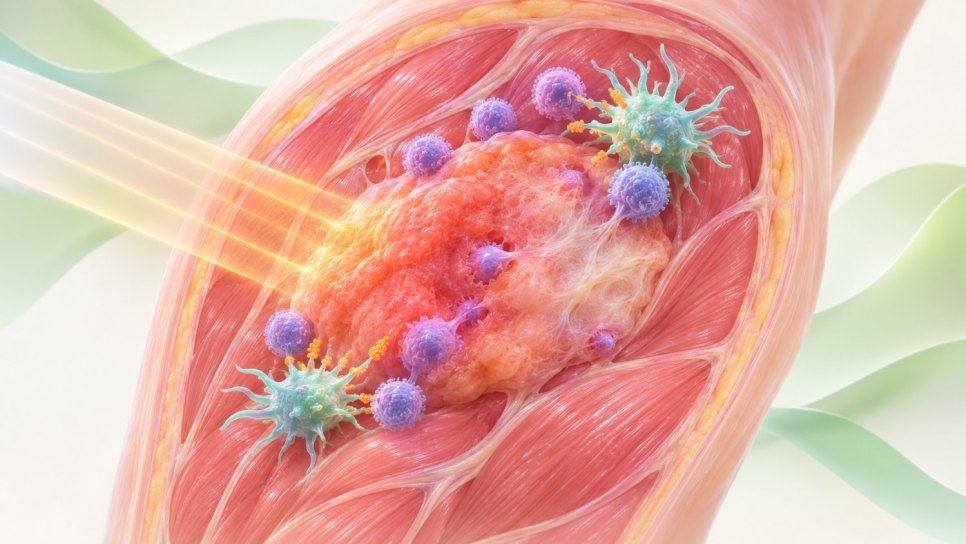
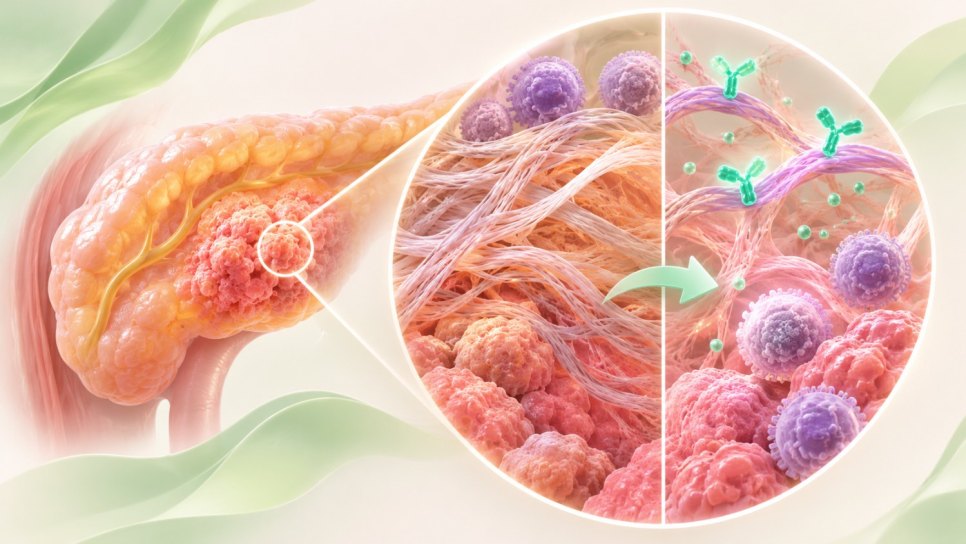
- How is it thought to work? The fibrous barrier around the tumor loosens, T cells enter the tumor and release interferon-gamma, which turns tumor support cells and neighboring immune cells into cells that present cancer antigens.
- What is unknown? Efficacy and safety in people. The press release does not give group sizes, statistical details or toxicity data.
- Clinical meaning: None for now; the findings are preclinical. A version designed for humans has entered safety testing, and clinical trials are planned for 2027.
What was done in the study?
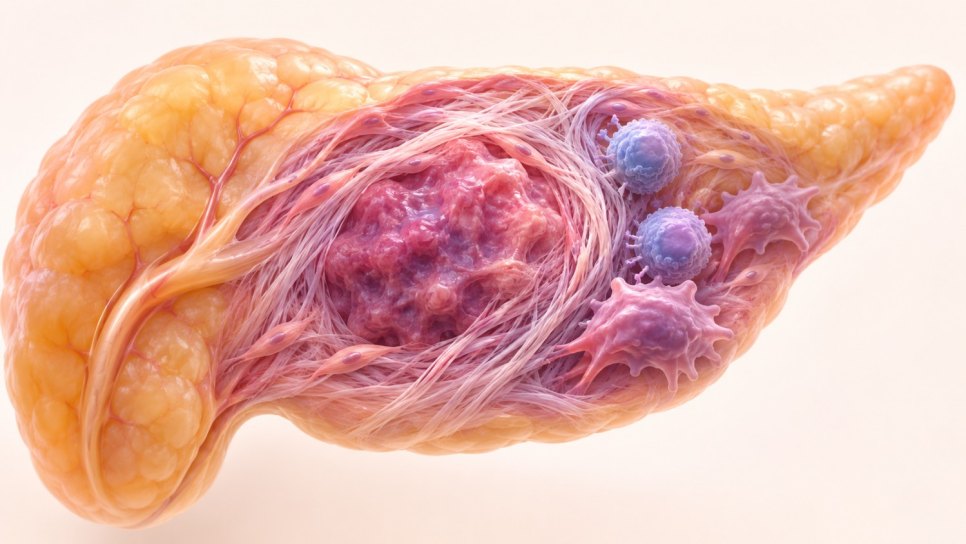
The stroma is the supporting tissue around tumor cells: fibrous structure, support cells and blood vessels. In pancreatic cancer the stroma is very dense and is thought to make it harder for immune cells to enter the tumor. In this study, a drug that blocks TGF-β signaling was directed specifically to this tumor surrounding and tested in mice.
The study was published in Cancer Cell under the title "A stroma-sensing TGF-β blockade reprograms CAF–myeloid niches to induce durable tumor immunity". The first author is Dong Woo Kang of MedPacto and the senior author is Seong-Jin Kim of MedPacto and the GILO Institute; John J. Letterio of Case Western Reserve University and University Hospitals is also among the authors. The work was funded by the Korea Drug Development Fund.
How does the drug work?
TGF-β is a signaling molecule that helps build a fibrous barrier around tumors and suppresses immune cells. TGF-β blockers given to the whole body have disappointed in clinical trials, partly because doses that are safe do not block enough inside the tumor.
The drug used here, FEBP-sTβRII, was designed by adding to a protein that captures TGF-β a tag that binds the form of fibronectin abundant in tumors. According to the announcement, the tagged drug accumulates in the tumor and stays there for days, while the untagged blocker had little effect on tumors. In blood, the untagged blocker changed 693 genes, compared with 25 for the targeted drug.
Once the barrier loosened, T cells entered the tumor and released interferon-gamma. The team reported this pattern in pancreatic tumors and in melanoma. The pattern is described as resembling what is seen in patients with melanoma, gastric cancer and pancreatic cancer who responded to immunotherapy.
What was reported, and how should it be read?
The table below summarizes the main findings in the press releases and how they should be interpreted.
| Reported in the news | How to read it |
|---|---|
| Tumors disappeared in 75% of treated mice in a hard-to-treat pancreatic cancer model. | The denominator (how many mice) and the comparison groups are not given in the announcement. In small groups, a single mouse changes the percentage considerably. |
| 7 of 8 mice were alive 270 days after treatment ended. | A very small number; it is not clear from the announcement which group it refers to. |
| Combined with anti-PD-1, pancreatic tumors that resisted anti-PD-1 alone were nearly eradicated. | The word "nearly" is used; no numerical rate is given. |
| Treated mice whose tumors disappeared rejected the same cancer when it was reintroduced; many also rejected bladder and lung tumors they had never encountered. | Points to immune memory; still observed in mice only. |
| In a highly metastatic triple-negative breast cancer model, growth slowed, lung spread was prevented and survival was extended. | In mice and in a single model; standard immunotherapy and untargeted blockers gave little or no benefit in this model. |
All findings are based on the University Hospitals and MedPacto press releases; the full text of the paper was not reviewed for this article.
- "Tumors disappeared in 75%, so 75% of patients will be cured." No. This rate comes from a mouse model. Because of the differences between mice and people, the same result in people is not guaranteed.
- "A cure for pancreatic cancer has been found." No. There are no efficacy or safety results in people; the drug is experimental and not approved.
- "We can ask the hospital for this drug." No. The drug is not currently available to patients. Clinical trials are planned; once eligibility criteria are announced, they can be discussed with your doctor.
- "This approach works in all cancer types." No. Although the target molecule has been found at high levels in many tumor types, the effect was reported only in pancreatic cancer, triple-negative breast cancer and melanoma models.
What does this mean for patients and families?
For people diagnosed with pancreatic cancer and their families, this news does not change today's treatment options. Treatment decisions are made by the physician and the multidisciplinary team according to the stage of the disease and the person's overall condition.
Scientifically, the news supports the idea that where you block TGF-β may matter as much as whether you block it. Whether that idea works in people will only be learned in future clinical trials.
Frequently Asked Questions
- Does this drug treat pancreatic cancer?
- That is not known. The effect has been reported only in mice. There are no efficacy or safety results in people.
- What is FEBP-sTβRII?
- It is an experimental drug designed by combining a protein that captures TGF-β with a tag that binds a form of fibronectin abundant in tumors. The aim is to concentrate the drug around the tumor and limit its effect in the rest of the body.
- Why might results in mice not carry over to people?
- Mouse models do not fully reflect the complexity of human tumors or the differences in the immune system. Many drugs that worked in mice have not shown the same effect in people, which is why human studies are needed.
- Can I apply for this treatment?
- Not at the moment. The drug is not open to patient use. Because clinical trials are planned, you can talk to your doctor once participation criteria are announced.
Glossary
- Stroma
- The supporting tissue around tumor cells, made of fibrous structure, support cells and blood vessels.
- TGF-β
- A signaling molecule that regulates cell growth and immune responses; around tumors it can suppress immunity.
- Fibronectin
- A structural scaffold protein in tissues; some forms are abundant in tumors and scarce in healthy adult tissue.
- Anti-PD-1
- A group of immunotherapy drugs that release the brake on T cells held back against the tumor.
- Interferon-gamma
- A signaling molecule released by T cells that stimulates surrounding cells.
- Immune memory
- The ability of the immune system to recognize a target it has met before.
- Preclinical study
- A study done in cell cultures or animals rather than in people.
DROZDOGAN Academy Commentary
This study highlights not a new drug in pancreatic cancer so much as a new idea: directing the blocker to the area around the tumor rather than the whole body.
⚡ Why it matters
In pancreatic cancer, the dense stroma that makes it hard for immune cells to enter the tumor is seen as one of the main obstacles to treatment. An approach directed to the tumor surrounding offers a new route for TGF-β blockade, which has been held back by side effects and insufficient dosing.
✅ Strengths
Several pancreatic models; a similar pattern in triple-negative breast cancer and melanoma; immune memory and T-cell transfer experiments; publication in a peer-reviewed journal.
⚠️ Limitations
Mouse data only; the press release gives no group sizes, statistics or toxicity data; the denominator of the 75% figure is unclear; the authors are linked to the drug company.
🩺 In practice
There is no practical change today. People with pancreatic cancer should not change treatment decisions because of this news; clinical trial options can be discussed with the doctor.
❓ Open questions
Is it safe and effective in people? How often, and at what level, is the fibronectin target present in patients' tumors? Which patients would respond? How would the combination with anti-PD-1 work in people?
Conclusion: Tumor-directed TGF-β blockade produced a strong immune response in mice with pancreatic cancer. Without human data, however, this finding should be read as a research direction, not a treatment option.
- This article was prepared in November 2026.
- The information is taken from the press releases of University Hospitals (Cleveland) and MedPacto dated 9–10 November 2026; the full text of the Cancer Cell paper was not reviewed for this article.
- The announcements do not report mouse numbers, statistical analyses or toxicity data; the figures are therefore given only as they appear in the announcements.
- Conflicts of interest: the senior author of the study is a founder of MedPacto and a co-founder of Celloram; another author is a co-founder of Celloram and a member of MedPacto's clinical advisory board; MedPacto holds pending patents on the drug.
- The academy commentary is our own. This article is not medical advice; make health decisions together with your doctor.
References
- Kang DW, et al. A stroma-sensing TGF-β blockade reprograms CAF–myeloid niches to induce durable tumor immunity. Cancer Cell 2026. doi.org
- University Hospitals Cleveland Medical Center. Press release on the Cancer Cell study. EurekAlert, 9 November 2026. eurekalert.org
- MedPacto. Press release on the Cancer Cell study. EurekAlert, 10 November 2026. eurekalert.org
Was this article helpful?
Your feedback helps us improve our content.