First Interim Survival Data for Preoperative Immunotherapy and Radiotherapy in Sarcoma
In this article
First Interim Survival Data for Preoperative Immunotherapy and Radiotherapy in Sarcoma
The first survival data from the phase II EFTISARC-NEO trial, announced on 10 November 2026, report 12-month disease-free survival of 81.1% in 38 evaluable patients with resectable soft tissue sarcoma who received eftilagimod alfa (efti), pembrolizumab and radiotherapy before surgery. It is important that a new combination now has follow-up data. But these are interim, secondary results from a small trial without a control arm; superiority over the standard approach has not been shown. In this article we explain what the trial did, what it reported and what it did not show. If you wonder what pembrolizumab is, see our article on pembrolizumab (in Turkish).
- What was announced? An abstract for CTOS 2026, released through a company announcement on 10 November 2026, presents the first survival data from EFTISARC-NEO. The data cut-off was 30 April 2026 and median follow-up was 19.1 months.
- Numbers: In 38 evaluable patients, 12-month disease-free survival was 81.1%, local recurrence-free survival 94.1% and distant metastasis-free survival 86.2%.
- How to read it: These are secondary and interim results of a small, single-arm phase II trial. No confidence interval, event-free survival or overall survival is given in this announcement.
- What it is not: It is not a comparison with standard treatment. Superiority over the standard approach was not shown, the combination has not become a sarcoma treatment option, and efti is not an approved drug.
Why does this topic matter?
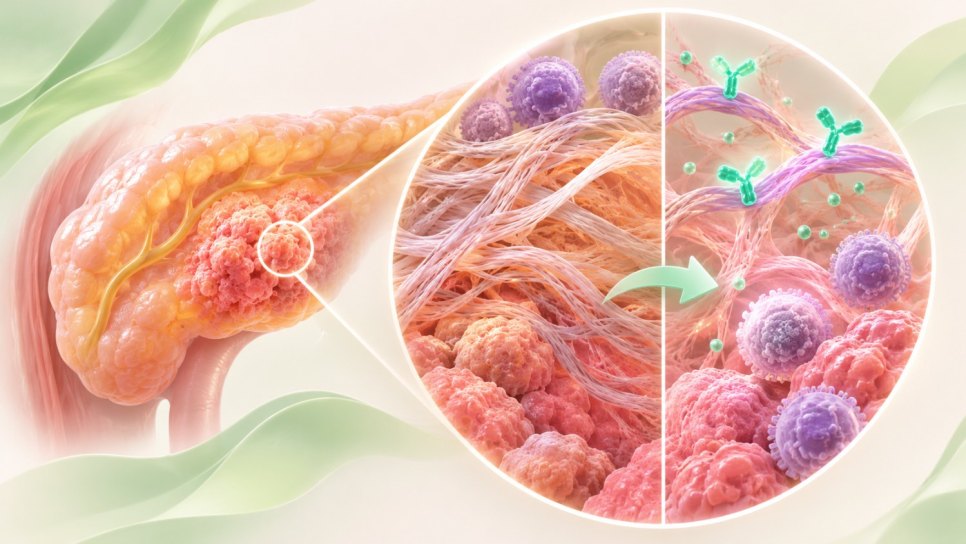
Soft tissue sarcomas are rare cancers with many different subtypes. For high-grade, resectable sarcomas of the arms and legs, the basis of treatment is surgery and radiotherapy; radiotherapy can also be given before surgery. Adding immunotherapy to the start of this plan is being studied in the hope of reducing both local and distant recurrence.
EFTISARC-NEO addresses this question with a single combination: pembrolizumab releases the brakes on immune cells, while efti, a soluble LAG-3 protein, is an investigational drug intended to stimulate antigen-presenting cells. The trial's primary endpoint, pathological response, was reported in 2025; now the first survival data have arrived.
A randomized phase II trial that added pembrolizumab to preoperative radiotherapy (SU2C-SARC032, 127 patients, stage III extremity sarcoma) was published earlier: two-year disease-free survival was 67% versus 52%, but grade 3 or higher adverse events were also more frequent (56% versus 31%). EFTISARC-NEO has a different design and patient group, so it cannot be compared directly with these figures; it only reminds us what comparative data look like in this field.
How was the preoperative treatment given?
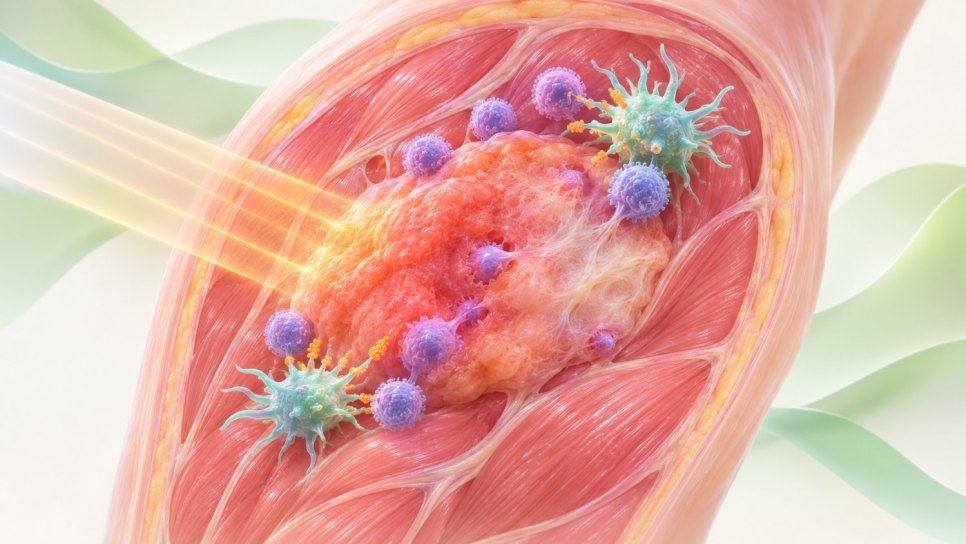
Before surgery, patients received three treatments together: efti, pembrolizumab and radiotherapy. Surgery was performed about 5-6 weeks after radiotherapy ended.
Figure 1 · Treatment and follow-up flow
The scheme reported in EFTISARC-NEO
Trial design and patients
The trial is a single-center, investigator-initiated, open-label, single-arm phase II study. This means that all patients received the same treatment and there was no comparison group.
| Feature | Reported | Why it matters |
|---|---|---|
| Trial type | Phase II, single-arm, open-label, investigator-initiated (NCT06128863); conducted at the Maria Skłodowska-Curie National Research Institute of Oncology in Warsaw | With no comparison arm, a direct comparison with standard treatment is not possible |
| Patients | 40 patients enrolled (July 2023-January 2025), 38 evaluable; sarcoma of the limbs, limb girdles or superficial trunk, FNCLCC grade 2-3, no metastases; Ewing sarcoma and alveolar and embryonal rhabdomyosarcoma were excluded | Results apply to this selected group of patients |
| Treatment | Efti subcutaneously (every 2 weeks, 5 doses), pembrolizumab 200 mg intravenously (every 3 weeks, 3 cycles) and radiotherapy of 50 Gy in 25 fractions; surgery 5-6 weeks after radiotherapy | The efti dose is not given here because sources disagree |
| Patient characteristics | Median age 54.5; 70% of tumors in the lower limb; median tumor size 8.8 cm; 60% grade 2, 40% grade 3; 27.5% recurrent tumors; the most common subtypes were myxofibrosarcoma (40%) and undifferentiated pleomorphic sarcoma (25%) | Subtype groups contain very few patients, so subtype-level interpretation is not reliable |
| Primary endpoint | Tumor hyalinization/fibrosis in the surgical specimen: median 51.5% (target 35%; historically about 15% with radiotherapy alone) | An early surrogate measure; it is not survival |
The table is compiled from the October 2025 company announcement, the CTOS 2025 presentation and news sources. Patient characteristics refer to the 40 patients enrolled.
What do the new survival data say?
| Measure | Reported value | Note |
|---|---|---|
| Median follow-up | 19.1 months (data cut-off 30 April 2026) | Follow-up is relatively short; survival data are immature |
| 12-month disease-free survival | 81.1% | 38 evaluable patients; secondary endpoint; no confidence interval given |
| 12-month local recurrence-free survival | 94.1% | No recurrence at the surgical site |
| 12-month distant metastasis-free survival | 86.2% | No metastases in distant organs |
| Grade, stage and subtype | No difference in disease-free survival was seen | Groups are very small; this does not mean "no difference" |
| TILs and hyalinization/fibrosis | High lymphocyte infiltration in the tumor and high hyalinization/fibrosis after treatment may be associated with better disease-free survival (investigators) | An observational, hypothesis-generating finding |
| Overall survival and event-free survival | Not reported in this announcement | Follow-up is ongoing |
| Radiological response (2025 presentation) | Partial response 13.2% (5 patients), stable disease 78.9% (30 patients), progression 7.9% (3 patients) | RECIST 1.1; tumor shrinkage was limited, and the response was mainly seen on pathological examination |
The survival figures are taken from Immutep's company announcement of 10 November 2026. The abstract and poster themselves could not be examined; the poster discussion will take place on 19 November 2026, and updated data may be presented there.
At what step is the evidence?
A treatment's path to the patient is long. EFTISARC-NEO fills in the first steps (pathological response and an early survival signal); the steps of a comparative trial and overall survival are not there yet.
Figure 2 · The evidence ladder
Which step has been reached for this combination
What does it mean, and what does it not mean?
- Small, single-arm trial: There are 38 evaluable patients and no comparison group. With this design, it cannot be separated whether the disease-free survival comes from the treatment or from patient selection and the natural course.
- Efti's contribution is unclear: Adding pembrolizumab to radiotherapy had itself been tested in a randomized trial. This trial cannot show whether efti gives any added benefit on top of pembrolizumab and radiotherapy.
- Interim and secondary result: Follow-up is 19.1 months; survival data are immature, no confidence interval was given and overall survival was not reported. A 12-month rate alone does not describe patients' long-term course.
- Heterogeneous patient group: Many different subtypes were evaluated together; most subtypes include only a few patients. No conclusions can be drawn by subtype.
- No safety details: This announcement does not give details of grade 3 or higher adverse events, immune-related events and wound complications; earlier sources use different wording. Of the 40 patients, 38 were evaluable: one patient lost their life after a serious event judged unrelated to treatment, and one patient declined surgery.
- Surrogate measure and historical comparison: Hyalinization/fibrosis is an early indicator and was compared with historical data of about 15%; this is not a controlled comparison. The sources are mainly company announcements.
- This result does not change treatment for now: Efti was not confirmed as an approved drug at the time this article was prepared; the trial was conducted in Poland and no site in Turkey was confirmed.
- Sarcoma board: The plan for a soft tissue sarcoma should be made, after imaging and biopsy before surgery, in a sarcoma board where the surgeon, oncologist and radiation oncologist decide together.
- Genetic and biomarker tests: Molecular tests on the tumor determine treatment options in some sarcomas (next-generation sequencing, in Turkish).
- Clinical trials: You can talk with your doctor about taking part in immunotherapy research (What is a clinical trial?, in Turkish).
- Drug access: The approval and reimbursement status of pembrolizumab in sarcoma depends on the indication and changes over time; ask your treatment team for current information (access in Turkey to FDA-approved drugs, SGK reimbursement conditions; both in Turkish).
Questions you can ask your doctor
- Were preoperative radiotherapy and other options discussed at the sarcoma board?
- Is there evidence for immunotherapy in my subtype?
- Is there a clinical trial I can join?
- What could be the side effects of preoperative treatment and its effect on wound healing?
Common misconceptions
- "81.1% disease-free survival means 81% of patients were cured." No. This is the estimated proportion of patients whose disease had not progressed at month 12; it is an interim result and longer follow-up is needed.
- "This combination was found superior to standard treatment." No. There is no comparison arm in the trial (reading research results correctly, in Turkish).
- "Immunotherapy can now be given in sarcoma." No. This combination is only being tested in clinical research; it is not an approved treatment option (common misconceptions about cancer, in Turkish).
Frequently asked questions
- What was reported in EFTISARC-NEO?
- In 38 evaluable patients, 12-month disease-free survival was reported as 81.1%, local recurrence-free survival as 94.1% and distant metastasis-free survival as 86.2%; median follow-up was 19.1 months.
- Does this result show that the new combination is better than standard treatment?
- No. Because the trial is small and single-arm, no direct comparison with the standard approach is possible; superiority was not shown.
- What is efti?
- Eftilagimod alfa (efti) is a soluble LAG-3 protein intended to support the immune response by stimulating antigen-presenting cells. It is still at the investigational stage.
- What can patients expect from this result?
- No change in treatment should be expected in the short term. The value of the combination will become clearer with larger, comparative trials and longer follow-up.
Glossary
- Soft tissue sarcoma
- A group of rare cancers arising from soft tissues such as muscle, fat and connective tissue.
- Disease-free survival (DFS)
- The time or proportion for which the disease has not recurred after treatment, and survival has not been affected by another cause.
- Local recurrence-free survival
- The proportion of patients in whom the tumor has not reappeared at the surgical site.
- Distant metastasis-free survival
- The proportion of patients who have not developed metastases in distant organs.
- Hyalinization/fibrosis
- Scar-like tissue that replaces tumor tissue in the surgical specimen as a response to treatment; an early indicator of response.
- Neoadjuvant treatment
- Treatment given before surgery.
- Single-arm trial
- A trial in which all patients receive the same treatment and there is no comparison group.
- Phase II trial
- A relatively small research stage in which first signs of a treatment's effect are sought.
- Eftilagimod alfa (efti)
- An investigational drug, a soluble LAG-3 protein, intended to stimulate antigen-presenting cells.
- FNCLCC grade
- A grading system that classifies a sarcoma by its cell features (cell differentiation, number of divisions, necrosis).
DROZDOGAN Academy Commentary
An interim result that offers the first follow-up data for a new immune combination in sarcoma but stands at an early level of evidence and should be read with care.
⚡ Why it matters
In resectable high-grade sarcoma, the main question of preoperative treatment is reducing distant recurrence. The trial goes beyond pathological response and offers a survival signal.
✅ Strengths
There is a primary endpoint with a prespecified target; the preoperative treatment appears feasible (38 patients underwent surgery, planned surgery was not delayed); the local recurrence rate is low; according to the company announcement, quality of life did not clearly deteriorate during treatment.
⚠️ Limits
Single-arm, small and single-center; survival is a secondary and interim result; there is no confidence interval or safety detail; efti's contribution cannot be separated; the data come mainly from a company announcement.
🩺 In practice
For now it does not change treatment decisions. We explain to patients that this is a research signal and that the standard approach is determined by the sarcoma board's decision.
❓ Open questions
Would survival also be better when compared with a control arm? What does efti add to pembrolizumab and radiotherapy? In which subtypes is the benefit clearer? How will long-term side effects and wound complications evolve?
Conclusion: The first survival data from EFTISARC-NEO are a promising research signal. For it to become a treatment option, benefit and safety must be shown in comparative trials.
- This article was prepared in November 2026.
- The survival information is taken from Immutep's company announcement of 10 November 2026; the CTOS 2026 abstract itself and the poster could not be examined directly. The design, treatment and pathological response information is compiled from the 2025 company announcement, the CTOS 2025 presentation file and news sources. The efti dose and safety details are not summarized here because sources are inconsistent. The SU2C-SARC032 figures are taken from a secondary summary.
- Because the trial is small and single-arm, the results are not compared with standard treatment. Drawings are simplified. The Academy commentary is our own.
- This article is not medical advice; make health decisions together with your doctor.
Sources
- Immutep Limited. Immutep Announces Release of CTOS 2026 Abstract Reporting First Survival Data from EFTISARC-NEO. 10 November 2026. globenewswire.com
- Immutep Limited. Primary Endpoint Met in EFTISARC-NEO Phase II Evaluating Neoadjuvant Efti in Soft Tissue Sarcoma and Data Presented at ESMO Congress 2025. 20 October 2025. globenewswire.com
- EFTISARC-NEO. CTOS 2025 presentation file (published by Immutep). immutep.com
- CancerNetwork. Eftilagimod Alfa/Pembrolizumab/RT Elicit Pathologic Responses in Sarcoma. cancernetwork.com
- Mowery YM, et al. Safety and efficacy of pembrolizumab, radiation therapy, and surgery versus radiation therapy and surgery for stage III soft tissue sarcoma of the extremity (SU2C-SARC032). Lancet 2024. pubmed.ncbi.nlm.nih.gov
- The ASCO Post. Addition of Pembrolizumab to Radiation Therapy and Surgery in Stage III Soft Tissue Sarcoma of the Extremity. November 2024. ascopost.com
Was this article helpful?
Your feedback helps us improve our content.