How Does Tumor Stiffness Increase Immune Suppression in Pancreatic Cancer?
In this article
How Does Tumor Stiffness Increase Immune Suppression in Pancreatic Cancer?
Pancreatic cancer is one of the cancers that benefits least from immune-based treatment. One reason may be that the tumor is made not only of cells but also of a stiff, dense tissue. A study published in Nature Immunology on 9 November 2026 reports that tumor tissue stiffness reaches T cells as a mechanical signal and can impair the function of TH1 cells, a subset of immune cells, through two cooperating proteins, YAP and RUNX1. The findings come from cell culture, mouse models and a limited number of human tissue samples; no effective treatment in humans has been shown. In this article we explain what the study did, what it showed and what it did not show. For how cancer works at the cell level, see our article on cancer biology.
- What was found? In pancreatic cancer, stiffer tissue pushes tumor-infiltrating TH1 cells toward dysfunction and toward behavior that suppresses immunity.
- Mechanism: Stiffness triggers integrin-mediated mechanical signaling in the T cell; YAP moves into the nucleus and, together with RUNX1, increases dysfunction-associated genes. The cells' secretory profile changes (IL-6, CCL3) and macrophages shift toward an M2-like, suppressive state.
- What was tried? Suppressing YAP or disrupting the YAP–RUNX1 interaction reversed TH1 cell dysfunction in experimental systems and restored antitumor immunity. The authors suggest this could be a target for strengthening immunotherapy in stiff tumors.
- What it is not: This is not a patient study. There is no approved or tested YAP–RUNX1 treatment in humans; treatment plans do not change because of this finding.
Why does this topic matter?
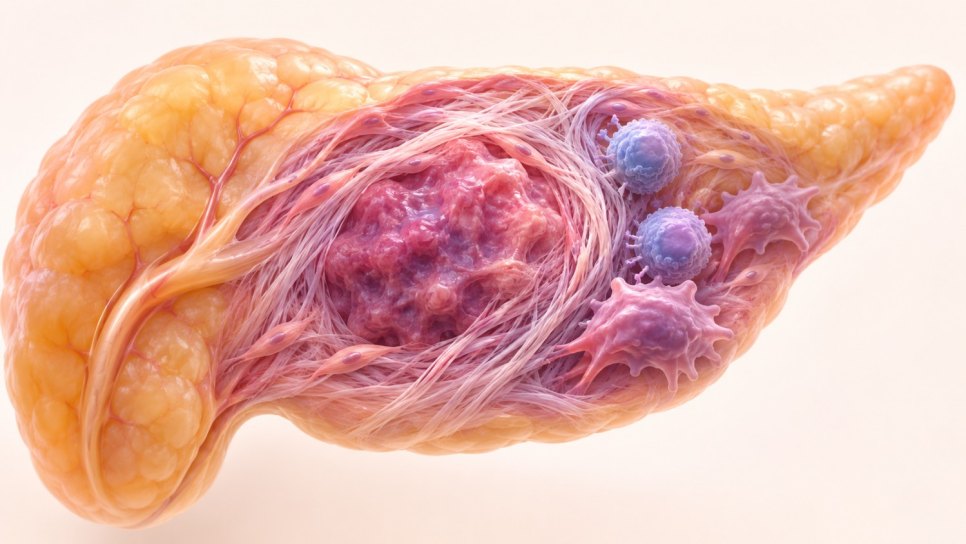
Pancreatic ductal adenocarcinoma is a cancer that builds a dense connective tissue (stroma) around itself. This tissue stiffens the tumor and also makes it harder for immune cells to enter the tumor and work there. Immune checkpoint inhibitors do not work in most patients with this cancer; rare tumors with MSI-high or mismatch repair deficiency are an important exception (pembrolizumab).
Thinking of stiffness not only as a physical barrier but also as a signal read inside cells opens a new window onto why resistance occurs. This study shows in detail how that signal is read in TH1 cells in particular and what it does.
TH1 cells are helper T cells that coordinate the immune response that helps recognize and clear tumor cells. When their function is impaired, they become ineffective themselves and can also send suppressive signals to neighboring cells.
How is stiffness "told" to the T cell?
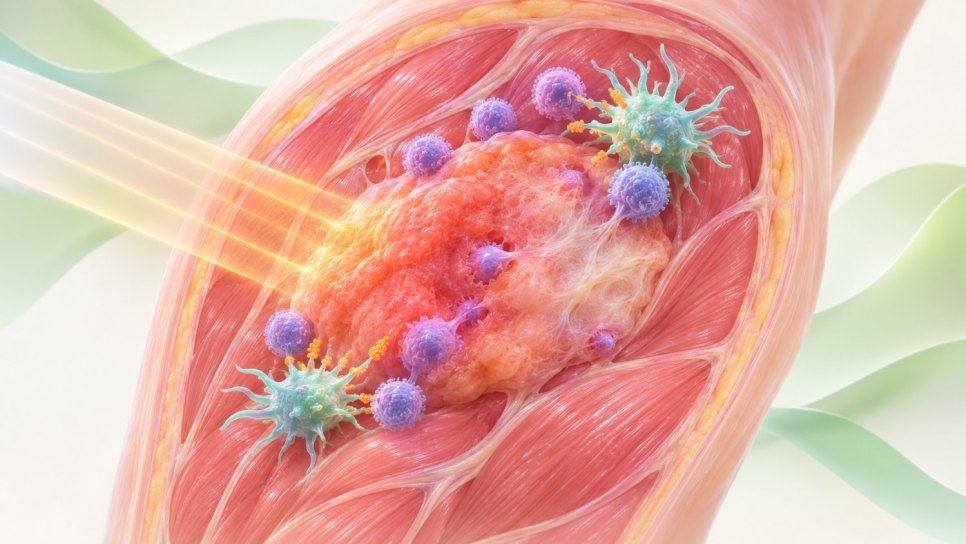
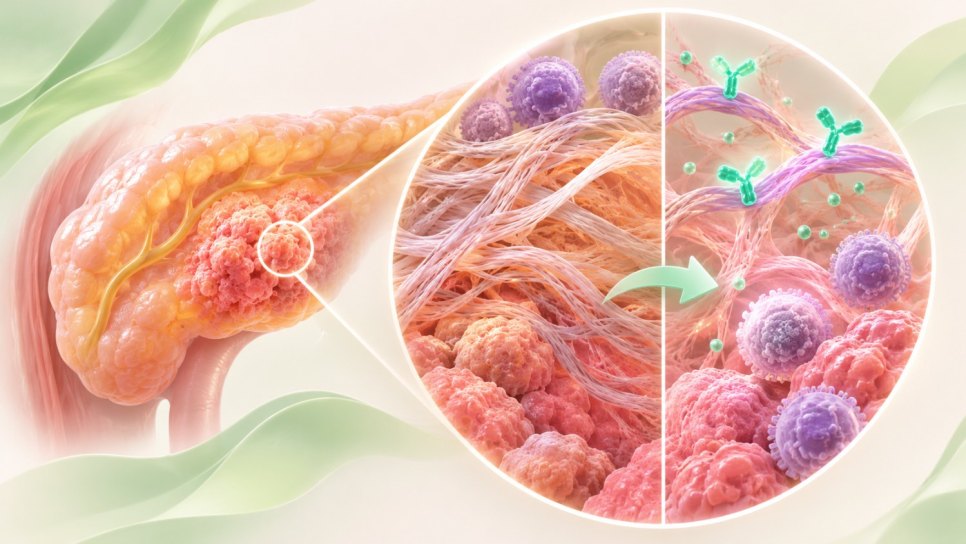
Cells sense the stiffness of their surroundings through proteins on their surface called integrins. In a stiff environment this signal causes the YAP protein to move into the nucleus. In the nucleus, YAP together with RUNX1 switches on certain genes. In the study these include genes linked to dysfunction and secreted signals such as IL-6 and CCL3. As a result, the TH1 cell both loses its function and steers macrophages into an M2-like state, that is, one that suppresses immunity.
Figure 1 · From stiffness to immune suppression
The mechanism proposed in the study
How did the researchers show this?
The study proceeds not with a single experiment but with many complementary systems. In human tissue, the relationship between stiffness and TH1 status is observed; in mouse models and hydrogels, stiffness is changed directly to test cause and effect.
| System | What was done? | What for? |
|---|---|---|
| Human pancreatic cancer tissue | Tissue stiffness was measured in 20 patients (at least 2,000 measurement points per sample); the 5 stiffest and 5 softest samples were examined by single-cell RNA sequencing (67,782 cells, 35 cell subtypes) | To see the relationship between stiffness and TH1 cell status in human tissue |
| Published human data | 21 high-stiffness and 22 low-stiffness samples were compared; stiffness was correlated with the TH1 signature score in TCGA pancreatic cancer data | A check in an independent dataset |
| Mouse single-cell and CITE-seq | 54,153 cells (29 subtypes) and 179,554 CD4+ T cells; n = 6 in the CITE-seq groups | To measure dysfunction markers such as loss of CD27/CD28, PD-1, CTLA-4 and SA-β-gal |
| Hydrogels | Soft (mean 0.96 kPa) and stiff (10.04 kPa) gels; stiffness was confirmed by atomic force microscopy | To separate the effect of stiffness from other factors |
| Mouse tumor models | Orthotopic KPC-luc and Panc02 pancreatic tumors; changing tissue stiffness with BAPN; comparison with and without immune reconstitution in NOG mice that lack immunity; n = 5 per group in most experiments | To test the effect of stiffness on tumor growth and TH1 cells in living animals |
| TH1-specific Yap deletion | Mice in which the Yap gene was deleted only in TH1 cells using Tbx21-Cre | To show that the effect depends on YAP |
| IL-6 and macrophage experiments | Anti-IL-6 treatment; M1/M2 markers in macrophages; PD-1, granzyme B and IFN-γ in CD8+ T cells | To measure the effect of the secreted signals on macrophages and other T cells |
| YAP–RUNX1 interventions | Verteporfin (a YAP inhibitor), Runx1 knockdown and rebaudioside C, found by virtual screening and binding the WW domain of YAP; a safety test in healthy mice at 50 mg/kg daily for 14 days (n = 5) | To test whether disrupting the YAP–RUNX1 axis restores TH1 function |
The table is compiled from the article's abstract and the descriptions of its supplementary data figures. Result numbers from the full text (tumor weight, survival, fold changes) could not be verified and are therefore not given here.
Where does the evidence stand?
A laboratory finding has a long road to the patient. This study fills the first steps convincingly; the last step, a treatment trial in humans, does not exist yet.
Figure 2 · The evidence ladder
Which steps the findings have been tested at
What does it mean, and what does it not mean?
- Weight of experimental models: The main results come from mouse models and hydrogels; most mouse experiments used only 5 animals per group. Mouse tumors do not reflect the full diversity of human pancreatic cancer.
- Human data are limited and observational: Stiffness was measured in 20 patients and the single-cell analysis rests only on 10 extreme samples (5 stiffest, 5 softest). This shows an association; it does not prove cause and effect in humans.
- An experimental molecule: Rebaudioside C, which disrupts the YAP–RUNX1 interaction, was used in laboratory and mouse experiments and has not been tested in humans. Eating it as a food sweetener does not produce the same effect.
- Combination results not verified: The abstract suggests that disrupting the YAP–RUNX1 axis could make stiff tumors more responsive to immunotherapy. We could not verify the combination data with anti-PD-1, or the authors' own assessment of limitations, from the full text.
- Center and population: The study was carried out mainly at cancer centers in China; the results need to be confirmed in other populations.
- This finding does not change treatment for now: There is no approved drug targeting YAP or RUNX1; a clinical trial was also not verified as of the date this article was prepared.
- Biomarker testing in pancreatic cancer: Tests such as MSI/mismatch repair deficiency and genetic changes like BRCA in the tumor determine treatment options (next-generation sequencing).
- Clinical trials: You can talk to your physician about taking part in research aimed at strengthening immunotherapy (what is a clinical trial?).
- Access to drugs: The licensing and reimbursement status of immunotherapies in Turkey changes over time; ask your treatment team for current information (access in Turkey to FDA-approved drugs, SGK reimbursement conditions).
Questions you can ask your physician
- Were MSI or mismatch repair deficiency and other biomarkers checked in my tumor?
- Is immunotherapy an option for me; if not, why not?
- Is there a clinical trial I could join?
- Do laboratory findings like these change my treatment plan for now?
Common misconceptions
- "A stiff tumor is always malignant." No. This study examines the effect of stiffness on immune cells; stiffness alone does not determine the course of the disease.
- "This finding has changed the treatment of pancreatic cancer." No. The findings come from experimental models and there is no patient treatment yet (reading research results correctly).
- "A sweetener carries this effect." No. The compound in the study was tested in purified form and at experimental doses in the laboratory; eating it as food is not evidence (common misconceptions about cancer).
Frequently Asked Questions
- How does tumor stiffness affect the immune system?
- According to the study, stiff tissue starts an integrin-mediated mechanical signal in T cells. The YAP protein moves into the nucleus and, with RUNX1, increases dysfunction genes; TH1 cells become ineffective and macrophages shift to a suppressive state.
- Is this finding a treatment?
- No. Suppressing YAP or disrupting the YAP–RUNX1 interaction restored TH1 function in experimental systems, but there is no treatment tested in humans.
- What is a TH1 cell?
- It is a subtype of helper T cell that coordinates the immune response against tumors.
- What can patients expect from this finding?
- No change in treatment should be expected in the short term. In the long term, approaches targeting stiffness and the YAP–RUNX1 axis could be used to strengthen immunotherapy only if their safety and efficacy are shown in clinical trials.
Glossary
- TH1 cell
- A subtype of helper T cell that coordinates the immune response against tumors.
- YAP
- A protein that relays the stiffness around a cell to the nucleus and influences which genes are switched on.
- RUNX1
- A transcription factor that regulates gene activation; in this study it works together with YAP.
- Integrin
- A family of proteins on the cell surface that senses the surroundings and passes mechanical signals into the cell.
- DASP
- The "dysfunction-associated secretory phenotype" defined in the study; the cell's changed secretory profile.
- M2-like macrophage
- A macrophage state that suppresses immunity and supports tissue repair.
- kPa (kilopascal)
- The unit of tissue stiffness; the higher the value, the stiffer the tissue.
- Single-cell RNA sequencing (scRNA-seq)
- A method that measures, one by one, which genes each cell in a tissue has switched on.
- Orthotopic model
- An experimental model in which the tumor is placed in the organ it arises from in the mouse (here the pancreas).
- Verteporfin
- A compound used in the laboratory to suppress YAP; in medicine it is used for another purpose (light-activated treatment of an eye disease).
DROZDOGAN Academy Commentary
A conceptually strong study that reminds us that to understand why immunotherapy does not work in pancreatic cancer we must look not only at cells but at the tissue the cells live in.
⚡ Why it matters
Tissue stiffness has mostly been thought of as a physical barrier. The study shows that stiffness is a signal read inside the T cell that reprograms its function.
✅ Strengths
Human tissue, different mouse models and hydrogels were used together; the effect was tested by deleting a gene specifically in one cell type (TH1); the mechanism was supported at the chromatin level (YAP and RUNX1 binding together at the same gene regions); a reversal strategy was tried.
⚠️ Limits
The findings come mainly from experimental models; mouse groups are small; the human data are observational and limited; the molecule tested was not tested in humans; the combination data could not be verified while this article was prepared.
🩺 In practice
For now it does not change treatment decisions. We tell patients that studies like this are promising but early, and that current options are determined by biomarker tests and the physician's assessment.
❓ Open questions
Could tissue stiffness become a measurable biomarker in patients? Can the YAP–RUNX1 axis be targeted safely? Does this effect hold in other stiff tumors? Would it benefit people when combined with immunotherapy?
Conclusion: The study sets out the role of the mechanical environment in immune resistance with a detailed mechanism. For it to become a patient treatment, safety and efficacy must be shown in humans.
- This article was prepared in November 2026.
- The information is taken from the abstract, methods and supplementary data figure descriptions of the study by Xu and colleagues published in Nature Immunology on 9 November 2026. Because the results section of the full text could not be examined while this article was prepared, effect-size numbers are not given.
- The study does not evaluate a treatment in humans; the findings rest on cell culture, mouse models and limited human tissue data. Drawings are simplified. The Academy commentary is our own.
- This article is not medical advice; make health decisions together with your physician.
Sources
- Xu Z, Deng S, Zhao H, et al. Mechanosensitive YAP–RUNX1 signaling drives TH1 cell dysfunction and tumor immunosuppression. Nat Immunol 2026. doi:10.1038/s41590-026-02708-y. doi.org
Was this article helpful?
Your feedback helps us improve our content.