
Coronavirus – overlooked issues, countries' contributions and what needs to be done

In this article
We will be living for a long time with the Coronavirus Pandemic (global outbreak) that we are facing. Inadequate precautions and indifference cause such outbreaks to spread rapidly around the world. The Coronavirus Pandemic is similarly spreading rapidly around the world, accompanied by many deaths. On the other hand, the Coronavirus Pandemic will inevitably subside over time to the status of an endemic (non-epidemic) disease. However, making the right decisions quickly is important to achieve this as soon as possible.
Countries' responses and health policies play a very important role in the spread or containment of coronavirus. Many countries may not have anticipated that this outbreak could spread so quickly and have such adverse consequences. The level of precautions was increased over time, but the disease continued to spread. The simple measures taken were insufficient to stop the spread of the disease. Many institutions and organizations stated that some countries had not acted quickly to reduce the spread of the disease, and that measures to identify people carrying the disease and reduce contact between people (isolation) had been insufficient or taken too late.
Related topics:
- Breaking news about coronavirus – The situation in the world and Turkey
- What are epidemics and pandemics? What are the differences between them?
At this point, schools have been closed for a while in many countries, including some parts of the United States; international flights and travel have been restricted or banned, and crowded events (sports, culture, entertainment, etc.) have been canceled.
On the other hand, measures taken to prevent the spread of the disease restrict people's daily lives. However, all these measures are an effort to implement scientists' recommendations to flatten the pandemic's spread curve and have potentially lifesaving benefits (Figure 1). By reducing physical contact as much as possible, it is thus expected that there will not be a large surge in the number of people falling ill at once and that the spread of the virus will slow down. These measures are also intended to provide sufficient hospital beds or intensive care support for everyone who needs them. Otherwise, it is thought that adequate healthcare will not be available to people who become ill (just as is happening in Italy at present).

Figure 1. Source: CDC, Drew Harris ; Credit: Connie Hanzhang Jin/NPR
For example, Italy is the country with the most cases of coronavirus disease (COVID-19) and the most deaths after China. To combat coronavirus, Italy became the first country to be placed entirely under quarantine, and all businesses except places such as pharmacies and banks have been temporarily closed. As of 15 March 2020, the number of deaths in Italy exceeded 1800 and the total number of cases exceeded 24 thousand.
On 13 March, the World Health Organization (WHO) announced that, after Asia, Europe had become the new center of the pandemic. It is likely that more cases and deaths will soon be reported in Europe than in the rest of the world. Accordingly, the likelihood of an ongoing outbreak within each country appears quite high. The final stage of spread within a country is when people in the community with no travel history or contact with another patient also become infected with the disease. These cases have been encountered in Europe and America, particularly in South Korea, Iran and Italy.
The World Health Organization's press statement of 13 March emphasized the importance of knowing where the virus is in order to combat this viral outbreak. "Find, isolate, test and treat to break the chain of COVID-19 transmission. Every case we find and treat will limit the spread of the disease", it stated.
Hong Kong and Singapore in particular encountered the novel coronavirus (scientific name SARS-CoV-2) earlier than other countries. However, despite this disadvantage, while each currently has fewer than 250 total cases, the total number of cases in Spain, Germany and France, where transmission appeared later, is 20 times higher than in these countries. Similarly, in Italy, a process that began with only 3 cases exceeded 20 thousand within 3 weeks. The same outbreak has shown marked differences between countries. This demonstrates how effective governments' responses to this outbreak can be in the spread or containment of the disease (Figure 2).
Countries that have succeeded and failed in managing the coronavirus outbreak...
During this outbreak, Singapore and Hong Kong rapidly established systems to identify and treat every case in their regions. Hong Kong rapidly developed diagnostic tests and installed them in laboratories at every major hospital in the city. Although new cases have appeared in countries such as these two that responded quickly at the start of the outbreak, the figures have not reached frightening levels. In contrast, countries such as Italy and Iran, whose measures were inadequate and which did not carry out many tests, are seen to be paying a heavy price.
Following very rapid spread, China and South Korea achieved a decline in new cases by carrying out extensive testing, isolating people with case contact and symptoms, and reducing social gatherings. During this difficult process, South Korea provided information transparently and successfully traced the contacts of people found to be infected after testing.
As a contrasting example, because of inadequate precautions and low testing capacity, the outbreak in Italy and Turkey's neighbor Iran began with many deaths and reached frightening proportions in a very short time. By the time measures were taken, it was already too late for many people.
Most European countries have now acknowledged that there is an outbreak in the community and have begun testing all patients presenting to hospitals with flu-like infections and pneumonia, regardless of travel history. At the same time, they have begun rapidly expanding healthcare, intensive care and testing capacity in case they face a situation like Italy's.
Turkey – early response, meaningful measures...
These experiences demonstrate why Turkey's decisions to isolate (contain) the disease (restricting travel and social activities, closing schools, etc.) are justified. With the small number of cases currently detected, Turkey is in the category of countries with rare (sporadic) cases. However, to maintain this situation, increasing testing in the country, identifying and isolating infected people, and tracing their contacts will increase our success in the struggle.
Below, you can see a comparison of Italy, which tests only people showing signs and symptoms, and South Korea, which carries out extensive testing. In Italy, many young people who did not feel ill spread the virus around them. This risk currently exists for Turkey; the government is introducing many measures, but because of the perception that "the disease does not kill young people", some of the young population appear to think they are not at risk and are moving around and socializing freely. Please be careful; let us not do this.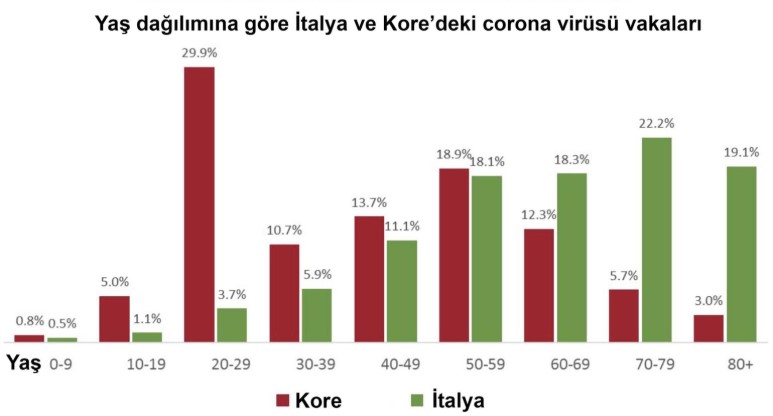
Is the United Kingdom taking a big gamble?
However, unlike all the other countries of the world, the United Kingdom is pursuing a different policy in combating this outbreak. The British government has stated that it recognizes the seriousness of the outbreak but that closing schools and postponing mass events are unnecessary. The British government and scientists argue that a very significant proportion of the population will inevitably be affected by the outbreak, but that this will also mean that a significant proportion of the British population will have become immune to the novel coronavirus (SARS-CoV-2).
The United Kingdom argues that this outbreak, which it expects to last a long time, should be fought through a system called "Herd Immunity". With no vaccine against this virus yet developed, it claims that the only way to achieve this is for the majority of the population to contract the disease.
"The United Kingdom states that its plan aims to slow down and control the disease in this way. As additional measures, it says that people currently suspected of having the disease should isolate themselves at home for 7 days and that the public should generally increase hygiene measures. It also advises older people and the sick not to leave their homes. Conversely, it argues that if schools are closed, seeking help from older people to care for children who are not attending school will lead to worse outcomes for the older group most affected by the disease.
Through this plan, it aims to protect at-risk groups more effectively by slowing the disease without putting pressure on healthcare system capacity.
However, experts who do not share this view believe it would be better to follow China and other successful examples rather than adopt a new strategy. They predict that the number of cases announced by the United Kingdom today equals the figures Italy announced 13 days ago, and that in 13 days it will face more than 20 thousand cases and more than 1500 people needing intensive care, just like Italy. They argue that this would mean insufficient hospitals and the collapse of the healthcare system.
Conclusion
The whole world will learn very important lessons from this outbreak, just as it has from other outbreaks. Countries' health policies and the isolation measures they take are important in combating the outbreak. However, it is individuals themselves who will implement them. Hygiene and other personal precautions are important to avoid contracting the disease. However, personal precautions will not be sufficient to prevent the disease from spreading. Everyone also needs to assume they are carrying the virus and avoid spreading it to others, in other words, take steps to avoid transmitting it.
We do not know how much larger the coronavirus pandemic will become or when it will end. Although there are some predictions, knowing the answer is almost impossible. The most accurate answer to this question should be: "This will depend entirely on how the world responds to the outbreak." If we want to stop and end the outbreak in the future, countries' health policies and people's active participation will be decisive...
Let us recall the preventive measures:
According to a study reported by Princeton University, the novel coronavirus can remain viable for up to 3 hours in aerosols, 24 hours on cardboard and 2-3 days on plastic and steel. Therefore, the two most important measures for protection against the coronavirus outbreak are: first, avoiding a known COVID-19 case whenever possible; and second, washing hands frequently. It is also important to reduce social contact and for people with mild-to-moderate flu/cold symptoms to stay at home during their illness as much as possible (see the 4th infographic below). If a person with these symptoms has chronic diseases such as cancer, cardiovascular disease or diabetes, they should contact the healthcare team following them.
Where is testing for the novel coronavirus (SARS-CoV-2) carried out in Turkey?
All hospitals, both public and private, can collect samples from patients. However, the samples collected are sent for testing to laboratories designated by the Ministry.
Patients with suspected coronavirus can visit their nearest healthcare facility, but these people are referred to level 2 and level 3 hospitals with infectious diseases services. Coronavirus testing can be carried out on people who meet the coronavirus case definition. The physician makes the decision; not everyone who wants a coronavirus test can have one.
Should I be tested for SARS-CoV-2?
Previously, people who had arrived from high-risk countries within the past 14 days and showed symptoms such as fever, cough and shortness of breath were tested. Now, arriving within the past 14 days and showing symptoms is sufficient, regardless of the country. If you have been in close contact with someone showing these symptoms who has recently traveled from this region, you should call a healthcare professional in advance and mention your close contact and their recent travel. Your healthcare professional will work with your province's public health department to determine whether you need to be tested for COVID-19.
Sources
2. bbc.com/turkce/haberler-dunya-51887343 (Koronavirüs neden hızlı yayıldı? Hangi önlemler işe yaradı?, Dr. Müge Çevik, St Andrews Üniversitesi*. Medical intern Dr. Ali İhsan Nergiz, İstanbul Üniversitesi**, 14 March 2020)
3. The Coronavırus Crısıs, Singapore Wins Praise For Its COVID-19 Strategy. The U.S. Does Not, March 12, 2020.
4. bbc.com/turkce/haberler-dunya-51871575 (Koronavirüs: İngiltere'de virüsün kontrollü yayılması planı işe yarayacak mı? 13 March 2020)
Was this article helpful?
Your feedback helps us improve our content.


Reader comments
Share your comment
Your name and comment are published only after administrator approval. Your email address is never shown to visitors.
Be the first to comment.