
EGFR Exon 20 Lung Cancer: First-Line Sunvozertinib Outperformed Chemotherapy

In this article
Is First-Line Treatment Changing in Lung Cancer with EGFR Exon 20 Insertions?
EGFR Exon 20 Insertions: A Different Challenge from Classic EGFR Mutations
EGFR exon 20 insertion mutations are a less common but clinically very challenging subgroup of EGFR-mutated NSCLC. These mutations arise from small genetic fragments inserted into the exon 20 region of the EGFR gene. The resulting structural change makes it harder for classic EGFR inhibitors to bind. Older-generation EGFR TKIs, which are very effective in classic EGFR mutations such as exon 19 deletions or L858R, therefore generally do not show sufficient efficacy in exon 20 insertions.
This patient group was historically treated with chemotherapy. In recent years, EGFR/MET-targeted antibodies such as amivantamab and more selective oral EGFR exon 20 inhibitors such as sunvozertinib have begun to fill this gap. In July 2025, sunvozertinib received accelerated approval from the US FDA for metastatic NSCLC with EGFR exon 20 insertions that had progressed after platinum-based chemotherapy. WU-KONG28 is testing this drug earlier, in the first line.
Brief Concept Note: What Is an EGFR Exon 20 Insertion?
EGFRis a receptor tyrosine kinase that regulates cell growth and proliferation. Exon 20 insertionis a specific type of mutation caused by the addition of extra genetic sequences to the region of the EGFR gene called exon 20. This mutation gives cancer cells a growth advantage, but behaves more resistantly to classic EGFR targeted drugs. This mutation therefore needs to be correctly identified and targeted with specific drugs.
How Does Sunvozertinib Work?
Sunvozertinib is an oral EGFR tyrosine kinase inhibitor developed to target EGFR exon 20 insertion mutations. Tyrosine kinase inhibitors suppress the enzyme activity that transmits cancer cells' growth signals within the cell. Sunvozertinib aims to stop the abnormal growth signal caused by EGFR exon 20 insertions.
The most important advantage of this approach is its ability to offer an oral targeted treatment instead of intravenous chemotherapy. However, being oral is not sufficient on its own; the real value lies in whether it provides better tumor control and a manageable safety profile compared with chemotherapy. WU-KONG28 answers this question at the phase 3 level.
First-Line Oral Targeted Treatment Versus Platinum-Pemetrexed Chemotherapy
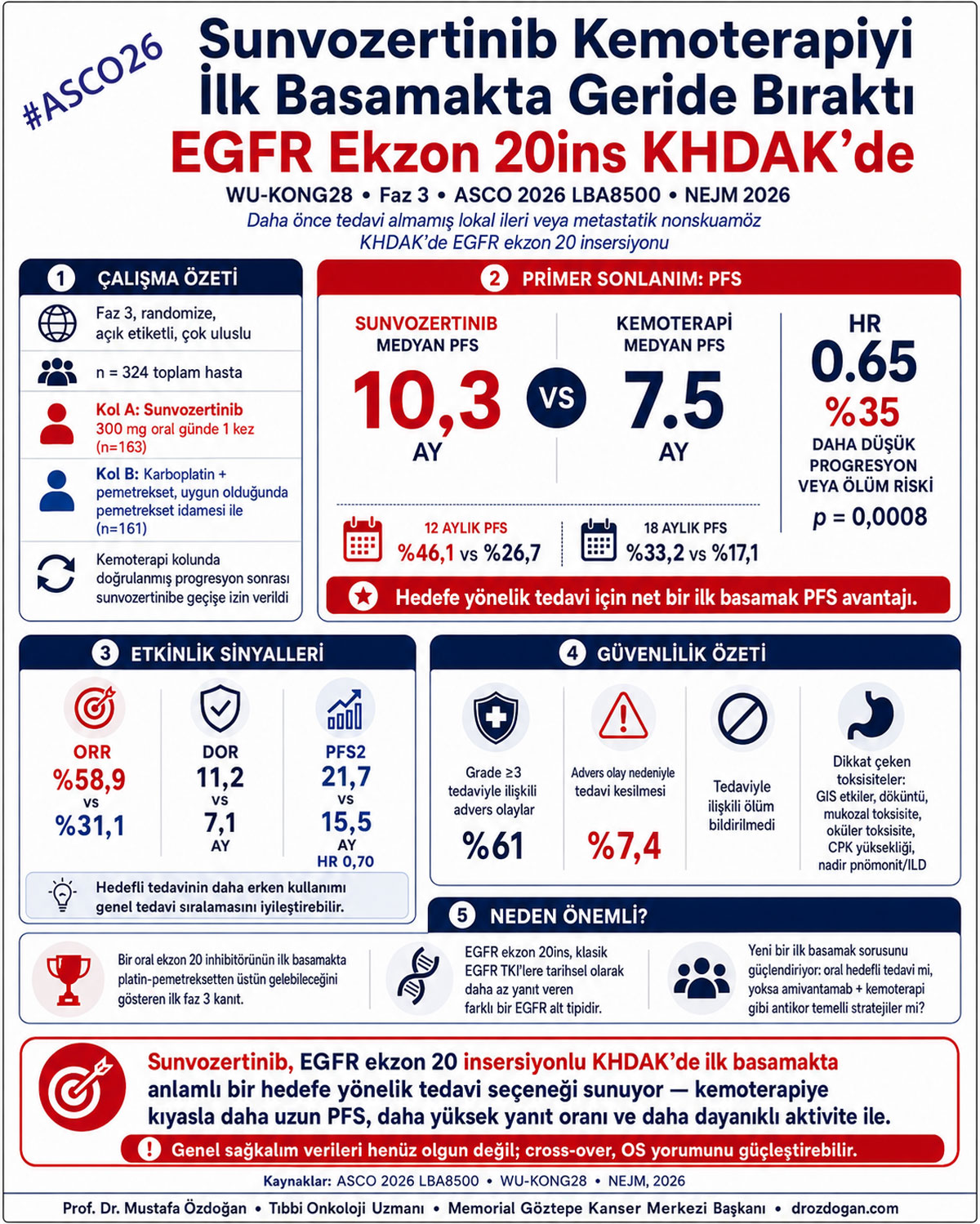
WU-KONG28 is a randomized, multinational, open-label phase 3 study conducted in treatment-naive patients with advanced NSCLC with EGFR exon 20 insertions. The study included patients with locally advanced or metastatic nonsquamous NSCLC, carrying an EGFR exon 20 insertion mutation, who had not previously received systemic treatment for advanced disease.
Patients were randomized 1:1 to two arms. In the sunvozertinib arm, patients received 300 mg orally, once daily of sunvozertinib. The control arm received carboplatin + pemetrexed chemotherapy; eligible patients continued pemetrexed maintenance. When disease progression in the chemotherapy arm was confirmed by BICR, crossover to sunvozertinib was permitted.
Brief Concept Note: What Are BICR, Randomized Phase 3, and Crossover?
BICRmeans blinded independent central review; it is a central assessment of imaging by independent experts who are unaware of the treatment arm. A randomized phase 3 studyis an advanced research stage in which a new treatment is compared with standard treatment, with the potential to change clinical practice. Crossoverallows a patient in the control arm to switch to the experimental treatment when the disease progresses; this may be ethically important but can complicate the interpretation of overall survival.
| Characteristic | Sunvozertinib arm | Chemotherapy arm | Clinical significance |
|---|---|---|---|
| Number of patients | 163 | 161 | A total of 324 patients were randomized 1:1. |
| Treatment | Sunvozertinib 300 mg orally, once daily | Carboplatin + pemetrexed; followed by pemetrexed maintenance in eligible patients | Single-agent oral targeted treatment was compared with platinum-based chemotherapy. |
| Patient group | Locally advanced or metastatic nonsquamous NSCLC with EGFR exon 20 insertions; treatment-naive in the advanced setting | The question of first-line targeted treatment was tested directly. | |
| Primary endpoint | Progression-free survival assessed by BICR | The duration of disease control without progression was evaluated. | |
| Crossover | Not applicable | Crossover to sunvozertinib after progression was permitted | Complicates the interpretation of OS because many patients in the control arm later receive targeted treatment. |
PFS: 10,3 Months Versus 7,5 Months
The primary endpoint of WU-KONG28 was met. According to BICR assessment, median progression-free survival in the sunvozertinib arm was 10,3 months, and in the chemotherapy arm it was 7,5 months . The hazard ratio was reported as 0,65, with a 95% confidence interval of 0,50–0,85 and a P value of 0,0008 .
This result shows that sunvozertinib reduced the risk of disease progression or death compared with chemotherapy by approximately 35% in relative terms . The 12-month PFS rate with sunvozertinib was %46,1, and with chemotherapy it was %26,7; the 18-month PFS rates were, respectively, %33,2 and %17,1 .
Brief Concept Note: What Do PFS and Hazard Ratio Mean?
PFSmeans progression-free survival; it expresses the period during which the disease remains under control without progression or death. Hazard ratiocompares the risk of an event occurring over time in two treatment arms. An HR of 0,65 indicates that the risk of progression or death in the sunvozertinib arm was lower than with chemotherapy.
Response Rate Almost Doubled: 58,9% Versus 31,1%
Sunvozertinib not only delayed disease progression but also increased the tumor shrinkage rate. The confirmed objective response rate in the sunvozertinib arm was %58,9, and in the chemotherapy arm it was %31,1 . Duration of response also favored sunvozertinib: the median duration of response was 11,2 months, compared with 7,1 months reported in the chemotherapy arm.
Brief Concept Note: What Are ORR and DOR?
ORRis the objective response rate; it indicates the proportion of patients whose tumors shrink measurably. DORis duration of response; it expresses how long tumor shrinkage lasts. A high ORR means rapid tumor control, while a long DOR means more durable control.
Main Efficacy Messages
- Superiority of targeted treatment in the first line: Sunvozertinib significantly prolonged PFS compared with platinum-pemetrexed chemotherapy.
- Higher response rate: Tumor shrinkage was substantially more frequent in the sunvozertinib arm.
- Response lasted longer: DOR was 11,2 months versus 7,1 months.
- Oral treatment advantage: Single-agent oral treatment offers a potential advantage in patient comfort compared with intravenously administered chemotherapy.
PFS2 Also Favors Sunvozertinib: The Initial Treatment Sequence May Matter
Second progression-free survival, or PFS2, in WU-KONG28 was also reported to favor sunvozertinib. Median PFS2 in the sunvozertinib arm was 21,7 months, and in the chemotherapy arm it was 15,5 months ; the HR was reported as 0,70 and the P value as 0,0111 .
Brief Concept Note: What Is PFS2?
PFS2is the time from randomization to a patient's second disease progression or death. This measure helps us understand the effect of subsequent treatment sequencing, as well as initial treatment, on total disease control. PFS2 favoring sunvozertinib suggests that using targeted treatment earlier may provide an advantage despite the subsequent course of treatment.
OS Data Are Not Yet Mature
Overall survival data are not yet mature. In addition, because a very large proportion of patients in the chemotherapy arm switched to sunvozertinib after progression, interpreting an OS difference becomes difficult. The study's most robust message today therefore concerns PFS, response rate, and duration of response. Longer follow-up is needed for overall survival.
EGFR-Class Adverse Effects and CPK Elevation Stand Out
Sunvozertinib's safety profile was reported to be consistent with previous studies and generally manageable. According to the OncLive summary, the rate of drug-related, grade 3 or higher treatment-related adverse events in the sunvozertinib arm was %61 . The rate of adverse events leading to treatment discontinuation was reported as %7,4 , and no treatment-related fatal adverse events were reported.
The main adverse effects requiring attention with sunvozertinib, consistent with the EGFR TKI class, are gastrointestinal adverse effects, skin rash, mucosal effects, ocular toxicity, and the rare risk of interstitial lung disease/pneumonitis. CPK elevation is also among the laboratory findings that require monitoring with this agent.
Brief Concept Note: What Are CPK Elevation and Pneumonitis?
CPKis an enzyme that can be released from muscle tissue; its elevation can be an indicator of muscle damage or irritation. Pneumonitisis drug-related inflammation of lung tissue; it may present with cough, shortness of breath, and low oxygen levels. These findings should be recognized early in patients using EGFR TKIs.
Dose Note: The Approved Dose and Study Dose Are Different
In the US FDA's accelerated approval in 2025, the recommended sunvozertinib dose for use after platinum therapy is 200 mg orally, once daily. In the WU-KONG28 first-line study, sunvozertinib was administered at 300 mg once daily. First-line use in practice should therefore not be implemented automatically before the prescribing information and country-specific approval processes are clarified.
The New Question After PAPILLON: Antibody + Chemotherapy or an Oral TKI?
First-line treatment of advanced NSCLC with EGFR exon 20 insertions no longer consists of chemotherapy alone. The PAPILLON study showed that amivantamab + chemotherapy significantly prolonged PFS compared with chemotherapy. With this study, amivantamab + carboplatin/pemetrexed became an important first-line option in many guidelines and in practice.
WU-KONG28 offers a different approach: single-agent oral targeted treatment instead of an intravenous antibody + chemotherapy combination. Because these two approaches have not been compared directly, it is not correct to say which is better. However, in clinical practice these two datasets show that molecularly targeted first-line options are now gaining strength in patients with EGFR exon 20 insertions.
| Study / approach | Treatment | Control | PFS | ORR | Clinical interpretation |
|---|---|---|---|---|---|
| PAPILLON | Amivantamab + carboplatin/pemetrexed | Carboplatin/pemetrexed | 11,4 vs 6,7 months; HR 0,40 | 73% vs 47% | The antibody + chemotherapy combination provided a strong PFS and response advantage over chemotherapy. |
| WU-KONG28 | Sunvozertinib oral monotherapy | Carboplatin/pemetrexed ± pemetrexed maintenance | 10,3 vs 7,5 months; HR 0,65 | 58,9% vs 31,1% | A single-agent oral EGFR exon20ins inhibitor demonstrated superiority over chemotherapy at the phase 3 level. |
| Platinum-pemetrexed chemotherapy | Conventional systemic chemotherapy | Not applicable | Approximately 6–8 months, depending on the study | Variable | It was the main standard for a long time; its place is now being redefined alongside targeted approaches. |
This Table Is Not a Direct Head-to-Head Comparison
PAPILLON and WU-KONG28 tested different treatment strategies in different studies. Patient populations, study designs, control arms, treatment administration methods, and follow-up durations differ. These data therefore cannot directly answer the question “Is amivantamab + chemotherapy or sunvozertinib better?” The correct message is that first-line targeted treatment options are rapidly gaining strength in patients with EGFR exon 20 insertions.
The Case for Using Targeted Treatment Earlier Is Strengthening
The most important clinical message of WU-KONG28 is that targeted treatment in advanced NSCLC with EGFR exon 20 insertions may no longer be confined to the post-platinum setting. Sunvozertinib demonstrating superiority in PFS and ORR over chemotherapy in the first line strengthens the idea of starting treatment with a molecularly targeted approach in patients carrying this mutation.
In practice, however, the decision will depend on several factors: country-specific approval and reimbursement status, access to amivantamab + chemotherapy, the patient's suitability for intravenous treatment, preferences for oral treatment, the presence of brain metastases, the exon 20 insertion subtype, adverse effect profile, and overall performance status.
Points to Consider in Patient Selection
- Correct identification of the mutation: EGFR exon 20 insertions are heterogeneous; accurate characterization by NGS is important.
- Brain metastases: WU-KONG28 stratified randomization according to brain metastasis status; details of CNS efficacy are important for practical decisions.
- Oral treatment advantage: Single-agent oral treatment may reduce hospital visits and the burden of infusions.
- Adverse effect management: Monitoring of skin, gastrointestinal effects, CPK, eyes, and pneumonitis is needed.
- OS maturity: The treatment's ultimate place should be interpreted carefully before overall survival data become clear.
Brief Concept Note: Why Is NGS Important?
NGSmeans next-generation sequencing and can screen for numerous genetic alterations simultaneously. EGFR exon 20 insertions consist of different subtypes; some more limited tests may miss these mutations or fail to characterize them in detail. Comprehensive molecular testing in advanced nonsquamous NSCLC is therefore critically important for treatment selection.
Hope for an Oral Targeted Treatment Alternative to Chemotherapy
Patient-Friendly Explanation
“If your lung cancer has a specific genetic alteration called an EGFR exon 20 insertion, classic EGFR drugs may generally not be sufficiently effective. In the new study, an oral targeted drug called sunvozertinib, used as initial treatment, kept the disease under control longer and produced tumor shrinkage in more patients compared with chemotherapy. However, survival results are not yet mature, and close monitoring of the drug's adverse effects is needed. The approval and access status of this treatment in our country should be assessed separately.”
Earlier Use of Targeted Treatment Is Gaining Strength in EGFR Exon 20 Patients
Academic Assessment
In advanced lung cancer with EGFR exon 20 insertion mutations, the sunvozertinib data appear to be an important result that could change the first-line treatment approach for this patient group.
Providing a higher response rate and longer disease control compared with chemotherapy strengthens the case for using targeted treatment earlier in these patients.
Caution is needed because overall survival data are not yet mature; however, this study shows that treatment of EGFR exon 20 patients will become increasingly selective and molecularly based.
How Will Sunvozertinib's True Place in the First Line Be Determined?
Open Questions
- OS outcome: Will a statistically significant or clinically important difference in overall survival emerge despite the high crossover rate?
- Sequencing with amivantamab + chemotherapy: Which patients will be better suited to an oral TKI, and which to an antibody + chemotherapy?
- CNS efficacy: How strong and durable is the control provided by sunvozertinib in patients with brain metastases?
- Exon 20 subtypes: Among more than a hundred EGFR exon 20 variants, does response differ by subtype?
- Resistance mechanisms: Which molecular resistance pathways develop after sunvozertinib?
- Combinations: Can combinations of sunvozertinib with amivantamab, chemotherapy, or other targeted agents add value?
Truecheck Note
Sunvozertinib currently has accelerated approval in the US for metastatic NSCLC with EGFR exon 20 insertions that has progressed after platinum-based chemotherapy. The WU-KONG28 first-line phase 3 data are very strong, but first-line approval and reimbursement status should be evaluated separately for each country.
A Chemotherapy-Free First-Line Era Is Approaching in Lung Cancer with EGFR Exon 20 Insertions
The WU-KONG28 study showed that first-line sunvozertinib provides better disease control than platinum-pemetrexed chemotherapy in advanced NSCLC with EGFR exon 20 insertions. Median PFS was reported as 10,3 months versus 7,5 months, HR 0,65, and P=0,0008. The objective response rate also favored sunvozertinib, at 58,9% versus 31,1%.
This result suggests that targeted treatment can now be used earlier in the EGFR exon 20 patient group, which remained dependent on chemotherapy for years. In particular, the option of single-agent oral targeted treatment may offer an important advantage in patient comfort and treatment practice.
However, overall survival data are not yet mature, and the high crossover rate in the chemotherapy arm will complicate OS interpretation. Sunvozertinib's ultimate place in the first line will therefore become clear together with mature survival data, CNS results, resistance biology, clinical positioning relative to amivantamab + chemotherapy, and country-specific approval/access conditions. Nevertheless, this study brings the future of molecularly targeted treatment in lung cancer with EGFR exon 20 insertions substantially closer.
References
- Heymach JV et al. First-Line Sunvozertinib in NSCLC with EGFR Exon 20 Insertion Mutations. New England Journal of Medicine. 2026.
- The ASCO Post. First-Line Sunvozertinib in Advanced NSCLC With EGFR Exon 20 Insertion Mutations. 29 May 2026.
- ASCO 2026 Abstract LBA8500. Sunvozertinib monotherapy versus platinum-based chemotherapy in first-line EGFR exon20ins advanced NSCLC: WU-KONG28.
- OncLive. Sunvozertinib Shows Superior Efficacy vs Chemo in Frontline Advanced EGFR Exon 20+ NSCLC. 2026.
- OncoDaily. ASCO 2026: Sunvozertinib Versus Chemotherapy in First-Line EGFR exon20ins Advanced NSCLC. 2026.
- Dizal. Phase 3 WU-KONG28 results: ZEGFROVY outperforms platinum-doublet chemotherapy in first-line EGFR exon20ins NSCLC. 29 May 2026.
- ClinicalTrials.gov. WU-KONG28: A Study of DZD9008 Versus Platinum-Based Doublet Chemotherapy in Advanced or Metastatic NSCLC With EGFR Exon20ins. NCT05668988.
- U.S. FDA. FDA grants accelerated approval to sunvozertinib for metastatic NSCLC with EGFR exon 20 insertion mutations. 2 July 2025.
- drozdogan.com. Sunvozertinib Received Accelerated FDA Approval in EGFR Exon 20-Mutated Lung Cancer. 3 July 2025.
- Zhou C et al. Amivantamab plus Chemotherapy in NSCLC with EGFR Exon 20 Insertions. New England Journal of Medicine. 2023.
Was this article helpful?
Your feedback helps us improve our content.


Reader comments
Share your comment
Your name and comment are published only after administrator approval. Your email address is never shown to visitors.
Be the first to comment.