
How Do Green Leafy Vegetables Reduce Fatty Liver?

PNAS (Proceedings of the National Academy of Sciences) published a new study in December 2018 showing that green leafy vegetables protected mice against non-alcoholic fatty liver disease and offered protection against this condition. Non-alcoholic fatty liver disease is a condition caused by the accumulation of fat in the liver. In America, %30-40 of young people have non-alcoholic fatty liver disease. This condition is also the most common cause of liver disease in Western countries. Experts have also associated it with obesity, cardiovascular diseases and metabolic risk factors .

Known ways to reduce liver fat are losing weight, increasing physical activity and choosing a healthy diet.
The study shows that inorganic nitrate, which occurs naturally in green leafy vegetables, reduces liver fat. Carlström and colleagues, who conducted the study, say that adding inorganic nitrate to the diets of mice consuming high levels of fat and carbohydrates significantly reduced their levels of fatty liver. The group receiving additional nitrate in its diet also showed lower blood pressure and better insulin sensitivity than the group not receiving nitrate. Earlier studies also showed that green leafy vegetables protect against metabolic diseases such as type 2 diabetes.
Carlström also stated that what makes green leafy vegetables so healthy has not yet been explained, but nitrate, which no one had investigated before, could be the key. Now, to investigate the therapeutic (treatment-related) value of nitrate supplementation for reducing the risk of fatty liver, human clinical studies need to be conducted. The results could lead to the development of new pharmacological and dietary approaches. People can benefit from consuming more green leafy vegetables. The green vegetables containing the most nitrate are celery, spinach, lettuce and arugula. To benefit from the protective effects of green leafy vegetables, large amounts are unnecessary; eating 200 grams daily is sufficient.
What Are the Differences Between Organic and Inorganic Nitrate / Nitrite?
Most readers of this article have probably heard nitrates described as “unhealthy” molecules until now. Nitrates and nitrites are probably / most likely carcinogenic to humans , one of 58 agents classified in this way. However, the inorganic nitrates discussed in this article have different structures and properties from the organic nitrates investigated as carcinogens (cancer-causing substances).
Both organic and inorganic nitrates / nitrites exert their main effects through a molecule called nitric oxide (NO) , which has specific effects in the body, particularly in the vascular system, but there are many important differences. Inorganic nitrate and nitrite have simple ionic structures, are produced endogenously (within the body) or are obtained from the diet (they are abundant in green leafy vegetables). Their organic counterparts, however, are much more complex and, except for nitrite in meat, are all medically synthesized products. Whereas organic nitrates have powerful acute effects that cause vasodilation (widening of blood vessels), the effects of inorganic nitrite are milder and depend on particular conditions. With chronic use, however, organic nitrates have the disadvantage of developing tolerance and endothelial dysfunction, whereas inorganic nitrate / nitrite can compensate for reduced endothelial function, and tolerance has not been reported. *
Further Information for Interested Readers:
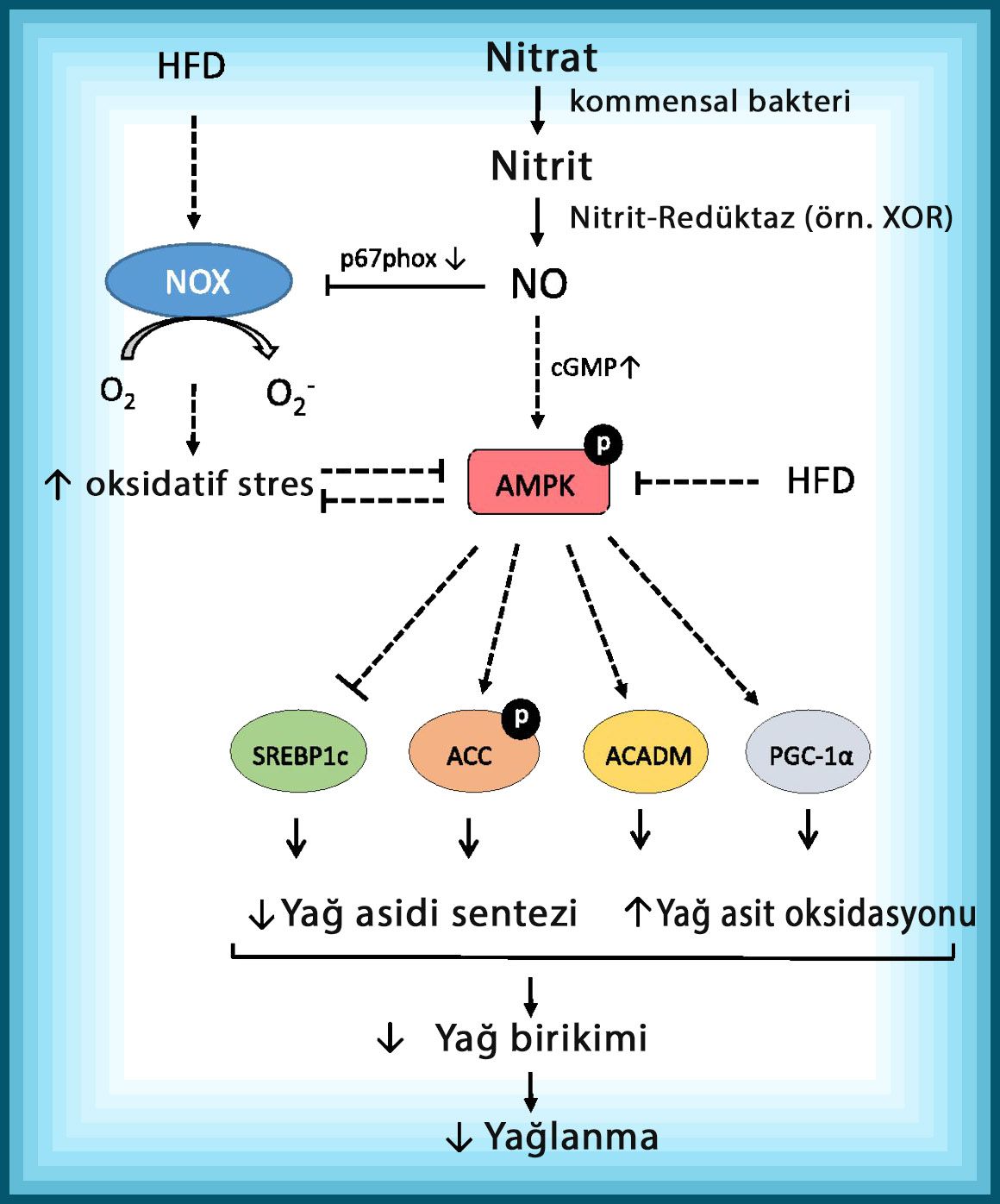
Below, you can see the metabolic process by which inorganic nitrates reduce fat accumulation and fatty changes.
Explanation
The figure is a simplified diagram showing some important metabolic pathways affected by dietary nitrate in alleviating fatty liver. A high-fat diet (high fatty diet, HFD) suppresses AMPK activity in at least two ways. First, excess energy obtained from a high-fat diet will downregulate AMPK through direct mechanisms involving changes in cellular energy status (the AMP / ADP / ATP ratio). A high-energy diet also activates NADPH oxidase (NOX) activity, and the resulting oxidative stress can suppress AMPK activation. Dietary nitrate can prevent this process through the formation of nitrite, nitric oxide (NO) and other bioactive nitrogen oxide species. Biological activation of nitrate depends on bacterial and nitrite reductase activity [for example, xanthine oxidoreductase (XOR)], respectively. NO serves to downregulate NOX activity, at least partly by reducing p67phox expression, and can activate AMPK in a cGMP-dependent manner. Reversal by nitrate of AMPK suppression triggered by a high-energy diet ultimately affects a series of downstream pathways to reduce lipid accumulation and steatosis (namely, by inhibiting SREBP1c, stimulating ACC phosphorylation and restoring ACADM and PGC1a).
Sources
AMP-activated protein kinase activation and NADPH oxidase inhibition by inorganic nitrate and nitrite prevent liver steatosis.
PNAS, 17 December 2018.
Was this article helpful?
Your feedback helps us improve our content.




Reader comments
Share your comment
Your name and comment are published only after administrator approval. Your email address is never shown to visitors.
Be the first to comment.