
What Is a Carcinogen? Known and Potential Cancer-Causing Agents for Humans

In this article
Substances and exposures causing severe genetic damage in cells and triggering mechanisms leading to cancer are called carcinogens . The Turkish equivalent means “cancer-causing.” The Turkish word “karsinojen” is often misspelled “kanserojen.” Its origin is “carcinogenesis,” referring to the process of cancer development.
Many people believe “chemical” carcinogens are the main cause of cancer. However, excluding tobacco and its numerous substances, chemical carcinogens account for a smaller share of cancer causes than commonly thought. The main causes are illustrated below:
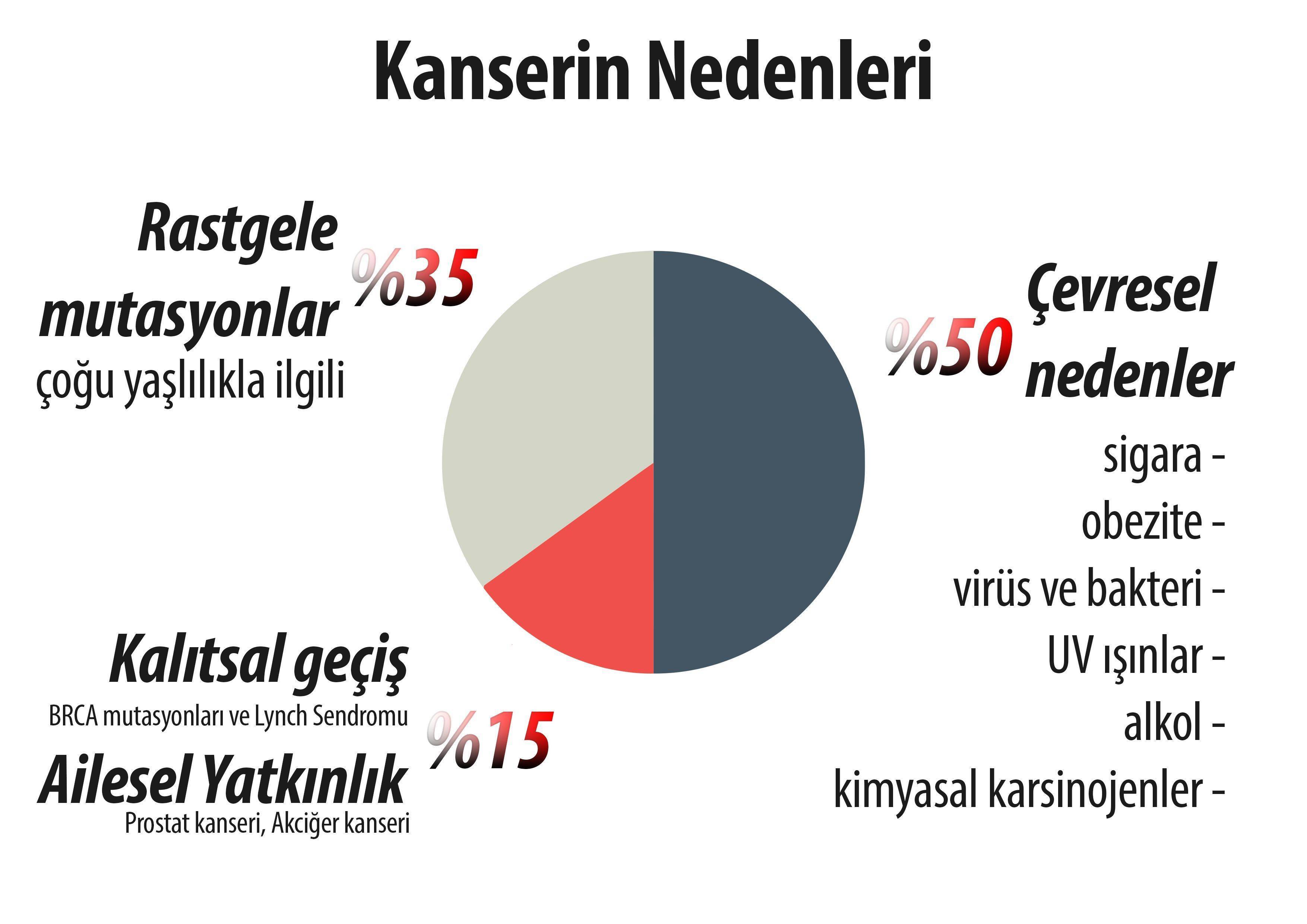
As the pie chart shows, half of cancers arise from environmental carcinogens, and a relatively small proportion of these from “chemical” carcinogens.
Cancer arising from environmental causes also means it is preventable (for example, preventing tobacco exposure can prevent %90 of lung cancers; sun protection can prevent most skin cancers; preventing HPV and hepatitis infections can prevent most cervical and liver cancers before they develop).
What Do Environmental Factors and Environmental Carcinogens Mean in Cancer?
Cancer results from changes in cellular DNA. Some may be inherited from parents; cancers arising for this reason are called hereditary cancers . Other cancers mainly arise from environmental factors. Environmental cancer causes are numerous and varied.
These include:
- Lifestyle factors (poor nutrition, smoking, physically inactive sedentary living)
- Naturally occurring exposures (solar ultraviolet rays, radon gas, infectious agents)
- Workplace chemicals (asbestos, certain pesticides, paints and solvents)
- Air pollution (diesel engine exhaust)
Not everyone exposed to carcinogens develops cancer. Substances called carcinogens also differ in their cancer-causing potential. Some cause cancer only after prolonged, high-level exposure (such as asbestos dust).
Why Does Cancer Not Develop in the Same Way in Everyone Exposed to Carcinogens?
Although smoking’s causation of lung cancer is an established, indisputable fact, why some heavy smokers do not develop it remained a question. Carcinogens damage cellular DNA, and just as our genetics differ, so does our ability to repair damaged DNA. Aziz Sancar and his team’s internationally influential work on carcinogen-related DNA damage mappingalso highlights differences in DNA repair systems. Different repair capacities are important for cancer development. This may explain why some people are more susceptible, and future genetics research may identify people predisposed because of differences in DNA repair systems.
How Is It Determined Whether Something Is Carcinogenic?
Determining whether something causes cancer can be difficult. Testing whether a substance causes cancer in humans is, of course, unethical. Scientists must therefore conduct different kinds of studies.
Laboratory Studies
Cell culture and animal studies are needed to learn whether a substance is carcinogenic. Many artificial or natural chemicals have been tested in laboratory animals. Scientists can also gain insight by analyzing results from previously studied similar chemicals.
Although laboratory studies do not always fully explain whether a substance is carcinogenic, all known human carcinogens have been found to cause cancer in laboratory animals.
Carcinogen tests in laboratory animals use higher doses than human exposures, so their results are often unrealistic. A substance carcinogenic at very high laboratory doses may not have the same effect at low doses. Its effect when inhaled also differs from application to the skin. It is important to emphasize that animal and human physiology differ, producing different responses to the same substance.
For safety reasons, a substance causing cancer in animals at high doses is assumed to cause cancer in humans too. It is not always possible to know at which doses a substance is carcinogenic. The best approach is therefore to reduce exposure through necessary precautions.
Human Studies
Another way to identify carcinogens is to study populations and determine which factors are associated with cancer. These are epidemiological studies. Although informative, they have limitations, chiefly because people do not live in controlled environments. We encounter many substances at any time in daily life and often cannot answer researchers’ questions precisely. Exposure and cancer development also take years, making definite conclusions difficult.
Using all this information, substances are classified by carcinogenicity. With sufficiently strong evidence, a substance is classified as a “carcinogen.” If evidence is disputed, it is called a “probable carcinogen.”
Who Decides Carcinogen Classification?
Many national and international organizations are responsible for identifying substances’ cancer-causing potential. Among these, the International Agency for Research on Cancer is followed worldwide.
International Agency for Research on Cancer = IARC
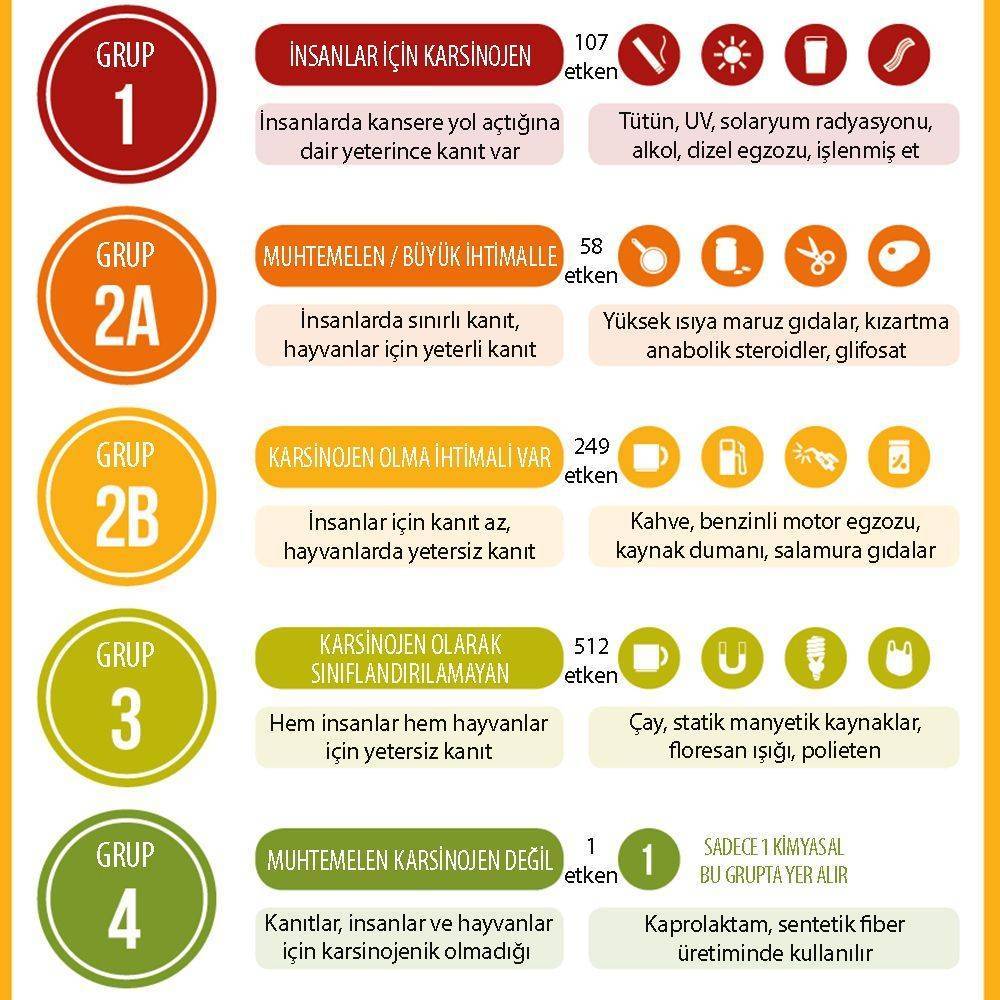
The International Agency for Research on Cancer (IARC) is part of the World Health Organization (WHO). Identifying cancer causes and carcinogens is a principal goal. Its classification system is the most widely used. Over the past 30 years, IARC has evaluated more than 900 potential candidates and placed them in these groups:
- Group 1: Carcinogenic to humans (107 agents) - Carcinogenic to humans
- Group 2A: Probably / very likely carcinogenic to humans (58 agents) - Probably carcinogenic to humans
- Group 2B: Possibly carcinogenic to humans (249 agents) - Possibly carcinogenic to humans
- Group 3: Cannot be classified as carcinogenic to humans; studies need to demonstrate this (512 agents) - Unclassifiable as to carcinogenicity in humans
- Group 4: Probably not carcinogenic to humans (1 agent) - Probably not carcinogenic to humans
Unsurprisingly, remembering how difficult testing these candidate carcinogens can be, most substances fall into Group 2B or Group 3. Substances classified as carcinogenic to humans (Group 1) number only around 100.
- You may be interested in: The Most Common Carcinogens in Foods
The list below shows whether something may increase cancer risk. Work and home life should be arranged to minimize these exposures. However, exposure does not necessarily mean cancer will develop; duration, amount and individual genetic characteristics are also important determinants.
Known Human Carcinogens
International Agency for Research on Cancer - IARC list

Group 1: Carcinogenic to Humans
- Acetaldehyde – acetaldehyde (from alcoholic beverages)
- Acheson process – acheson process (associated with occupational exposure)
- Aflatoxins – aflatoxins
- Alcoholic beverages – alcoholic drinks
- Aluminum production – aluminum production
- 4-Aminobiphenyl – 4-aminobiphenyl
- Areca nut – areca nut
- Aristolochic acid – aristolochic acid (and plants containing it)
- Arsenic and inorganic arsenic compounds – arsenic and inorganic acid compounds
- Asbestos (all forms) and mineral substances (such as talc or vermiculite) that contain asbestos – asbestos (all forms) and asbestos-containing minerals (such as talc = powder or vermiculite)
- Auramine production – auramine production
- Azathioprine – azathioprine
- Benzene – benzene
- Benzidine and dyes metabolized to benzidine – benzidine and dyes metabolized to benzidine
- Benzo[a]pyrene (this substance was detected in electronic cigarettes in studies from 2017)
- Beryllium and beryllium compounds – beryllium and beryllium compounds
- Betel quid, with or without tobacco – betel quid, with or without tobacco
- Bis(chloromethyl)ether and chloromethyl methyl ether (technical-grade) – Bis (chloromethyl) ether and chloromethyl methyl ether
- Busulfan – busulfan
- 1,3-Butadiene – 1,3-Butadiene
- Cadmium and cadmium compounds – Cadmium and cadmium compounds
- Chlorambucil – Chlorambucil
- Chlornaphazine – Chlornaphazine
- Chromium (VI) compounds – Chromium (VI) compounds
- Clonorchis sinensis (infection with), also known as the Chinese liver fluke – clonorchis sinensis (infection with), also known as the Chinese liver fluke
- Coal, indoor emissions from household combustion – coal, indoor emissions from household combustion
- Coal gasification – exposure to coal gas
- Coal-tar – coal tar, coke production
- Cyclophosphamide – cyclophosphamide
- Cyclosporine – cyclosporine
- 1,2-Dichloropropane – 1,2-dichloropropane
- Diethylstilbestrol – diethylstilbestrol
- Engine exhaust, diesel – diesel engine exhaust
- Epstein-Barr virus (infection with) – epstein barr virus EBV (infection with)
- Erionite – erionite
- Ethanol in alcoholic beverages – ethanol in alcoholic beverages
- Ethylene oxide – ethylene oxide
- Etoposide – etoposide
- Fission products, including strontium-90 – Fission products including Strontium-90
- Fluoro-edenite fibrous amphibole – fluoro-edenite fibrous amphibole
- Formaldehyde – formaldehyde
- Haematite mining (underground) – Haematite mining (underground)
- Helicobacter pylori (infection with) – Helicobacter pylori (infection with)
- Hepatitis B virus (chronic infection with) – Hepatitis B virus (chronic infection with)
- Hepatitis C virus (chronic infection with) – Hepatitis C virus (chronic infection with)
- Human immunodeficiency virus type 1 (HIV-1) (infection with) – human immunodeficiency virus type 1 (HIV-1) (infection with)
- Human papilloma virus (HPV) types 16, 18, 31, 33, 35, 39, 45, 51, 52, 56, 58, 59 (infection with) (Note: The HPV types that have been classified as carcinogenic to humans can differ by an order of magnitude in risk for cervical cancer) - human papillomavirus (HPV) types 16, 18, 31, 33, 35, 39, 45, 51, 52, 56, 58, 59 (with infection) (Note: HPV types classified as carcinogenic to humans, Sr cervical cancer risk by order of magnitude)
- Human T-cell lymphotropic virus type I (HTLV-1) (infection with) - human T-cell lymphotropic virus type 1 (HTLV-1) (infection with)
- Ionizing radiation (all types) – ionizing radiation (all types)
- Iron and steel founding (workplace exposure) – iron and steel founding (workplace exposure)
- Isopropyl alcohol manufacture using strong acids - isopropyl alcohol manufactured using strong acids
- Kaposi sarcoma herpesvirus (KSHV), also known as human herpesvirus 8 (HHV-8) (infection with) - human herpesvirus 8 (HHV-8), also known as Kaposi sarcoma herpesvirus (KSHV) (infection with)
- Leather dust - leather dust
- Lindane – lindane
- Magenta production – magenta production
- Melphalan – melphalan
- Methoxsalen (8-methoxypsoralen) plus ultraviolet A radiation, also known as PUVA – methoxsalen (8-methoxypsoralen) plus ultraviolet A radiation, also known as PUVA
- 4,4'-Methylenebis(chloroaniline) (MOCA) – 4,4'-Methylenebis (chloroaniline) (MOCA)
- Mineral oils, untreated or mildly treated – Mineral oils, untreated or mildly treated
- MOPP and other combined chemotherapy including alkylating agents – MOPP and other combined chemotherapy including alkylating agents
- 2-Naphthylamine – 2-Naphthylamine
- Neutron radiation – Neutron radiation
- Nickel compounds – Nickel compounds
- N'-Nitrosonornicotine (NNN) and 4-(N-Nitrosomethylamino)-1-(3-pyridyl)-1-butanone (NNK) – N'-Nitrosonornicotine (NNN) and 4- (N-Nitrosomethylamino) -1- (3-pyridyl) -l-butanone (NNK)
- Opisthorchis viverrini (infection with), also known as the Southeast Asian liver fluke – Opisthorchis viverrini (infection with), also known as the Southeast Asian liver fluke
- Outdoor air pollution (and the particulate matter in it) – Outdoor air pollution (and the particulate matter in it)
- Painter (workplace exposure as a) – painter (workplace exposure as a)
- 3,4,5,3',4'-Pentachlorobiphenyl (PCB-126)
- 2,3,4,7,8-Pentachlorodibenzofuran
- Phenacetin (and mixtures containing it) – phenacetin (and mixtures containing mixtures)
- Phosphorus-32, as phosphate – phosphorus-32, as phosphate
- Plutonium – plutonium
- Polychlorinated biphenyls (PCBs), dioxin-like – dioxin-like polychlorinated biphenyls
- Processed meat (consumption of) – processed meat (consumption)
- Radioiodines, including iodine-131 – radioiodines, including iodine-131
- Radionuclides, alpha-particle-emitting – radionuclides, alpha-particle-emitting
- Radionuclides, beta-particle-emitting – radionuclides, beta-particle-emitting
- Radium-224 and its decay products – Radium-224 and its decay products
- Radium-226 and its decay products – Radium-226 and its decay products
- Radium-228 and its decay products – Radium-228 and its decay products
- Radon-222 and its decay products – Radium-222 and its decay products
- Rubber manufacturing industry – rubber manufacturing industry
- Salted fish (Chinese-style) – salted fish (Chinese-style)
- Schistosoma haematobium (infection with) – schistosoma haematobium (infection with)
- Semustine (methyl-CCNU) – semustine (methyl-CCNU)
- Shale oils – shale oils
- Silica dust, crystalline, in the form of quartz or cristobalite – silica dust, crystalline, in the form of quartz or cristobalite
- Solar radiation - solar radiation
- Soot (as found in workplace exposure of chimney sweeps) - Soot (such as chimney residues found at work)
- Sulfur mustard – sulfur mustard
- 2,3,7,8-Tetrachlorodibenzo-para-dioxin
- Thiotepa
- Thorium-232 and its decay products - Thorium-232 and its decay/disintegration products
- Tobacco, smokeless – tobacco, smokeless
- Tobacco smoke, secondhand – passive cigarette smoking
- Tobacco smoking – smoking (all tobacco and tobacco products)
- ortho-Toluidine – ortho-Toluidine
- Treosulfan – treosulfan
- Trichloroethylene – trichloroethylene
- Ultraviolet (UV) radiation, including UVA, UVB, and UVC rays - ultraviolet (UV) radiation including UVA, UVB and UVC rays
- Vinyl chloride – vinyl chloride
- Wood dust – wood dust
- X- and Gamma-radiation – X and Gamma radiation
Group 2A: Probably / Very Likely Carcinogenic to Humans
- Acrylamide
- Adriamycin (doxorubicin)
- Androgenic (anabolic) steroids
- Art glass, glass containers, and press ware (manufacture of)
- Azacitidine
- Biomass fuel (primarily wood), emissions from household combustion
- Bischloroethyl nitrosourea (BCNU), also known as carmustine
- Captafol
- Carbon electrode manufacture
- Chloral
- Chloral hydrate
- Chloramphenicol
- alpha-Chlorinated toluenes (benzal chloride, benzotrichloride, benzyl chloride) and benzoyl chloride (combined exposures)
- 1-(2-Chloroethyl)-3-cyclohexyl-1-nitrosourea (CCNU)
- 4-Chloro-ortho-toluidine
- Chlorozotocin
- Cisplatin
- Cobalt metal with tungsten carbide
- Creosotes
- Cyclopenta[cd]pyrene
- DDT (4,4'-Dichlorodiphenyltrichloroethane)
- Diazinon
- Dibenz[a,j]acridine
- Dibenz[a,h]anthracene
- Dibenzo[a,l]pyrene
- Dichloromethane (methylene chloride)
- Diethyl sulfate
- Dimethylcarbamoyl chloride
- 1,2-Dimethylhydrazine
- Dimethyl sulfate
- Epichlorohydrin
- Ethyl carbamate (urethane)
- Ethylene dibromide
- N-Ethyl-N-nitrosourea
- Frying, emissions from high-temperature
- Glycidol
- Glyphosate
- Hairdresser or barber (workplace exposure as) – hairdressing or barbering (as a profession)
- Human papillomavirus (HPV) type 68 (infection with)
- Indium phosphide
- IQ (2-Amino-3-methylimidazo[4,5-f]quinoline)
- Lead compounds, inorganic – lead compounds, inorganic
- Malaria (caused by infection with Plasmodium falciparum) – malaria
- Malathion
- Merkel cell polyomavirus (MCV)
- 5-Methoxypsoralen
- Methyl methanesulfonate
- N-Methyl-N´-nitro-N-nitrosoguanidine (MNNG)
- N-Methyl-N-nitrosourea
- Nitrate or nitrite (ingested) under conditions that result in endogenous nitrosation
- 6-Nitrochrysene
- Nitrogen mustard
- 1-Nitropyrene
- N-Nitrosodiethylamine
- N-Nitrosodimethylamine
- 2-Nitrotoluene
- Non-arsenical insecticides (workplace exposures in spraying and application of)
- Petroleum refining (workplace exposures in)
- Pioglitazone
- Polybrominated biphenyls (PBBs)
- Procarbazine hydrochloride
- 1,3-Propane sultone
- Red meat (consumption of) – high red meat consumption
- Silicon carbide whiskers
- Styrene-7,8-oxide
- Teniposide
- Tetrachloroethylene (perchloroethylene)
- Tetrafluoroethylene
- Trichloroethylene
- 1,2,3-Trichloropropane
- Tris(2,3-dibromopropyl) phosphate
- Very hot beverages (above 65 degrees Celsius) – very hot beverages (above 65 degrees)
- Vinyl bromide
Was this article helpful?
Your feedback helps us improve our content.



Reader comments
Share your comment
Your name and comment are published only after administrator approval. Your email address is never shown to visitors.
Be the first to comment.