
Is Continuous or Intermittent Chemotherapy More Beneficial in Stage 4 Breast Cancer?

At the European Society for Medical Oncology (ESMO) 2019 Breast Cancer Congress, analyses of the Stop & Go study showed that continuous chemotherapy provided greater benefit than intermittent treatment in advanced breast cancer, both increasing survival and preserving quality of life.
A phase-III clinical trial , Stop & Go assigned patients with HER2 -negative breast cancer, totaling 420 patients, to an intermittent chemotherapy schedule (4 cycles, then a “treatment holiday,” then another 4 cycles) or a continuous schedule with the same 8 cycles given consecutively. Both arms received first-line “paclitaxel plus bevacizumab” and second-line “capecitabine or liposomal doxorubicin.”
Survival results
Frans Erdkamp of Zuyderland Medical Center in the Netherlands presented findings on the survival benefits of continuous chemotherapy compared with intermittent treatment in both first- and second-line chemotherapy. “Although our main focus in this analysis was on second-line treatment effectiveness, interestingly, updated overall survival results showed better survival with continuous treatment for all patients, including first-line treatment,” he said.
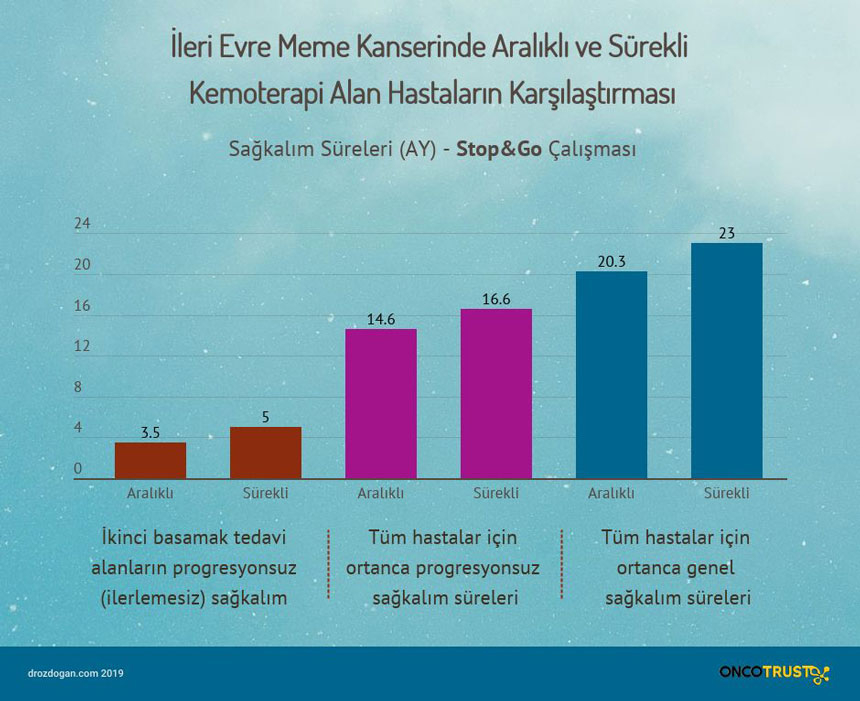
- The 270 patients receiving second-line treatment were divided into two arms: 131 received intermittent and 139 continuous chemotherapy. Progression-free survival was 3.5 months with intermittent treatment and 5 months with continuous treatment (HR 1.04, CI= 0.69–1.57).
- Median progression-free survival across both first and second lines was 14.6 months for intermittent treatment and 16.6 months for continuous treatment.
- Median overall survival for the entire patient group was 20.3 months with intermittent treatment and 23 months with continuous treatment (HR: 1.93, CI= 1.26–2.95).
Quality-of-life results
The study’s quality of life results were presented by Anouk Claessens. “In clinical practice, we see important differences in treatment strategies, so we thought a trial investigating the effect of scheduling with modern agents on quality of life would be useful,” she said. Dr. Claessens noted that, at the start of the study, they had thought treatment holidays would benefit quality of life.
Quality of life was measured every 12 weeks during treatment and follow-up. The trajectories of both physical and mental quality-of-life scores were tracked for each scheduling arm, and differences in trajectories between arms were estimated. Median follow-up was 11.3 months.
“We saw a linear decline in physical quality-of-life scores in the intermittent treatment arm,” said Dr. Claessens, adding: “Comparing the quality-of-life trajectories between treatment arms showed that the maximum differences were not statistically significant, but there was a trend toward more favorable scores in the continuous treatment arm.”
Researcher Monique Bos of Erasmus University Medical Center in the Netherlands said: “We were somewhat surprised by these quality-of-life results, which contradicted our hypothesis. When explaining treatment schedules to patients, we tend to suggest that a ‘holiday,’ by the nature of the word, might be beneficial, but that was not the case.” she said.
Comment
This study provides meaningful answers to a question encountered very often in clinical practice: our patients with advanced breast cancer ask why uninterrupted treatment is recommended. Until now, based on evidence from chemotherapy regimens no longer in use, we knew that in metastatic (advanced) breast cancer, continuous chemotherapy was better. Both the survival and quality-of-life data from this new Stop & Go study, consistent with previous international treatment guideline recommendations, support giving preferably single-agent chemotherapy (at least after first-line treatment) continuously for as long as the patient tolerates it and it remains effective. The finding that continuous chemotherapy was in no way associated with worse quality of life is also highly meaningful and emphasizes the importance of our advanced breast cancer patients choosing continuous chemotherapy.
Sources
Was this article helpful?
Your feedback helps us improve our content.




Reader comments
Share your comment
Your name and comment are published only after administrator approval. Your email address is never shown to visitors.
Be the first to comment.