
LASER System Developed to Find and Destroy Cancer Cells in the Blood

Cancer cells can migrate to different tissues and organs. Destroying them before they metastasize is thought to be a potentially effective cancer treatment strategy. In this context, a study published in June 2019 in Science Translational Medicine announced that a laser system had been developed to detect and destroy cancer cells in the bloodstream. The system can detect cancer cells with 1000 times greater sensitivity than current methods.
The laser system was developed at the University of Arkansas in the United States. Its operating principle is based on detecting sound waves . When the laser is applied to a blood vessel, it sends energy into the bloodstream. Circulating melanoma (skin cancer) cellsabsorb more energy than healthy cells. This causes cancer cells to heat up and expand rapidly. The resulting temperature increase creates a photoacoustic (sound wave) effect. Sound waves are recorded by a small ultrasound transducer placed on the skin, and tumor cells passing through the blood are identified in the recordings. The same laser system can also destroy circulating tumor cells. Heat generated by the laser causes vapor droplets to form inside tumor cells. These droplets expand and mechanically rupture the cell.
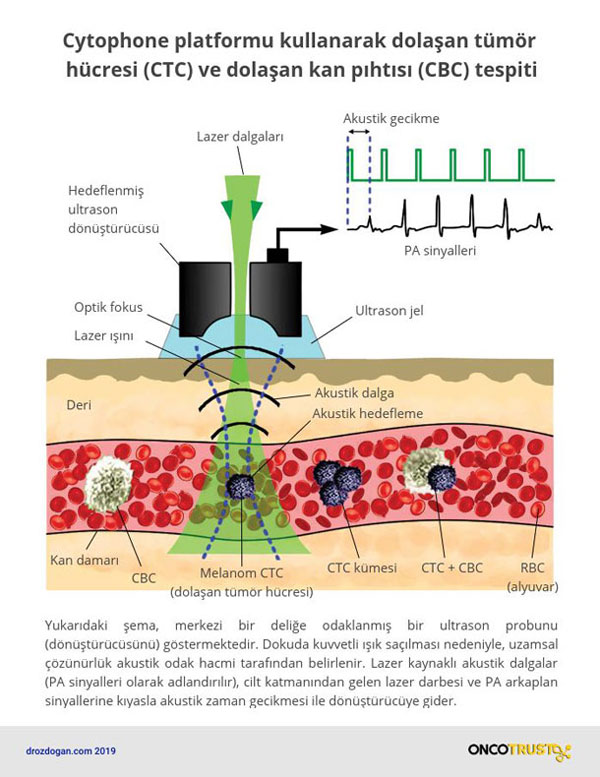
Cytophone is the name of this system, which is initially planned for use in melanoma treatment. Melanoma cells contain the light-absorbing pigment melanin. After the laser is applied, analysis is based on waves generated by melanin pigment in normal or cancerous skin cells.
The Device Was Tested in 28 Melanoma Patients and 19 Healthy Volunteers
- You may also be interested in: Mehmet Toner: A Turkish Scientist Pioneering Cancer Liquid Biopsy Worldwide With a Smart Microchip
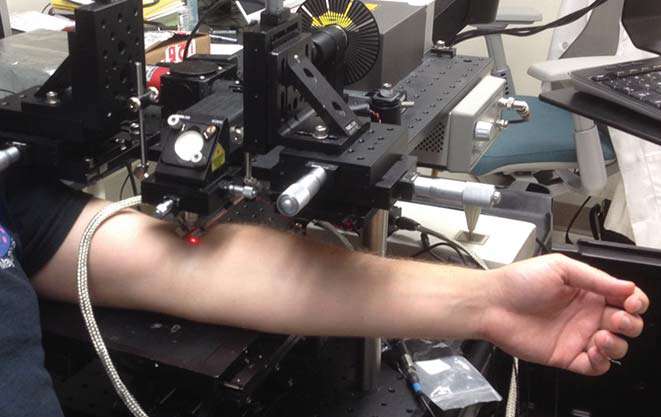
The laser system was applied to patients' antecubital areas (the inner elbow). It successfully identified circulating tumor cells in 27 patients within 10 seconds to 60 minutes. The laser produced no false-positive results in healthy volunteers and caused no side effects. After treatment, the cancer patients had fewer circulating tumor cells. Although the device used a low-energy laser, cancer cells were successfully destroyed.
What Does This Study Mean for Us?
- A nonsurgical laser system has been developed to recognize and destroy circulating tumor cells.
- The laser system can scan 1 liter of blood inside blood vessels in 1 hour. It is also the first device tested in humans that targets circulating tumor cells.
- Destroying circulating tumor cells may prevent metastases. However, further research and clinical studies are needed before the device can be used in clinical practice.
- Destroying circulating tumor cells before they form new tumors in other tissues and organs could offer an effective treatment option.
- The laser system's most important feature is that it detects and destroys cancer cells from outside the skin .
- This system is completely noninvasive, meaning it involves no surgical intervention.
- The system is also planned for use in treating other cancer types. However, other cancer cells do not carry the melanin antigen. Therefore, researchers plan to inject certain biomarkers and molecules to target cancer cells effectively.
Sources
In vivo liquid biopsy using Cytophone platform for photoacoustic detection of circulating tumor cells in patients with melanoma.
Sci Transl Med. 12 June 2019.
Was this article helpful?
Your feedback helps us improve our content.




Reader comments
Share your comment
Your name and comment are published only after administrator approval. Your email address is never shown to visitors.
Be the first to comment.